Craft Fair Insurance: What Vendors Need and How to Compare
Craft fair insurance usually becomes a question the day an acceptance email says "please send your certificate of insurance before the event." Suddenly there are words like "per occurrence," "aggregate" and "additional insured," and a deadline. This guide explains what those words mean, what organizers commonly ask for, how to compare an annual policy with per-event coverage using simple math, and how to count insurance in each market's costs so it doesn't quietly lower your profit.
One important note: this is a plain-language overview, not insurance or legal advice. Policies differ a lot. Before you buy, read the event's exact requirements and talk to a licensed insurance agent about your products.
Why markets ask for insurance
Craft fairs and farmers markets put a lot of tents, tables and people in a small space. If a shopper trips over a table leg, a tent blows into a neighbor's booth, or a product causes a reaction or an injury, someone may file a claim. Organizers ask vendors to carry their own liability coverage so those claims don't land only on the event, the venue or the city.
Requirements vary by event. Some small markets don't ask for insurance at all. Others ask for specific limits and wording, and won't let you set up without proof.
The words you'll see on an application
General liability
Covers claims that your business caused injury to someone else or damage to their property. The classic examples at a market are trips and falls in your booth and wind damage from your tent.
Product liability
Covers claims that a product you sold caused harm: a skin reaction to a soap, a candle that caused a fire, a toy part that broke. On many policies it's included with general liability (sometimes called "products-completed operations"). If you sell anything people eat, put on their skin, burn or give to children, ask specifically how products are covered.
Per occurrence and aggregate
The per occurrence limit is the most the policy pays for one incident. The aggregate limit is the most it pays for all claims during the policy period. One specialty insurer's guide for art and craft shows says event minimums are often $1 million per occurrence and $2 million aggregate. Treat that as a common pattern, not a rule: your event's paperwork has the real numbers.
Additional insured
Many events ask to be named as an additional insured on your policy, so the coverage also protects them for claims connected to your booth. The same guide says most fairs and shows require you to list the event this way. You'll need the organizer's exact legal name and address, and sometimes the venue's or the city's too.
Certificate of insurance (COI)
The certificate is a one-page summary of your policy, issued by your insurer, that shows your limits, the policy dates and any additional insured. It's the proof the organizer asks for. Insurers who sell to vendors often let you download certificates for each event from your account.
What craft fair insurance often doesn't cover
Liability insurance is about claims from other people. It often does not cover your own things. Questions to ask about:
- Your inventory and equipment: damage to your tent, tables and stock, for example in a storm.
- Theft of stock or cash from your booth.
- Your stock in transit, in the car on the way to the market.
- Injuries to you or your helpers.
Some vendor policies offer add-ons for equipment and inventory. Whether they're worth it depends on what your booth and stock are worth.
Annual policy or per-event coverage?
If you only need coverage for one event, our guide to event vendor insurance explains how single-event policies work.
Most vendors choose between two options:
- An annual policy that covers every market in the policy year.
- Per-event coverage bought for each market's dates.
The right choice depends mostly on how many markets you do. Here's the math with made-up prices, just to show how to compare quotes. Say you're quoted $300 a year for an annual policy, or $45 per event.
| Markets per year | Annual policy, cost per market | Per-event cost per market |
|---|---|---|
| 3 | $100.00 | $45.00 |
| 6 | $50.00 | $45.00 |
| 7 | $42.86 | $45.00 |
| 12 | $25.00 | $45.00 |
| 20 | $15.00 | $45.00 |
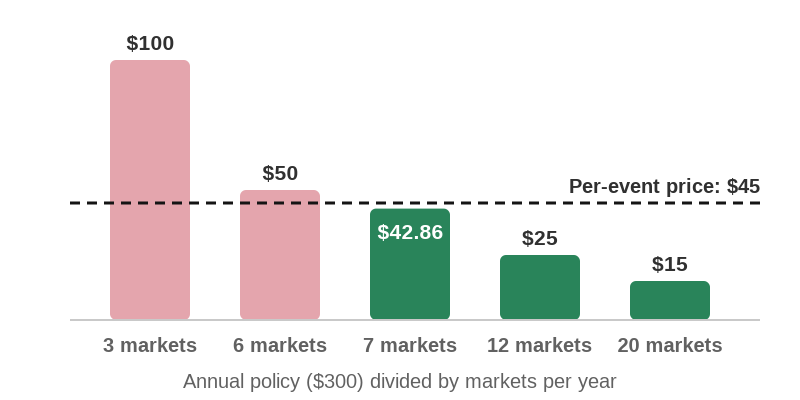
The break-even is simply the annual price divided by the per-event price: $300 ÷ $45 is about 6.7, so from 7 markets a year the annual policy is cheaper. Plug in your real quotes and do the same division. Also check whether the annual policy includes certificates and additional insureds for every event, or charges for each one.
Count insurance in each market's costs
Insurance is easy to forget when you work out whether a market was worth it, because you paid for it months ago. Spread an annual premium over the markets you expect to do, and add that share to each market's costs.
With the $300 annual policy and 12 markets, that's $25 per market. Here's what it does to a one-day market:
| Without insurance | With insurance | |
|---|---|---|
| Sales | $900 | $900 |
| Booth fee | $90 | $90 |
| Gas and food | $45 | $45 |
| Insurance share | $25 | |
| Event expenses | $135 | $160 |
| Event expenses as % of sales | 15.0% | 17.8% |
If you use the common target of keeping event expenses under 15% of sales, this market moves from "right on the line" to "over it" once insurance is counted. That's not a reason to drop insurance; it's a reason to count it, so your numbers tell the truth. Insurance is one of the lines in our craft fair expenses checklist, and the free craft fair profit calculator shows the expense percentage for any market. If you're deciding whether a market is worth rebooking, our guide is a craft fair worth it puts the expense rule next to the others.
Farmers market vendor insurance
The same basics apply at farmers markets. Many markets ask for liability coverage and a certificate naming the market as additional insured, sometimes for the whole season rather than one date. If you sell food, product liability matters even more, and the market may also ask for health department or cottage food paperwork. Our guide on how to become a vendor at a farmers market covers the other steps.
Questions to ask before you buy
Take this list to an agent or use it to compare vendor policies online:
- Does the policy meet the per occurrence and aggregate limits in my events' requirements?
- Are products I sell covered, including anything people eat, wear, burn or put on their skin?
- Can I name events as additional insured, and is there a fee for each one?
- How fast can I get a certificate for a new event?
- Does it cover markets in every state where I sell?
- Are my tent, tables and inventory covered, or is that an add-on?
- Does it cover helpers or family who work the booth?
- What's the deductible, and what's excluded?
And three habits that save last-minute stress: ask each organizer for their exact insurance wording as soon as you're accepted, send the certificate early, and keep a copy on your phone at the market.
FAQ
Do I need insurance to sell at a craft fair?
Only if the event requires it or you want the protection. Many larger fairs, venues and farmers markets require vendor liability insurance and a certificate before you set up. Smaller markets may not. Read the vendor application and ask the organizer.
How much liability insurance do craft fair vendors need?
Use the limits in each event's requirements. One specialty insurer's guide says shows often ask for $1 million per occurrence and $2 million aggregate, but some events ask for different limits or extra coverage.
What does "additional insured" mean for a craft fair?
It means the event (and sometimes the venue or city) is added to your liability policy for claims connected to your booth. You'll need the organizer's exact name and address, and your insurer will show it on the certificate.
Is per-event insurance cheaper than an annual policy?
For a few markets a year, often yes. Divide the annual price by the per-event price to find how many markets it takes for the annual policy to become cheaper, then compare with how many markets you plan to do.