Craft Fair Expenses Checklist: Every Cost to Count
Most vendors know their booth fee by heart. Far fewer know their total craft fair expenses, because the rest of the costs are spread across months: the application fee paid in spring, the gas on the day, the coffee, the bags, the raffle donation, the new canopy weights. This checklist puts every cost in one place, grouped by when you pay it, and ends with the other half of the picture vendors often miss: the sales that never touch the card reader, like cash, Venmo, Zelle and PayPal.
Why a checklist?
Because the costs you forget are the ones that make a market look better than it was. Leave out $60 of small costs at a market you think made $300, and a fifth of that profit was never there. A checklist also makes markets comparable: when every market is counted the same way, the numbers mean the same thing.
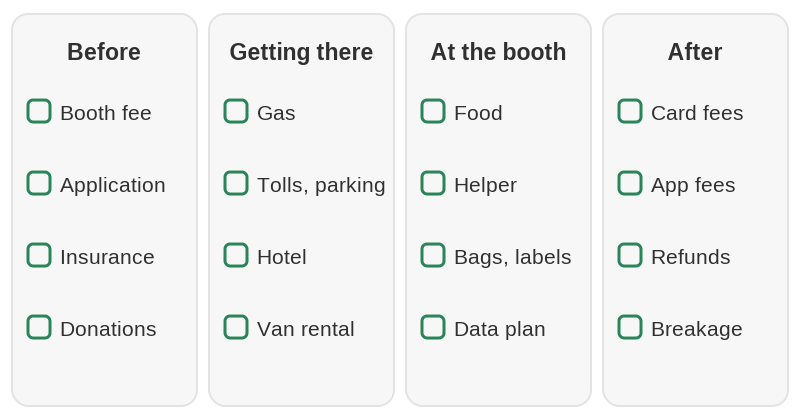
Before the market
These are usually paid weeks or months ahead, which is exactly why they get forgotten:
- Booth fee. The big one. Include any deposit.
- Application or jury fee. Often non-refundable, even if you're not accepted.
- Electricity or corner fees. Some organizers charge extra for power or a corner spot.
- Table, chair or tent rental from the organizer.
- Event insurance. Some shows require proof of liability insurance. Count the policy for that event, or a share of an annual policy. Our craft fair insurance guide explains what's usually asked.
- Permits. Some states or cities require a temporary sales permit for events. Check with the state or city, and with an accountant if you're unsure. Our craft fair sales tax guide shows how a few states handle events.
- Promotion for the event. Printed signs, a boosted post or flyers made for this market.
- Donations. Raffle items or gift baskets the organizer asks for. Count what they cost you to make, not their price.
Getting there
- Gas. Miles driven ÷ your car's miles per gallon × the price per gallon. For your tax return, the IRS publishes a standard mileage rate you may be able to use instead; ask your accountant which method fits you.
- Tolls and parking. Easy to forget, especially at city markets with paid parking.
- Hotel. Every night you stay because of the show.
- Van or trailer rental, if you need extra space for a big show.
At the booth
- Food and drinks. Coffee, lunch and snacks for you and anyone helping.
- Helper pay. If someone works the booth with you, their pay is a cost of the market.
- Bags, tissue, boxes and labels used at this market.
- Receipt paper and small supplies.
- Phone data or a hotspot, if the venue has no Wi-Fi and you rely on it for card payments.
- Samples and giveaways.
After the market
- Card fees. Your processor keeps a percentage of each card sale, often plus a fixed amount per transaction. Use the actual fees on your payout report.
- Payment app fees. If you accepted payment apps for goods, check whether the app charges a fee for business payments.
- Refunds and returns from that market.
- Breakage and damaged stock. Things that broke in transport or on the table.
- Cleanup or storage, if you pay for either because of the market.
Equipment: spread it across markets
A canopy, weights, tables, display shelves, lights and a card reader last for many markets. Charging all of it to the first fair makes that fair look terrible and the rest look too good. Instead, divide each item's price by the number of markets you expect to use it for.
| Equipment | Price | Markets it should last | Cost per market |
|---|---|---|---|
| Canopy | $240 | 24 | $10.00 |
| Canopy weights | $80 | 40 | $2.00 |
| Folding tables (two) | $120 | 40 | $3.00 |
| Display shelves | $300 | 20 | $15.00 |
| Total | $30.00 |
Add the per-market amount as one line on your list. Some vendors leave equipment out of the per-market math and track it once a year instead. Either is fine; just do it the same way every time.
Example: a one-day market, every cost counted
| Cost | Amount |
|---|---|
| Booth fee | $85.00 |
| Application fee | $15.00 |
| Gas | $18.00 |
| Parking | $8.00 |
| Lunch and coffee | $16.00 |
| Bags and receipt paper | $6.00 |
| Raffle donation, at cost | $9.00 |
| Share of annual insurance | $12.00 |
| Event expenses | $169.00 |
| Equipment share | $30.00 |
| With equipment | $199.00 |
With $1,150 in sales, event expenses are 14.7% of sales, just under the 15% line many vendors use. With the equipment share, it's 17.3%. Product costs and card fees come on top of this. Our guide on how to calculate craft fair profit puts all of it together, and the free craft fair profit calculator does the math for you.
Sales outside the card reader: cash, Venmo, Zelle, PayPal
Expenses are only half of the profit math. The other half is sales, and the ones that go missing are the ones outside your card reader.
Record them in your POS when you can
If you sell with Shopify POS, you can add a custom payment type for each method you accept, such as "Venmo" or "Zelle." Ring up the sale as usual and choose that payment type. The sale lands in the same reports as your card sales, with the method on the order. Our guide on tracking craft fair sales in Shopify POS shows where those reports are.
If you can't, keep a simple log
A note on your phone works. For each payment outside the POS, write:
| Time | Amount | Method | What sold |
|---|---|---|---|
| 10:42 | $28.00 | Venmo | Small mug |
| 11:15 | $56.00 | Zelle | Two candles |
| 1:30 | $35.00 | PayPal |
After the market, check the log against each app's history. It takes five minutes and catches the payment you forgot to write down.
Count cash with a float
Count your starting cash (the float) before you open. At the end of the day:
Cash sales = cash at the end − starting float − any cash you added + any cash you took out
Example: you start with $150, add nothing, take nothing out and end with $618. Your cash sales were $468.
Sales tax doesn't depend on how they paid
Sales paid in cash or through an app are still sales. If your state requires you to collect sales tax at events, it usually applies to those sales too. Rules vary by state, so confirm with your state's department of revenue or an accountant.
Keep the receipts
Many of these costs may be deductible business expenses, but this checklist isn't tax advice. Keep receipts for every item (a photo is fine) and ask an accountant what applies to you. If you keep everything in one spreadsheet, our free craft fair profit spreadsheet template has a column for each cost on this list. And when you're deciding whether a market earned its place on next year's calendar, the rules vendors use to judge a craft fair start from these numbers.
FAQ
What expenses should I count for a craft fair?
Everything you spent because of that market: booth and application fees, travel, parking, hotel, food, helper pay, packaging, donations at cost, insurance, card fees and a share of your equipment.
How do I track cash sales at a craft fair?
Count your float before you open and your cash at the end. Cash sales are the ending cash minus the float, adjusted for any cash you added or took out during the day.
How do I record Venmo or Zelle sales at a craft fair?
Ring them up in your POS with a custom payment type for each app, or keep a log with the time, amount, method and item. Check the log against each app's history after the market.
What percentage of sales should craft fair expenses be?
Many vendors aim to keep event expenses under 15% of sales. Product costs and card fees are counted separately because they grow with your sales.