Event Vendor Insurance: How One-Day Coverage Works
Event vendor insurance is often the last box to tick before a one-off market: a festival you applied to on a whim, a holiday pop-up in a brewery, a convention two states away. The organizer wants a certificate by Friday, and you don't want to buy a full year of coverage for one Saturday. This guide is about that situation: how single-event and one-day policies work, what to check before you buy one, how to time it so the certificate arrives before the deadline, and how much the policy really weighs on a small event's numbers.
If you sell at many markets a year, an annual policy is usually the better comparison. Our craft fair insurance guide explains the terms (per occurrence, aggregate, additional insured) and does the annual-versus-per-event math. This one stays with the single event.
This is a plain-language overview, not insurance or legal advice. Policies differ. Read the event's exact requirements and the policy wording, and ask a licensed agent if anything is unclear.
When single-event coverage makes sense
One-day or short-term policies fit a few common cases:
- You only do a handful of events a year, or you're trying your first one.
- One event requires insurance and the rest of your markets don't.
- You're testing a new kind of event, such as a convention or a festival, before committing to a season.
- Your annual policy lapsed or doesn't cover a particular event (another state, a different activity).
If you expect to do more than a few insured events this year, price an annual policy too before you buy three one-day policies in a row.
What organizers usually ask for
Requirements come from the event, the venue and sometimes the city. They're usually in the vendor packet or the acceptance email. One specialty insurer's guide for art and craft shows lists what organizers typically look for: general liability at a minimum, often $1 million per occurrence and $2 million aggregate, the event listed as an additional insured, and a copy of your certificate of insurance. The same guide warns that a vendor who doesn't supply a certificate can be refused or lose the vendor deposit.
Treat those numbers as a common pattern, not a rule. Copy the exact wording from your event's paperwork: the limits, who must be named as additional insured (organizer, venue, city), and the deadline.
How one-day and single-event policies work
Several insurers sell vendor coverage by the event. Here's how three of them describe their own products on their websites (checked in November 2026; terms and prices change, so confirm before you buy):
| Insurer (own page) | How short-term coverage is sold |
|---|---|
| ACT Insurance | One-event policy advertised from $49, with three days of coverage meant to include setup, the event and teardown |
| Insurance Canopy | Festival vendor coverage advertised from $49 per event, covering 1 to 3 days, with a downloadable certificate |
| Thimble | General liability bought by the hour, day, week or month |
A few things these pages make clear, and that are worth checking on any policy:
The coverage window has to include setup and teardown
Accidents happen while you're carrying tables and staking a tent, not just while you're selling. If the event is Saturday but load-in is Friday evening, a policy that starts Saturday morning doesn't cover Friday. Match the policy dates to the load-in and load-out times in the vendor packet.
Product liability may not be included
General liability covers claims that you caused injury or property damage at the event, like a customer tripping over your table leg. Claims about the products you sold are a separate question. ACT Insurance, which sells both one-day and annual policies, says on its comparison page that most one-day or short-term vendor plans don't include product liability, while its annual policy does. If you sell food, skincare, candles or children's items, ask about product coverage specifically.
Your own things usually aren't covered
Liability coverage pays for harm to other people. Damage to your own tent, stock or card reader is usually a separate add-on. Thimble, for example, notes that general liability doesn't cover your own equipment and offers equipment protection as an add-on, and Insurance Canopy lists theft and damage coverage as an optional extra on its festival vendor page.
Additional insureds may be free, or not
Most events want to be named on your policy. Insurance Canopy says adding additional insureds is free on many of its policies, but some coverages charge a fee. If an event asks you to name the organizer, the venue and the city, check how each one is added and what it costs before you check out.
A timeline that beats the certificate deadline
Most last-minute stress comes from finding out what the event needs a few days before it starts. A simple timeline for one event:
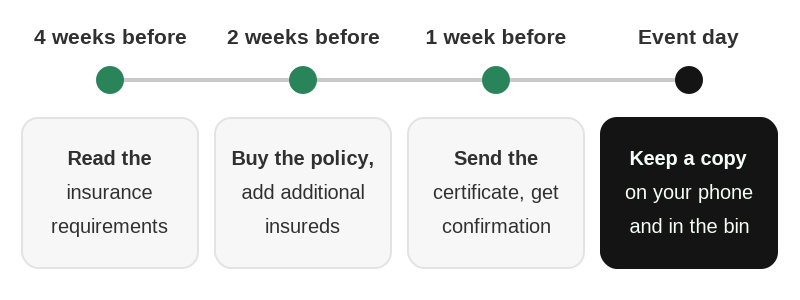
- When you're accepted (about four weeks out): find the insurance section of the vendor packet. Write down the limits, the additional insured names and addresses exactly as written, and the certificate deadline.
- About two weeks out: buy the policy, with dates that cover load-in through load-out, and add the additional insureds. Download the certificate and check every name and date on it.
- About a week out: send the certificate the way the organizer asked (upload, email, vendor portal). Ask for confirmation that it was accepted.
- On the day: keep the certificate on your phone and a printed copy in your market bin. Our printable craft fair checklist has a line for it.
Count the policy in the event's costs
For a single event, the policy isn't spread across a season. It belongs entirely to that one day, and at small events it can change the picture. Two examples with made-up numbers and a $49 policy:
| Weekend festival | Brewery pop-up | |
|---|---|---|
| Sales | $1,400 | $420 |
| Booth fee | $175 | $40 |
| Gas, parking, food | $60 | $18 |
| One-day insurance | $49 | $49 |
| Event expenses | $284 | $107 |
| Expenses as % of sales | 20.3% | 25.5% |
| Without the insurance | 16.8% | 13.8% |
At the festival, the policy adds about 3.5 points to the expense share. At the small pop-up it nearly doubles it: the $49 policy costs more than the booth. That doesn't make the pop-up a bad idea, but it's worth knowing before you say yes, and it's a good question for the organizer ("Is insurance required, and can vendors use a policy they already have?").
The free craft fair profit calculator shows expenses as a share of sales for any event; put the policy in "other costs". Our craft fair expenses checklist lists insurance as its own line so it doesn't get forgotten.
Questions to ask before you buy a one-day policy
- Do the policy dates and hours cover load-in, the event and load-out?
- Do the limits match the event's requirements (per occurrence and aggregate)?
- Is product liability included, and does it cover what I sell?
- Can I name everyone the event asks for as additional insured, and is there a fee?
- How fast can I download the certificate, and can I fix a name on it?
- Does it cover the state where the event is?
- Are helpers working the booth covered?
- Is my own equipment or stock covered, or is that an add-on?
If you're doing your first events, our guide on how to sell at craft fairs puts insurance in context with the rest of the preparation, and our list of questions to ask before booking a craft fair helps you find out what an event requires before you pay for the booth.
FAQ
Can I get vendor insurance for just one day?
Yes. Several insurers sell single-event or short-term vendor policies, some by the day and some covering a few days so setup and teardown are included. Check that the dates cover load-in and load-out, not just the hours the event is open.
How much does one-day event vendor insurance cost?
Prices vary by insurer, coverage and event. Some insurers advertise single-event vendor policies starting around $49, but your quote depends on what you sell, the limits and any add-ons. Compare quotes and the policy wording, not just the price.
Does single-event insurance include product liability?
Not always. One insurer that sells both kinds says most one-day or short-term vendor plans don't include product liability, while annual policies often do. If you sell food, skincare, candles or children's items, ask specifically.
How do I add the event as an additional insured?
You give the insurer the organizer's exact legal name and address (and the venue's or city's if they ask), usually while buying the policy or afterward in your online account. The names then appear on your certificate of insurance, which you send to the organizer.