Is a Craft Fair Worth It? 5 Rules Vendors Use to Decide
Is a craft fair worth it? After a long weekend at the booth, most vendors answer with a feeling: "it was slow" or "people loved the new mugs." Feelings are useful, but they're not enough to decide whether to pay the booth fee again next year. This guide gives you five simple rules that vendors we talked to in craft fair groups often use, and runs three real-looking markets through them so you can see how the rules work together.
Before using the rules you need the market's real profit, not just its sales. If you haven't worked that out yet, start with how to calculate craft fair profit, or put your numbers in the free craft fair profit calculator.
Rule 1: The booth fee should be 10% of sales or less
This is the rule you'll hear most. Divide your sales by the booth fee to get the booth fee multiple. If you sold $1,800 at a $250 booth, your multiple is 7.2x, which means the booth fee took about 14% of your sales.
Many vendors want at least 10x, so the booth is no more than 10% of sales. Some are stricter and want 15x. Others accept 8x for big shows that bring new customers. Pick a line that fits your products and stick to it, so markets are judged the same way.
You can also use the rule before you book. Divide what you realistically expect to sell by your target multiple, and that's the most the booth should cost:
| Booth fee | Sales needed at 8x | Sales needed at 10x | Sales needed at 15x |
|---|---|---|---|
| $75 | $600 | $750 | $1,125 |
| $150 | $1,200 | $1,500 | $2,250 |
| $250 | $2,000 | $2,500 | $3,750 |
| $400 | $3,200 | $4,000 | $6,000 |
If a $400 booth would need $4,000 in sales and your best market ever was $2,200, the math is telling you something before you spend a dollar.
Rule 2: Total event expenses under 15% of sales
The booth fee isn't the only cost of being there. Add gas, parking, food, the application fee, a hotel, insurance and anything else you spent to do that market. Then divide by sales.
A common target is under 15%. Two markets with the same booth fee can land far apart on this rule: the one an hour from home with a hotel night will almost always score worse than the one across town.
Rule 3: Profit at least twice your expenses
Once you subtract product costs and card fees too, compare what's left with your event expenses. Some vendors want profit to be at least double the expenses. It's a simple way to make sure the market isn't mostly paying for itself.
Rule 4: Hit your number per hour
Divide profit by every hour you put in: packing, driving, setup, selling and teardown. Then compare it with what your time is worth to you. There's no right answer here. Some makers are happy with $20 an hour because they enjoy the day. Others won't do a market under $40. What matters is that you set the number before you look at the results, so you're not adjusting it to feel better.
Rule 5: Don't drop a market after one bad year
This one isn't math, and it may be the most important. Bad weather, a new layout, a booth in a dead corner or a competing event can sink one edition of a good market. Many vendors only drop a fair after two disappointing editions in a row. One bad year earns a "maybe, try it once more." Two bad years earn a skip. Our guide to comparing the same market year over year shows how to spot the difference between a bad day and a bad market.
Three markets, five rules
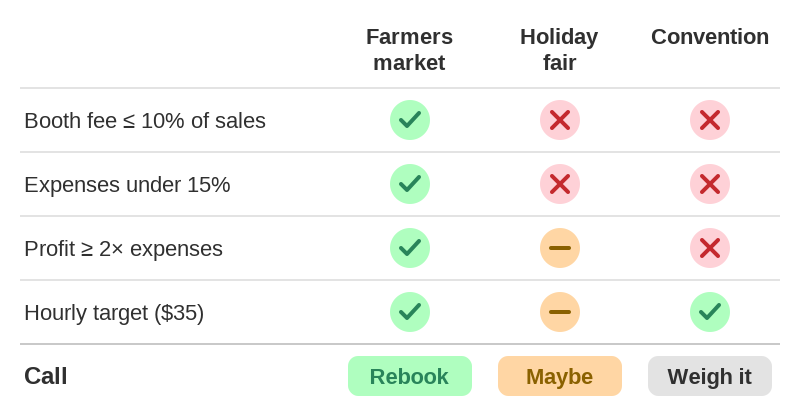
Here are three markets run through the same rules. Product costs are 30% of sales and card fees about 3% in each one.
Market A: Saturday farmers market
| Amount | |
|---|---|
| Sales | $620 |
| Booth fee | $45 |
| Other event costs (gas, coffee) | $20 |
| Product costs and card fees | $204.60 |
| Profit | $350.40 |
| Hours (drive, setup, selling, teardown) | 7 |
Booth multiple 13.8x (pass). Expenses 10.5% of sales (pass). Profit is 5.4 times the $65 in expenses (pass). About $50 an hour (pass for most people). This one is an easy rebook.
Market B: Two-day holiday fair
This is the fair from our profit calculation guide: $1,800 in sales, a $250 booth, $404.40 in event costs and $802.30 in profit over 24 hours.
Booth multiple 7.2x (fail at 10x). Expenses 22% (fail). Profit just under twice the expenses (borderline). About $33 an hour (depends on your target). It's the first year at this fair.
Verdict: maybe. The numbers aren't great, but one edition isn't enough to drop it. Before next year, ask the organizer about attendance and advertising, and look at what sold. If it comes in weak again, skip it.
Market C: Three-day convention
| Amount | |
|---|---|
| Sales | $4,200 |
| Booth fee | $600 |
| Hotel, gas, food | $590 |
| Product costs and card fees | $1,386 |
| Profit | $1,624 |
| Hours | 36 |
Booth multiple 7x (fail). Expenses 28% (fail). Profit 1.4 times expenses (fail). About $45 an hour (pass). This is the interesting one: it's the biggest profit of the three in dollars and the best hourly pay after the farmers market, yet it fails three rules because it's expensive to be there.
When the rules disagree
Market C is common with big shows. The ratios look bad because the costs are high, but the dollars and the hourly pay are good. When the rules disagree, ask:
- Can the costs come down? Sharing a hotel room or a booth with another vendor changes the ratios quickly.
- Is the market bringing something besides sales? Custom orders, wholesale contacts, email signups and invites to other shows don't show up in the profit line. Write them down for each market.
- Was this edition normal? Weather, a bad booth spot or a new organizer can explain a lot.
- Would you do it again for the experience? That's a fine reason, as long as you know what it costs.
The questions to ask an organizer before you book are worth their own list. We wrote one in questions to ask before booking a craft fair.
A simple way to decide
Put the rules together into one call per market:
| Result | When |
|---|---|
| Rebook | Passes the booth fee rule and your hourly number, and you'd happily do it again |
| Maybe | Misses one or two rules, or it was the first year at this market |
| Skip | Misses most rules two editions in a row, or the hourly pay is far below your number |
Write the call down with one line on why ("slow foot traffic, organizer moved us to the back"). Next year, when the application email arrives, you'll know exactly what happened.
FAQ
What is a good booth fee for a craft fair?
There's no single price. A good booth fee is one your expected sales can cover at least ten times over. If you expect to sell about $1,200, a booth up to $120 fits the 10x rule. At 8x, up to $150.
How many items do I need to sell to cover the booth fee?
Divide the booth fee by your average profit per item (price minus what the item costs you). At a $250 booth and $17 profit per item, you need about 15 items just to pay for the space, before gas and food.
Should I quit a craft fair after one bad year?
Usually not. Many vendors give a market a second edition before dropping it, because weather, booth placement or a one-time event can explain a slow year. Two weak editions in a row is a clearer signal.
Is a craft fair worth it if I don't make much money?
It can be, if it brings custom orders, wholesale leads or new customers who buy online later. Just track those results, so you're choosing the market for a reason and not out of habit.