Craft Fair Sales Tax: Permits, Collecting and Records
Craft fair sales tax is the topic vendors most often put off until a week before the market, usually after seeing "seller's permit number" on a vendor form. The rules aren't the same anywhere: each state sets its own, cities and counties can add their own rates, and states treat one-day events in different ways. This guide explains the basic questions to answer for each market, shows how a few states handle temporary events (with links to their official pages), works through the math of collecting tax, and covers the records that make filing painless.
This is general information, not tax advice. Rules change and depend on your products and situation. Confirm everything with the state's revenue department or a tax professional before you sell.
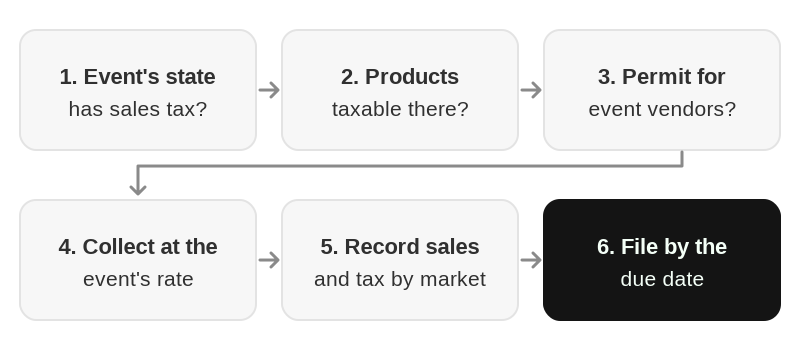
The four questions for every market
- Does the state where the fair takes place have a sales tax? For in-person sales, the rules of the place where the sale happens are the ones that usually matter, not where you live.
- Are your products taxable there? Most states with a sales tax tax handmade goods like jewelry, candles and art. Some products, often certain foods, can be exempt.
- What permit does that state want from event vendors? A regular seller's permit, a temporary permit, a special event license, or something else.
- What rate applies at the event's location? State rate plus any local rates.
States without a statewide sales tax
According to the Tax Foundation's 2026 table of state and local sales tax rates, five states have no statewide sales tax: Alaska, Delaware, Montana, New Hampshire and Oregon. Alaska allows local sales taxes, so a market in an Alaska city may still have one. Everywhere else, assume you'll need to deal with sales tax until you've confirmed otherwise.
How states handle one-day events: five examples
States use different approaches for vendors at fairs, festivals and markets. Here are five, from each state's own pages, as examples of the patterns you'll meet. If you sell in a different state, look for the same kind of page on its revenue department's website.
| State | What its official page says (summarized) |
|---|---|
| California | If you sell at a location for less than 90 days, you're a temporary seller who needs a temporary seller's permit, registering each location. If you already hold a permit, you register a sub-permit for the event. Vendors at three or more swap meets, flea markets or special events in 12 months need an ongoing permit, and event operators must get evidence of your permit before renting you space. |
| Colorado | Sellers without a permanent place of business who sell at fairs, festivals and bazaars get a Special Event Sales Tax License using form DR 0589. |
| Idaho | Sellers at organized events work with the event promoter to get a temporary seller's permit, valid for 90 days. |
| Iowa | The state doesn't issue temporary permits. At a craft show you give the event sponsor your name, address and permanent permit number, and sponsors must identify the vendors making taxable sales. |
| Wisconsin | A vendor selling taxable items must have a Wisconsin seller's permit unless its sales are exempt, for example sellers of nontaxable items such as vegetables or fruits. |
Two things stand out. First, organizers are often part of the process: some collect vendor permit numbers or report vendors to the state. That's why vendor forms ask for your permit number. Second, "I only do two markets a year" doesn't automatically mean you're off the hook. Check the state's rule for occasional sellers.
Collecting the tax: two ways to price
Once you know the rate at the event's location, you can price in two ways. Say the combined rate is 7.25% and an item is $25.
Tax added at checkout. The sign says $25, the customer pays $26.81, and $1.81 is tax you owe the state. Simple to report, but totals end in odd cents and slow down cash sales.
Tax included in the price. The sign says $25 and the customer pays $25. The tax is inside the price: $25 ÷ 1.0725 = $23.31 is your sale, and $1.69 is tax. Cash is faster, but you keep less per item, and some states have rules about how tax-included prices must be shown. Check before you do it.
| Tax added | Tax included | |
|---|---|---|
| Customer pays | $26.81 | $25.00 |
| Your sale (before tax) | $25.00 | $23.31 |
| Sales tax collected | $1.81 | $1.69 |
On 100 items, tax-included pricing at this rate means about $169 less in sales than adding the tax. If you switch to tax-included prices, raise sign prices a little to make up for it. Our guide on how to price items for a craft fair covers the rest of the pricing math.
Set the rate before you sell
If you use a POS app, check that the tax rate it will charge matches the event's location, not your home address. Many apps calculate tax from the location or address you set up, so a market in another city or state may need its own location or a manual rate. Ring up a test sale at home and look at the tax line.
Cash and payment apps count too
Sales tax applies to the sale, not the payment method. Cash, Venmo and Zelle sales at the booth are taxable just like card sales. Record them in your POS or on paper so the tax you report covers everything.
Keep records by market and by state
When filing time comes, you'll need taxable sales and tax collected for each period, and often by location. A simple log, one row per market:
| Date | Market | City, state | Taxable sales | Tax collected | Permit used |
|---|---|---|---|---|---|
| May 10 | Spring Makers Market | Boise, ID | $820.00 | $49.20 | Temporary permit |
| Jun 14 | Riverside Craft Fair | Davenport, IA | $1,140.00 | $79.80 | Iowa permit, given to sponsor |
| Jul 19 | Summer Art Walk | Madison, WI | $960.00 | $52.80 | Wisconsin seller's permit |
(Example rows with made-up amounts; use the actual rate for each location.)
Keep each market's vendor paperwork with the row: the organizer's tax instructions, your permit and the confirmation of any return you filed. If you track sales in Shopify POS, our guide to tracking craft fair sales in Shopify POS shows how to pull one market's orders, and the export includes the tax on each order. A craft fair profit spreadsheet with a "state" and "tax collected" column keeps it all in one place.
Sales tax isn't your income
The tax you collect belongs to the state, so leave it out of your sales when you work out whether a market was worth it. If you sold $1,140 plus $79.80 in tax, your market's sales are $1,140. Put that number, the booth fee and your other costs in the free craft fair profit calculator, and keep the tax aside for the return.
Sales tax permits and any filing fees are also a cost of selling at events. Our craft fair expenses checklist has a line for them.
FAQ
Do I have to charge sales tax at a craft fair?
In most states with a sales tax, yes, for taxable products like handmade goods. Some products and some occasional sellers can be exempt. Check the rules of the state where the fair takes place, not just your home state.
Do I need a sales tax permit to sell at a craft fair?
Often yes. Depending on the state, that can be a regular seller's permit, a temporary permit, or a special event license. Many vendor applications ask for the number. The state's revenue department website explains which one applies.
What sales tax rate do I charge at a craft fair?
Usually the combined state and local rate for the event's location. Ask the organizer, check the state's rate lookup tool, and set that rate in your POS before the market.
Can I include sales tax in my craft fair prices?
Some vendors do, for faster cash sales, but you keep less of each sale and some states have rules about how tax-included prices must be shown. Check with the state before switching.