How to Price Items for a Craft Fair (Formula and Example)
Knowing how to price items for a craft fair is half math and half nerve. Price too low and you can sell out and still lose money once the booth fee, gas and card fees come off. Price too high for the crowd and you carry everything home. This guide gives you a simple formula, works it through with a full example, and then checks the result against a real market's costs, which is the step most pricing guides leave out.
Step 1: Know what one item really costs you
Start with three parts:
- Materials: everything that goes into one item, including packaging (bag, card, tag, sticker).
- Labor: how long one item takes, times what an hour of your time is worth. Time a batch and divide, because "about ten minutes" is usually closer to fifteen.
- Overhead per item: tools, studio costs, website and software, spread over how many items you make. A rough approach: add up a month of these costs and divide by the items you make in a month.
Cost = materials + labor + overhead
Leaving out labor is the most common pricing mistake. If your price only covers materials, the craft fair is paying you nothing for the hours you spent making the stock.
Step 2: The cost-plus formula many makers use
A formula you'll see in many maker groups and pricing guides:
- Wholesale price = cost × 2
- Retail price = wholesale price × 2
The first doubling gives you a margin to run and grow the business. The second leaves room for a shop to buy from you and still make money, which keeps your retail price consistent if you ever sell wholesale. If you'll never sell wholesale, you can treat the formula as a ceiling and test lower, but write down why.
A full example: beaded earrings
| Part | Amount |
|---|---|
| Beads, wire and hooks | $2.60 |
| Card, bag and sticker | $0.60 |
| Labor: 15 minutes at $20 an hour | $5.00 |
| Overhead (tools, website, software) | $0.80 |
| Cost per pair | $9.00 |
| Wholesale (× 2) | $18.00 |
| Retail (× 2) | $36.00 |
$36 is the formula's answer. Whether it's the right price depends on the market. At a juried fine craft show, $36 earrings may look cheap. At a church holiday bazaar, they may sit all day. So the formula gives you a starting point, and the next two steps tell you whether it works.
Step 3: Check the price against the market's costs
Here's the step that turns a price into a plan. A market has costs that don't belong to any one item: the booth fee, gas, food and maybe a hotel. Your prices have to cover those too.
Say the market is a one-day holiday fair:
| Market cost | Amount |
|---|---|
| Booth fee | $150 |
| Gas | $35 |
| Food and parking | $25 |
| Total | $210 |
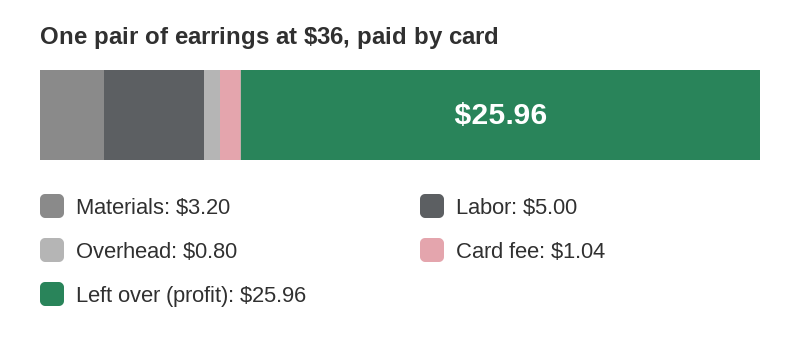
At $36, each pair of earrings leaves $27 after its own cost ($36 − $9). Card fees take a little more: at 2.6% plus 10 cents, about $1.04 per sale, so call it $25.96 per pair. To cover $210 you need to sell about 8 pairs before you've made a profit on the day. Most vendors can judge whether that's realistic.
Now try $24 instead, a price that might feel "safer":
- $24 − $9 cost = $15
- Card fee about $0.72
- About $14.28 per pair
- 15 pairs just to cover the market
Dropping the price by a third nearly doubled the number of sales you need before you earn anything. That's why underpricing hurts so much at fairs: the booth fee doesn't shrink when your prices do.
For a whole booth with many products, use your average profit per item instead of one product's, or put the totals in the free craft fair profit calculator. Our guide on how to calculate craft fair profit shows the full calculation after the market.
Step 4: Adjust for the crowd, not for your nerves
Once the math says a price works, the remaining question is the crowd. A few ways to find the right level without guessing:
- Visit as a shopper first. Walk the fair before you apply and write down prices in your category. If every jewelry booth is between $20 and $45, $36 is in range.
- Ask the organizer what typical shoppers spend. Our list of questions to ask before booking a craft fair includes this one.
- Watch sell-through, not just sales. If you sell out of something by noon, the price may be low. If something sells once all weekend, the price or the product may not fit that crowd. Our guide to what sells best at craft fairs shows how to rank products after each market.
- Change one thing at a time. Raise one product's price at the next market of the same kind and compare. Changing everything at once tells you nothing.
Price points: build a ladder
A booth with everything at $36 has nothing for the person who wants a small gift and nothing for the person ready to spend. Many vendors build a ladder of price points:
| Level | Example price | Role |
|---|---|---|
| Impulse | $5 to $12 | Stickers, cards, small add-ons; easy yes, good with cash |
| Core | $18 to $40 | Your main products; most of your sales |
| Anchor | $60 and up | Big pieces that make the booth feel like a shop |
Price each level with the same formula. Then check that the ladder still covers the market: if most of your sales are $8 stickers, you need a lot of them to pay a $150 booth.
Small details that change real money
Round prices. Whole-dollar prices ($12, $20, $36) make cash faster and reduce the coins you need in your float. If you charge sales tax on top, the total won't be round anyway, so some vendors include tax in the sign price where that's allowed. That's a question for your state, not a rule; we cover the basics in our craft fair sales tax guide.
Bundles. "1 for $12, 3 for $30" lifts the average sale and still leaves a healthy margin if your cost per item is low. Run the bundle through the same check: $30 − (3 × $3 cost) = $21 for three items, $7 each, versus $9 each sold singly. Worth it only if it makes people buy three instead of one.
Card fees. Card processing is a percentage plus a few cents per sale, so it hits small sales hardest. On a $5 sale, 2.6% plus 10 cents is $0.23, almost 5% of the price. On a $36 sale it's about 2.9%. If you sell many tiny items, a $10 card minimum or bundles keep fees in check. (Check the current rates of your own card reader; we compare two common ones in Square vs Shopify POS for craft fairs.)
Discounts at the end of the day. End-of-day discounts train repeat shoppers to wait. If you must discount, discount slow movers you've already decided to drop, not your stars.
Write the prices down with the date
Keep a simple record: product, price, cost and the date the price changed. When you compare one year's market with the next, you'll know whether sales went up because more people came or because you raised prices. Our guide to comparing craft fair sales year over year explains why that matters.
FAQ
What is the formula for pricing crafts to sell at a fair?
A common one is cost × 2 for wholesale and wholesale × 2 for retail, where cost is materials plus labor plus overhead for one item. Then check that the price covers the market's booth fee, gas and card fees at a number of sales you can realistically make.
Should craft fair prices be lower than online prices?
Many vendors keep the same prices in person and online, so customers don't feel misled when they visit your website later. You may skip shipping costs at a fair, but you add the booth fee, travel and your time at the booth.
How do I price items so I make money after the booth fee?
Work out profit per item (price minus cost minus card fee), then divide the market's costs by it. If the number of sales needed is more than you can realistically make, raise prices, lower costs, or pick a cheaper market.
Should I include labor when pricing handmade items?
Yes. If labor isn't in the cost, every sale pays only for materials, and the hours you spent making stock are unpaid. Use an hourly rate you'd accept for the work, even if it's modest at first.