Craft Fair Tent Buying Guide: Frame, Size and Weights
A craft fair tent is the biggest piece of gear most outdoor vendors buy, and it's easy to pick the wrong one: too heavy to carry alone, legs that slant in and steal table space, a colored top that tints every product, or no plan for weights until the market manager walks over. This guide is a neutral checklist for choosing a 10 by 10 canopy for markets, what real markets require for tent weights (with links to their rules), how to stay safe in wind, and how to work the tent into each market's costs.
We don't rank brands here. Features matter more than names, and the right tent depends on how often you sell outdoors, how far you carry it and who helps you set up.
Do you need a craft fair tent at all?
For outdoor craft fairs and farmers markets, usually yes. Shade protects you and your products, rain happens, and a tent makes the booth look like a shop instead of a table in a parking lot. Indoor shows don't need one. Before you buy, check:
- Does the market provide tents? Some do, for a fee or included in the booth price.
- What size is the booth? Most outdoor booth spaces are 10 by 10 feet, and some markets require tents to be exactly that. The Harker Heights, Texas farmers market guide, for example, says tents must be 10x10.
- What does the market require for weights? More on that below; it affects which tent and how much extra gear you carry.
The buyer's checklist
1. Straight legs, not slanted
Pop-up canopies come with straight legs or slanted legs. A slant-leg canopy may cover a 10 by 10 footprint at the feet but give a smaller roof on top, so you get less shade and less room for tables under the edges. For a 10 by 10 booth, straight legs give you the full space you're paying for.
2. Frame material and weight
Frames are usually steel or aluminum. Steel tends to be heavier for the same size; aluminum tends to be lighter to carry but often costs more. Look at the total weight in the bag, not just the frame, and picture carrying it from the parking lot. If you'll often set up alone, a lighter frame and a wheeled bag are worth more than a slightly thicker leg.
3. One-person setup
Most pop-up canopies can be opened by one person, but it's much easier with two. Practice at home before the first market: open it, raise it, take it down, pack it. Time yourself. If it takes you 20 minutes alone in your driveway, plan for more at a busy load-in.
4. Height
Adjustable legs let you raise the canopy so tall displays, banners and taller customers fit. Check the lowest and highest leg setting, and the height at the edge (where people walk in), not only at the peak.
5. Top color: white is the safe choice
Light passes through the canopy top and colors everything under it. A blue or green top tints your products and your photos. A white top keeps colors closer to true, which matters for jewelry, ceramics, textiles and anything people choose by color. If you want color, put it in your banner and table covers instead.
6. Sidewalls
At least one back wall is useful: it blocks wind and rain from behind, hides your stock, and gives you a surface to hang a sign or products. Full sidewalls help in rain and cold. Mesh walls cut wind less but keep air moving in summer.
7. A flame-retardant label, if your venues ask
Some venues require tent fabric to be flame-retardant and labeled. UC Irvine's special events rules, for example, require tent fabrics to be an approved flame-retardant material with a certified label present at all times. Not every market asks, but if you sell at fairgrounds, campuses or city events, check for the label before you buy.
8. Places to attach weights
Look for a way to strap weights to each leg low down, and points on the frame for straps or bungees. If the canopy has none, plan to use straps around the legs.
Tent weights: what markets actually require
Weights are where many first-time vendors get caught out. Rules vary, so read each market's vendor rules, but here are three published examples:
| Source | What it says |
|---|---|
| Larimer County Farmers' Market, Colorado | 40 pounds on each tent leg; vendors without adequate weights may be asked to take tents down |
| Harker Heights Farmers Market, Texas | At least 25 pounds per leg, 100 pounds per tent; the 2021 handbook says gallon water jugs and single bricks aren't acceptable |
| UC Irvine canopy safety guide | At least 40 pounds per leg for a 10 by 10 canopy, and double the weight on each leg for larger canopies |
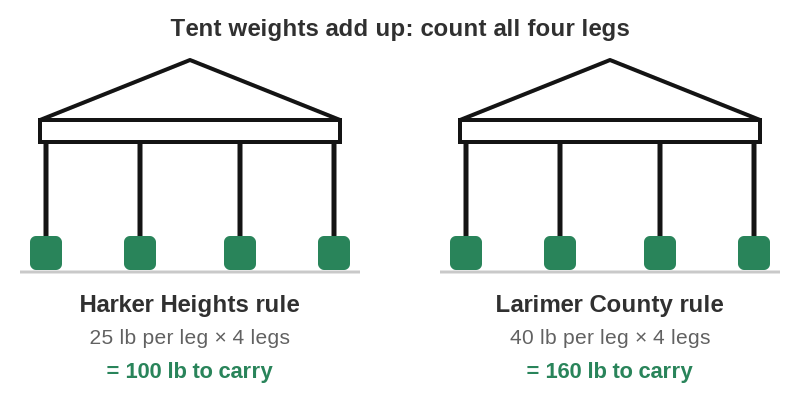
The total is what surprises people. At 40 pounds per leg, you're carrying 160 pounds of weights to every market, on top of the tent, tables and stock. Plan how you'll move them: a wagon or hand truck, weights split into smaller pieces, or weights you fill on site where the market allows it.
Common types of weights
- Sandbag weights that wrap around the leg. Light to carry empty; fill them with sand.
- PVC pipe filled with concrete, hung from the frame with a strap. Cheap to make and compact.
- Plate or cast weights that stack at the foot of each leg.
Whatever you use, weigh it once on a bathroom scale so you know it meets the rule. Water jugs look heavy but aren't: a gallon of water weighs a little over 8 pounds, so you'd need five per leg to reach 40.
Wind safety
A canopy without enough weight can lift in a gust and hit people, cars or the booth next door. A few habits:
- Weights go on before anything else, as soon as the canopy is up, and come off last at teardown.
- Keep weights low on the legs and strapped tight so they can't swing.
- Drop the sidewalls in strong wind, since walls catch air like a sail.
- Lower the canopy or take it down if gusts pick up and the manager says so. Products can go under the table for an hour; an airborne tent is a much bigger problem.
If a tent does cause damage or injury, that's what vendor liability insurance is for, and some markets require it. Our guide to craft fair insurance explains the basics.
What a craft fair tent costs per market
A tent is equipment, so its cost is easiest to understand spread over the markets you'll use it for. Here's the math with example prices (check current prices where you buy):
| Item | Example price |
|---|---|
| 10 by 10 straight-leg canopy | $250 |
| Four weights | $90 |
| Back wall | $40 |
| Total | $380 |
| Markets it lasts | Cost per market |
|---|---|
| 10 | $38.00 |
| 20 | $19.00 |
| 40 | $9.50 |
If you do 15 outdoor markets a season and the tent lasts three seasons, that's 45 markets and about $8.44 per market. Add that share to each outdoor market's costs, next to the booth fee, gas and food. Our craft fair expenses checklist has a line for an equipment share, and the free craft fair profit calculator lets you add it under other costs.
A cheaper tent that breaks after one windy season may cost more per market than a sturdier one that lasts three.
Setup and care tips
- Practice at home before the first market, including taking it down in a hurry.
- Pack in the order you set up: canopy and weights last into the car, first out.
- Never store it wet. Open it at home to dry after a rainy market, or the top can mildew.
- Bring a small repair kit: zip ties, a spare strap, tape.
- Plan the booth under it. Our guide to craft fair display ideas has four layouts for a 10 by 10 space, and the printable craft fair checklist includes the tent gear.
FAQ
What size tent do I need for a craft fair?
Most outdoor booth spaces are 10 by 10 feet, so a 10 by 10 canopy is the standard. Check the market's rules first; some require exactly that size, and larger booths may allow a 10 by 15 or 10 by 20.
How much weight do I need on each tent leg?
Use what the market requires. Published examples range from 25 pounds per leg (Harker Heights Farmers Market) to 40 pounds per leg (Larimer County Farmers' Market and UC Irvine's canopy safety guide). Add more in windy conditions.
Can I use water jugs as tent weights?
A gallon of water weighs only a little over 8 pounds, and some markets, like Harker Heights, say gallon jugs aren't acceptable. Sandbag weights, concrete-filled pipes or plate weights are more common.
Should my craft fair tent be white?
White is the safest choice for selling, because a colored top tints the light on your products. If your products are sold by color, a white canopy shows them closer to how they really look.