Christmas Market Vendor Guide: Stock, Cold, Lines and Profit
Being a Christmas market vendor is a different job from doing a one-day craft fair. Many holiday markets run several weekends in a row, some outdoors in the cold, with long days, bigger crowds, shoppers who want things wrapped, and lines at the busiest hours. It can be the best stretch of your year, and it's also when costs pile up quietly: a season booth fee, a helper, bags and tissue, gas for eight trips. This guide covers planning stock for a whole season, staying warm and powered on long days, wrapping and lines, helper costs, and how to check whether the season actually paid off.
If you're still deciding what to make for the holidays, start with our Christmas craft fair ideas. This guide is about running the booth once you have the products.
Plan the season, not just the day
A multi-weekend market is one long event with breaks for restocking. Plan it backward from a season target. Here's an example with made-up numbers: four weekends, Saturday and Sunday, and a $600 booth fee for the season.
Season target. Using the common rule of sales at least 10 times the booth fee: $600 × 10 = $6,000. Round to a stretch goal of $6,400.
Split by weekend. Here's an example split that builds toward Christmas. Replace it with your own history as soon as you have one season of numbers:
| Weekend | Share | Sales goal | Sales at $20 average | Items (1.3 per sale) |
|---|---|---|---|---|
| 1 | 20% | $1,280 | 64 | 83 |
| 2 | 23% | $1,472 | 74 | 96 |
| 3 | 27% | $1,728 | 86 | 112 |
| 4 | 30% | $1,920 | 96 | 125 |
| Season | 100% | $6,400 | 320 | 416 |
Our guide to multi-day craft show goals explains splitting a goal by day, and the same idea works by weekend.
Can you make enough?
This is where holiday seasons go wrong. If about 70% of what you bring sells, 416 items sold means bringing about 600 over the season. Now check your production:
| Items | |
|---|---|
| Needed for the season (about 416 ÷ 0.7) | 600 |
| Made before the market opens | 260 |
| Made during the season (85 per week × 4) | 340 |
| Total | 600 |
If you can only make 50 items a week during the season, you need 400 ready before opening, which means starting much earlier. Do this math in September, not in December. Our guide on how much inventory to bring to a craft fair shows how to split the total by product.
Restock from what sold
After weekend 1, count what came home by product and make more of what sold out first. Your best sellers in week one are a better guide than your plans in October.
Cold, long days and power
Outdoor Christmas markets mean standing still in the cold for hours. Practical setups that help:
- Layers you can open and close, since the afternoon sun and the after-dark cold can feel like two different days.
- Something between your feet and the ground: a thick foam or rubber mat under where you stand.
- Gloves you can work in: fingerless gloves or thin touchscreen gloves for handling cash, bags and the card reader.
- Hot drinks from home in a thermos, and real breaks. A short walk to warm up is easier with a helper.
- Sidewalls on the windy side of the tent, if the market allows them.
Plan for power too. Apple says iPhone and iPad are designed for use between 32° and 95° F, and that very cold conditions can temporarily shorten battery life. Keep your phone and a charged power bank in an inside pocket between sales, start every day fully charged, and bring a spare cable. A dead phone at 4 p.m. on the busiest Saturday is the most expensive problem you can have.
Gift wrap and bags
Holiday shoppers often ask, "Can you wrap it?" Decide your answer before the season:
- Simple and free: tissue, a bag and a sticker with your logo. Quick, and it makes every sale feel like a gift.
- Boxed for a fee: a gift box for $2 to $3, which covers the box and some of your time.
- Pre-wrapped stock: your fastest sellers already wrapped, with the price on the tag, so the line keeps moving.
Count wrapping as a real cost. With example prices of $0.40 for a bag, $0.10 for tissue and $0.08 for a sticker, that's $0.58 per sale. Over 320 sales it's about $186 for the season. Small per sale, but it belongs in your numbers.
Fold boxes and prep bags at home on weeknights. Wrapping on the spot during a rush is how lines get long.
Payments and lines
The busiest hours at a holiday market are when you most need checkout to be fast.
- Two ways to take cards. A second phone or tablet can help on busy days. Shopify, for example, says Tap to Pay on iPhone is available on every plan at its normal in-person rates, which can work as a second checkout or a backup. Check what your own system supports and test it at home.
- Round prices make cash faster.
- A bigger cash float than usual on the last weekends.
- One person rings up, one person wraps, if you have a helper.
- Offline payments set up in advance, in case the market's signal drops under the crowd. Our comparison of Square vs Shopify POS for craft fairs covers how offline payments work on each and who carries the risk.
A helper: worth it, but count it
Long days and lines make a helper tempting, and often worth it. But a helper can easily become your biggest cost of the season. With example numbers:
| Amount | |
|---|---|
| Helper pay per hour | $18 |
| Hours per market day | 9 |
| Market days | 8 |
| Helper cost for the season | $1,296 |
That's more than twice the booth fee. Options: a helper only on Saturdays (half the cost), only for the last two weekends, or a trade with another vendor who covers your breaks. If you pay a helper, ask an accountant how to handle it properly in your state.
Did the season pay off?
When the market ends, add everything up for the whole season, not weekend by weekend. Here's the example season:
| Amount | |
|---|---|
| Sales | $6,400.00 |
| Product costs (30% of sales) | −$1,920.00 |
| Card fees (2.6% + 15¢ on $5,600 of card sales, 280 card sales) | −$187.60 |
| Booth fee for the season | −$600.00 |
| Helper | −$1,296.00 |
| Wrapping and bags | −$186.00 |
| Gas and parking (8 days × $15) | −$120.00 |
| Food | −$160.00 |
| Profit | $1,930.40 |
| Market hours (8 days × 10 hours) | 80 |
| Profit per market hour | about $24 |
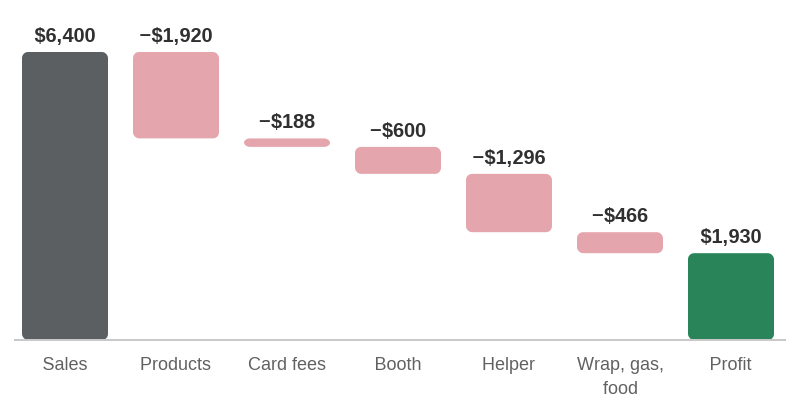
What the numbers say:
- The booth fee passed easily: sales were 10.7 times the $600 fee.
- Event costs were high: booth, helper, wrapping, gas and food came to $2,362, about 37% of sales, mostly because of the helper.
- The helper was the lever: with a helper only on Saturdays, the season would have kept about $648 more, if sales held up on Sundays without them.
- Production hours aren't in here. Product costs above are materials. If you count the evenings spent making stock, the true hourly number is lower, which is worth knowing before you sign up for next year.
Run your own season through the free craft fair profit calculator using the season totals, and keep the weekend-by-weekend sales too. If weekend 1 barely covered its share of the booth fee two years in a row, next year you might choose a shorter market or a different one. Our guide on how to calculate craft fair profit explains each line.
FAQ
How do I become a Christmas market vendor?
Find the holiday markets you want well before the season and check when each one opens applications. Apply with good product and booth photos, and check the paperwork the market asks for, such as insurance and a sales tax permit.
How much stock do I need for a Christmas market?
Work backward from a season sales goal, divide by your average sale to get the number of sales, multiply by items per sale, and bring extra so the table doesn't look empty. Then check that you can actually make that many items before and during the season.
How do I stay warm at an outdoor Christmas market?
Dress in layers, stand on a thick mat instead of the bare ground, use gloves you can work in, bring hot drinks, and take short breaks to move around. Sidewalls on the windy side of the tent help if the market allows them.
Is it worth hiring a helper for a Christmas market?
Often, on the busiest days, because lines and breaks are hard alone. But a helper can cost more than the booth fee, so count it in your season's costs and consider using help only on the busiest days.