Best Card Reader for Craft Fairs: 4 Options Compared
There's no single best card reader for craft fairs, but there is a best one for how you sell: how many card sales you take, whether you also have an online store, and how often the signal drops at your markets. This guide compares four common options for US makers (Square, SumUp, PayPal's point of sale app and Shopify POS) on the numbers that matter at a booth, works out what each costs over a weekend and a season, and ends with a checklist to test your reader before market day.
Two notes before the table. Every rate and price below comes from each company's own US page, checked in November 2026 and linked, and they change, so confirm before you buy. And a disclosure: BoothVerdict, the app behind this blog, is being built for sellers who use Shopify POS. We've kept this comparison to published numbers so you can check each one.
What matters in a card reader at a craft fair
- The per-sale rate. A percentage plus a fixed number of cents. The cents matter most on small sales.
- Monthly fees. Some options are free until you add features; one needs a paid store plan.
- Reader price. A one-time cost, but it takes many markets of cheaper fees to make up a pricier reader.
- Offline payments. Whether you can keep taking cards when the signal drops, and who carries the risk.
- Tap to Pay on your phone. A free backup if the reader dies or you forget it.
- One inventory. If you sell the same products online, whether the booth and the website share stock counts.
The four options side by side
| Square | SumUp | PayPal Point of Sale | Shopify POS | |
|---|---|---|---|---|
| In-person rate | 2.6% + 15¢ | 2.6% + 10¢ | 2.29% + 9¢ | 2.6% + 10¢ (Basic plan) |
| Monthly fee | $0 (Free plan) | $0 (standard) | $0 | Shopify plan: $39/mo, or $29/mo billed yearly |
| Reader | $59 | $99 (Solo) | $29 first reader, then $79 | $49 (Tap & Chip) |
| Tap to Pay on phone | iPhone | iPhone and Android | iPhone and Android | iPhone |
| Offline card payments | Yes, seller carries the risk | Limited pilot; ask first | Not stated on the pages we checked | Yes with compatible readers, seller carries the risk |
Sources: Square pricing, reader and offline payments; SumUp pricing, Solo price, Tap to Pay and offline transactions; PayPal point of sale pricing and Tap to Pay on iPhone and Android; Shopify pricing, hardware, Tap to Pay on iPhone and offline payments.
A few details behind the table:
- PayPal's point of sale app used to be called Zettle. Its $29 price is for the first reader for a new business user; the standard price is $79. Its Tap to Pay on iPhone help page says the fee is the same as a card reader payment.
- Shopify POS needs a Shopify plan, which also runs an online store. Shopify says Tap to Pay on iPhone is on every plan at the normal in-person rate, and that Tap to Pay and swiped cards aren't supported offline.
- SumUp calls offline transactions on the Solo a pilot for a limited number of merchants, not enabled by default.
A weekend in numbers
A two-day fair with 70 card sales totaling $2,100, about $30 each (example numbers):
| Percentage part | Fixed part | Card fees | |
|---|---|---|---|
| PayPal Point of Sale (2.29% + 9¢) | $48.09 | $6.30 | $54.39 |
| SumUp (2.6% + 10¢) | $54.60 | $7.00 | $61.60 |
| Shopify POS, Basic (2.6% + 10¢) | $54.60 | $7.00 | $61.60 |
| Square, Free (2.6% + 15¢) | $54.60 | $10.50 | $65.10 |
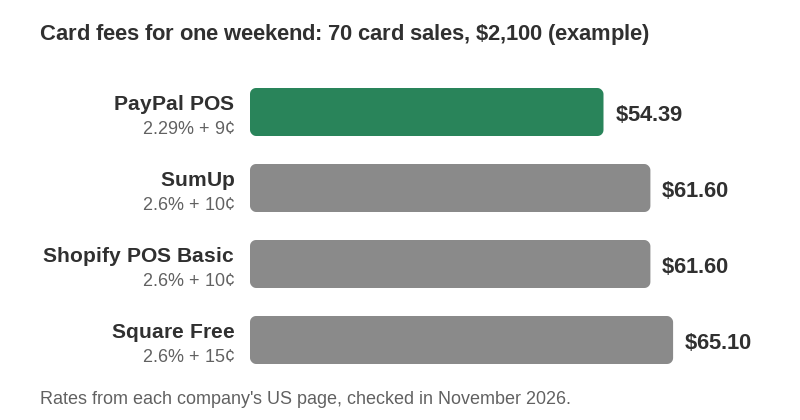
The spread is about $11 a weekend between the lowest and highest. Real, but small next to the booth fee.
A season in numbers
Twelve markets like that one, plus the reader and any monthly plan:
| Card fees (12 markets) | Reader | Monthly plan (12 months) | First-year total | |
|---|---|---|---|---|
| PayPal Point of Sale | $652.68 | $29 | $0 | $681.68 |
| SumUp | $739.20 | $99 | $0 | $838.20 |
| Square, Free | $781.20 | $59 | $0 | $840.20 |
| Shopify POS, Basic | $739.20 | $49 | $348 (yearly billing) | $1,136.20 |
Read the last row carefully. If you already pay for Shopify to run your online store, that $348 isn't a cost of the markets; it's a cost you'd pay anyway, and Shopify POS comes out at $788.20 with one inventory for the booth and the website. If you don't sell online with Shopify, paying for a plan just for markets is the most expensive way to take cards here.
Choose by your situation
| Your situation | Usually the better fit | Why |
|---|---|---|
| Only in-person, few markets | Square or PayPal | No monthly fee, cheap reader; Square documents offline mode |
| Only in-person, many card sales | PayPal or SumUp | Lowest per-sale costs add up over a season |
| Online store on Shopify | Shopify POS | One product list and stock count; POS included in the plan |
| Lots of tiny sales | PayPal or SumUp | Lower fixed cents per sale |
| Weak signal at most markets | Square or Shopify POS | Documented offline card payments (seller carries the risk) |
If you're deciding between two specific options, our detailed comparisons of SumUp vs Square and Square vs Shopify POS for craft fairs go deeper on payouts, offline rules and readers.
You may also see Stripe Terminal mentioned. Stripe describes it as a programmable point of sale: a toolkit for businesses that build their own checkout app, rather than a ready-made app you download and use at the booth. For most makers, one of the four above is simpler.
Test your reader before market day
Do this at home the night before, not at 8:55 with a customer waiting:
- Charge everything: reader, phone and a power bank.
- Run a real sale with your own card for $1, then refund it.
- Try a tap payment on your phone, so you know the backup works.
- Turn Wi-Fi and data off and try an offline sale, if your option supports it. Check the offline limit you've set.
- Check your items: prices loaded, bundles and discounts working.
- Set up other payment types you accept (Venmo, Zelle, cash) so they're recorded in the same app. In Shopify POS that's a custom payment type; our guide to tracking craft fair sales in Shopify POS shows how.
- Pack a backup: a second charging cable and a printed sign with your payment app handle.
Our printable craft fair checklist includes this list with the rest of your booth gear.
The reader is only half the story
Card fees are one line in a market's costs. After each market, subtract product costs, the booth fee, gas and food from sales to see what the market really made. The free craft fair profit calculator does that in a minute, including card fees as a percentage or a dollar amount. And if most of your sales are small, our guide on how to price items for a craft fair shows how bundles and a card minimum keep fees down.
FAQ
What is the best card reader for craft fairs?
It depends on how you sell. Without an online store, Square, SumUp and PayPal's point of sale app have no monthly fee, with PayPal showing the lowest per-sale rate in November 2026. If your online store runs on Shopify, Shopify POS keeps one inventory for the booth and the website.
Which card reader has the lowest fees for craft fairs?
Of the four compared here, PayPal Point of Sale listed the lowest US in-person rate in November 2026 at 2.29% + 9¢. SumUp and Shopify's Basic plan were 2.6% + 10¢, and Square's Free plan was 2.6% + 15¢. Check current rates before you buy.
Do card readers work at craft fairs without Wi-Fi?
Most use your phone's data connection, so they work wherever your phone has signal. For places without signal, Square and Shopify POS document offline card payments, with the seller carrying the risk of later declines. Bring a hotspot and test offline mode at home.
Do I need a card reader or can I use my phone?
Square, SumUp, PayPal and Shopify all offer Tap to Pay on a phone, so you can take contactless cards without a reader. A reader also takes chip cards that don't tap, and keeps your phone free, so many vendors use both.