How to Calculate Craft Fair Profit (With a Full Example)
If you want to know how to calculate craft fair profit, start by forgetting the number on your card reader at the end of the day. That number is sales. Profit is what's left after the booth fee, the gas, the food, the card fees and the cost of everything you sold. This guide walks through the math one line at a time, with a complete example from a two-day fair, so you can run the same numbers on your own markets.
The craft fair profit formula
Here is the whole thing in one line:
Profit = total sales − event costs − payment fees − cost of the products you sold
Each piece needs a little care:
- Total sales is everything customers paid you for your products at that market: card, cash, Venmo, Zelle, PayPal and anything else.
- Event costs are what you spent to be there: booth fee, application or jury fee, gas, parking, food, a hotel, insurance, a helper.
- Payment fees are what your card processor and payment apps kept.
- Cost of products sold is what the items you actually sold cost you to make or buy: materials, packaging, labels.
Most vendors get the first line right and underestimate the other three. Let's go through them with real numbers.
The example: a two-day holiday fair
You sell handmade candles and ceramics. You did a two-day holiday fair and here's what happened:
- 72 items sold for $1,800 in total, about $25 each on average.
- $1,300 of that came in by card across 52 transactions. The other $500 was cash and Venmo.
- The booth was $250 for both days, plus a $25 non-refundable application fee.
- The fair is 40 miles from home and you drove it twice: 160 miles round trip in total.
Step 1: Count every sale, and only sales
Add up every payment from the market, not just the card reader total. Cash and payment apps are the sales vendors forget most often, especially when a friend sends $30 over Venmo for a mug. If you take payments outside your POS, write each one down the moment it happens. Our craft fair expenses checklist has a simple way to log them.
Two things should not go into sales:
- Sales tax you collected. That money belongs to your state, not you. If your total includes tax, take it out before you start. Rules differ by state, so confirm what applies to you with your state's department of revenue or an accountant.
- Refunds and returns. If someone returned a piece the next week, subtract it from that market's sales.
In our example, sales are $1,800 after taking out sales tax.
Step 2: List every event cost
This is where most of the profit disappears. Put every cost of doing that specific market in one list:
| Event cost | How it's calculated | Amount |
|---|---|---|
| Booth fee | Both days | $250.00 |
| Application or jury fee | Non-refundable | $25.00 |
| Gas | 160 miles ÷ 25 mpg × $3.50 a gallon | $22.40 |
| Parking | $5 a day, two days | $10.00 |
| Food and coffee | Two days | $40.00 |
| Event insurance | Policy required by the organizer | $30.00 |
| Raffle donation | What the item cost you, not its price | $12.00 |
| Bags and tissue paper | Used up at this fair | $15.00 |
| Event costs total | $404.40 |
A few notes on getting this list right:
- Count donations at your cost. If you donated a $40 bowl to the organizer's raffle and it cost you $12 to make, the cost is $12.
- Spread out big purchases. A new canopy or display shelves will last for many markets. Don't charge the whole thing to one fair. Divide it by the number of markets you expect to use it for.
- Mileage for taxes is a different number. For your tax return, the IRS publishes a standard mileage rate each year that you may be able to use instead of actual costs. For judging a market, actual gas is fine. For taxes, check with an accountant.
Step 3: Subtract card and payment fees
Card processors usually charge a percentage of each payment plus a small fixed fee per transaction. Use the rate on your own statement. For this example we'll use 2.9% plus 30 cents:
- Percentage part: $1,300 × 2.9% = $37.70
- Fixed part: 52 transactions × $0.30 = $15.60
- Card fees: $53.30
If you accepted Venmo, PayPal or another app as payment for goods, check whether that app charges a fee for business payments and add it here too. Cash has no fee, which is one reason some vendors like it.
Step 4: Subtract the cost of the products you sold
Only count what you sold, not everything you brought. If you track a cost for each product (materials, wicks, glaze, jars, labels, packaging), multiply it by the number of units sold.
If you don't know your exact costs yet, use an honest estimate. In our example, the candles and ceramics cost about 30% of their price to make, so:
- $1,800 × 30% = $540 cost of products sold
Getting this number more accurate is worth an evening. It's the biggest cost on most makers' lists, bigger than the booth fee.
Step 5: Put it all together
| Line | Amount |
|---|---|
| Total sales | $1,800.00 |
| Cost of products sold | −$540.00 |
| Card fees | −$53.30 |
| Booth fee | −$250.00 |
| Other event costs | −$154.40 |
| Profit | $802.30 |
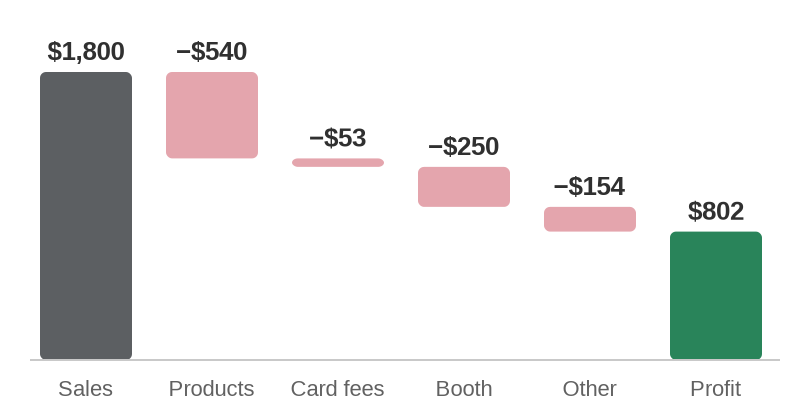
So the fair made you $802.30, not $1,800. That's still a decent weekend, but it's a very different number to plan around. You can plug your own numbers into the free craft fair profit calculator and get the same breakdown in a minute.
Step 6: Work out your profit per hour
A market isn't only money, it's time. Count every hour, not just the hours at the booth:
| Task | Hours |
|---|---|
| Pricing, packing and loading the car | 3.0 |
| Driving, four one-way trips | 3.5 |
| Setup | 2.0 |
| Selling, two days of 7 hours | 14.0 |
| Teardown | 1.5 |
| Total | 24.0 |
$802.30 ÷ 24 hours = about $33 an hour. That's the number to compare with other ways you could spend a weekend, like another market, online orders or simply a day off.
What the numbers tell you
Once you have profit, a few ratios help you compare markets of different sizes. Vendors we talked to in craft fair groups often use these:
- Booth fee multiple. Sales ÷ booth fee. Here, $1,800 ÷ $250 = 7.2x. Many vendors want at least 10x, so this fair falls short on that rule.
- Event costs as a share of sales. $404.40 ÷ $1,800 = 22%. A common target is under 15%.
- Profit compared with expenses. $802.30 is just under twice the $404.40 in event costs. Some vendors want profit to be at least double.
None of these rules decides on its own. A first year at a fair is often slower than the second, and a market that misses one target can win on another. We go through how to weigh them in Is a craft fair worth it?.
Common mistakes when calculating craft fair profit
- Treating sales tax as income. It inflates your sales and your profit.
- Forgetting the application fee. It's easy to miss because you paid it months earlier.
- Counting only card sales. Cash and payment apps are part of the market's sales.
- Using your retail price for donations or samples. Use what they cost you.
- Leaving out your time. $800 for 24 hours and $800 for 10 hours are very different markets.
- Looking at one market alone. Compare it with the same market last year and with your other shows. Our guide to comparing the same market year over year shows how.
If you'd rather keep all of this in a spreadsheet, we put together a free template in Craft fair profit spreadsheet: a free template.
FAQ
Should I include sales tax when I calculate craft fair profit?
No. Sales tax you collected is money you owe to the state, so take it out of your sales before you start. How and when you pay it depends on your state, so check with your state's department of revenue or an accountant.
Do I count my canopy and tables as a cost of one fair?
No. Equipment you'll use at many markets should be spread over all of them. If a $240 canopy will last about 24 markets, count $10 per market.
What if I don't know the cost of my products?
Start with an estimate as a percentage of your price, then refine it. Add up materials, packaging and labels for one batch and divide by the number of items it makes. Our guide on how to price items for a craft fair shows a full cost breakdown.
What's a good profit for a craft fair?
There's no single number. Compare profit per hour with what your time is worth to you, and compare each market with your other markets. A fair that pays well per hour and brings new customers is usually worth booking again.