How to Get Repeat Customers From Craft Fairs
Knowing how to get repeat customers is what turns a craft fair from a one-day sale into something that keeps paying. Most people who buy from your booth will never see you again unless you give them a reason and a way to: a list to join, a card worth keeping, a schedule of where you'll be next. This guide covers each of those, the basic email and text message rules to follow (with links to the official guidance), a follow-up you can send after every market, and a simple way to measure whether any of it works.
Why repeat customers matter at markets
A booth fee buys you one day in front of a crowd. Every buyer who comes back to your next market, or orders from your website later, is a sale that didn't need another booth fee to happen.
Here's the math with example numbers. Say a market brings you 60 buyers and you get 15 of them (25%) onto an email list. Over the next few months, 4 of those 15 buy again at another market or online, spending $32 each on average:
| Amount | |
|---|---|
| Buyers at the market | 60 |
| Joined your list | 15 |
| Bought again within a few months | 4 |
| Extra sales | $128 |
$128 isn't life-changing from one market. But if you do 15 markets a year and the list keeps growing, those small numbers stack up, and the people on it already know and like your work.
1. Ask for an email at the booth, with a reason
"Want to join my mailing list?" gets a polite no. A reason gets a yes:
- "I send one email a month with where I'll be next."
- "New collections go to the list first."
- "I'll let you know when the blue mugs are back." (for people who wanted something that sold out)
Three ways to collect:
- At checkout, while you're bagging the purchase: "Want an email when I'm back here in the spring?" If yes, type it straight into your POS or write it down.
- A clipboard sheet at the end of the table, with columns for name and email and a line at the top saying what they're signing up for.
- A QR code sign that opens a signup form, for people who'd rather type on their own phone. Our guide to vendor booth signs shows where to put it.
Write down which market each signup came from. It's the only way to know later which markets build your list.
The email rules, in plain language
In the US, commercial email is covered by the CAN-SPAM Act. The FTC's compliance guide for business lists the requirements. A few that matter most for a small maker:
- Include your valid physical postal address (a street address, a registered P.O. box or a registered private mailbox).
- Give a clear way to opt out, and honor opt-out requests within 10 business days.
- Don't use misleading subject lines or "from" information.
Most email marketing services add the unsubscribe link and address field for you, but the FTC is clear that you stay responsible even if you hire someone else to send. Asking people before you add them is also simply good practice: a small list of people who want your emails beats a big list that ignores them.
Text messages are stricter
Texting customers about sales and new products has its own rules. The FCC says prior express written consent is required for autodialed texts that include or introduce an advertisement, with limited exceptions, and that people can revoke consent in any reasonable way. If you want a text list, use a service built for it that records consent and handles opt-outs. Some tools are made for market vendors; VendorLoop, for example, is a text message tool for market vendors where customers join with a QR code. If you're unsure, ask a professional before you start texting.
2. Cards and inserts with a reason to come back
A business card in the bag is easy to throw away. One with a reason to keep it isn't. (Our guide to business cards for handmade crafts covers what to print.) Ideas:
- Your market schedule printed on the back, or a QR code to an always-updated schedule page.
- An offer with a code for your website, like free shipping on the next order. A code is also a measuring tool: every use tells you that card worked.
- Care instructions for the product (jewelry, ceramics, candles). People keep those.
- "Show this card at my next market" for a small extra, like free gift wrap.
Example numbers to show how to read it: you put 200 cards with a free-shipping code in bags over a season, and the code is used 9 times. That's a 4.5% response from cards you were going to hand out anyway.
3. Tell people where you'll be next
The easiest repeat customer is someone who already likes your work and just needs to know where to find you.
- A sign at the booth: "Next: Riverside Market, Saturdays in June."
- A schedule on your website and social profiles, kept current.
- One short email before each market to the people who signed up there or nearby.
If you return to the same markets every year, this compounds. Our guide to comparing craft fair sales year over year shows how to see whether a market grows from one edition to the next, and part of that growth is returning customers.
4. Take custom orders and wish lists
People who ask "do you have this in blue?" or "can you make a bigger one?" are telling you they want to buy again. Take their name, contact and what they want on a simple order form, give them a realistic date, and follow up. A custom order is a repeat sale you already know the customer wants.
5. Follow up within a few days of the market
While people still remember your booth, send a short email to the new signups. A template, with the subject line "Thanks for stopping by at the Holiday Makers Market":
Hi, it was great to meet you on Saturday. Here are the pieces that sold out and are back in stock, plus where I'll be next: Riverside Market, December 14. If you'd rather shop now, everything is on my website.
End it with your name, your business name, your postal address and an unsubscribe link. Keep it short and useful. One email after the market and one before the next is plenty for most makers.
6. Remember your regulars
A returning customer who's greeted with "Good to see you again, how are the mugs holding up?" is more likely to come back a third time. You don't need a database for this; a note in your phone after each market helps. If your POS has customer profiles (Shopify POS, for example, lists simple customer profiles among its included features), you can attach purchases to a name with the customer's OK. Keep only what you need, and only with permission.
How to measure repeat customers
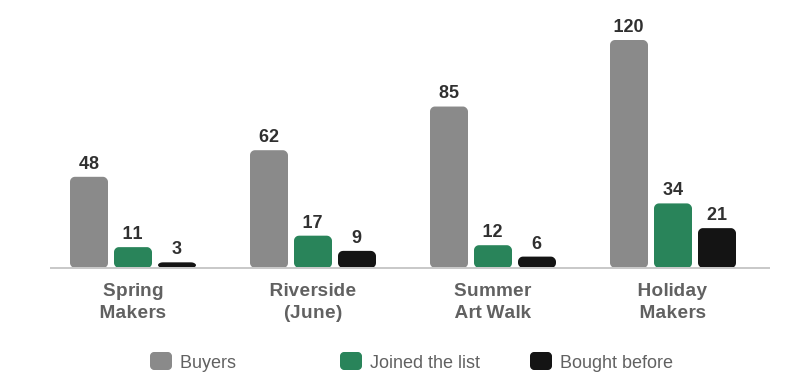
Track a few numbers per market in a simple table. Example numbers:
| Market | Buyers | Signups | Signup rate | "Bought before?" yes | Code uses after |
|---|---|---|---|---|---|
| Spring Makers Market | 48 | 11 | 23% | 3 | 2 |
| Riverside Market (June) | 62 | 17 | 27% | 9 | 3 |
| Summer Art Walk | 85 | 12 | 14% | 6 | 1 |
| Holiday Makers Market | 120 | 34 | 28% | 21 | 5 |
Where the numbers come from:
- Buyers: the number of orders for that market in your POS. Our guide to tracking craft fair sales in Shopify POS shows how to pull one market's orders.
- Signups: count the sheet or the form entries tagged with that market.
- "Bought from me before?" Ask it casually at checkout and keep a tally. It's rough, but it shows the trend.
- Code uses: from your website's order reports.
In the example, the holiday market sends the most returning buyers, and the summer art walk has a low signup rate, maybe because it's a tourist crowd that won't be back. That's useful when you decide what to rebook: a market with modest sales but many returning customers may be worth more than its numbers suggest. Put each market's sales and costs into the free craft fair profit calculator, and keep the repeat-customer numbers next to the profit. Our guide on how to sell at craft fairs shows where this fits in the full loop, from choosing markets to deciding what to rebook.
FAQ
How do I get people to sign up for my email list at a craft fair?
Give them a reason (your schedule, first look at new work, a restock alert), ask at checkout while bagging, and offer a clipboard or a QR code for people who prefer to type. Note which market each signup came from.
Can I email customers I met at a craft fair?
Ask them first, and follow the FTC's CAN-SPAM rules for commercial email: a valid physical postal address, a clear way to opt out, opt-outs honored within 10 business days, and honest subject lines.
Can I text customers from a craft fair?
Only with the right consent. The FCC requires prior express written consent for autodialed marketing texts, with limited exceptions. Use a texting service that records consent and handles opt-outs, and ask a professional if you're unsure.
How often should I email craft fair customers?
For most makers, one email after a market and one before the next one is enough. Keep each one short and useful: what's new, what's back and where you'll be.