Artist Alley Display: How to Set Up a Convention Table That Sells
An artist alley display has to do a lot on very little space: one table, a crowded aisle, thousands of people walking past, and a few seconds to make someone stop. It also has rules a craft fair booth usually doesn't, like height limits and "nothing past the edge of your table." This guide covers what an artist alley table usually includes (with real rules from a few conventions), how to build up instead of out, print bins, signs and bundles, taking payments in a packed hall, how much stock to bring for a multi-day con, and a full example budget so you know whether the weekend paid off.
What you're working with: the table and the rules
Every convention sets its own rules, so read your con's artist alley packet or FAQ before you buy anything. Here's what a few conventions publish, as examples of how much they vary:
| Convention | Table | Display rules |
|---|---|---|
| Sakura-Con | 2.5 ft by 8 ft, with a tablecloth and skirt | Displays up to 4 ft high on the table and 8 ft on the floor; one table per artist, no extra tables |
| Anime Weekend Atlanta | Six-foot table | Displays up to 8 ft from the floor, strictly enforced; no wider than the table including supports; backdrops no more than 2 ft behind the table |
| Anime Expo | (see the con's packet) | Leave an opening of at least 2 square feet so staff and attendees can see you; displays can't extend past the edges of your table; stands must be fixed to the table and can't encroach on neighbors |
| MTAC | One 6-foot table, two chairs and two exhibitor badges in the table package | Someone with an exhibitor badge must be at the table at all times |
(Rules summarized from each convention's own pages, checked in November 2026. They change from year to year.)
Three things show up again and again: a 6- or 8-foot table, a height limit measured from the floor or from the tabletop, and a rule that your display stays inside your own table space. Design for those three and you'll pass at most shows.
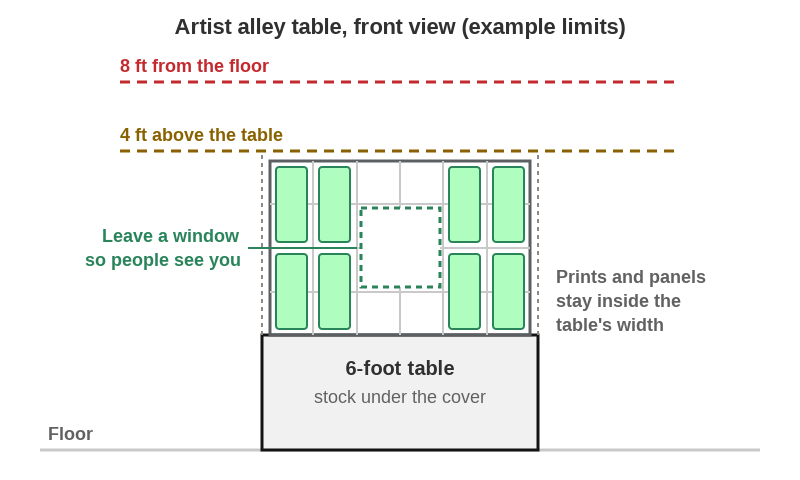
Build up, not out
On a 6-foot table, the flat surface fills up fast. Height gives you more display without breaking the "inside your table" rule:
- Grid wall panels zip-tied into a back wall or an A-frame, with prints in clear sleeves clipped on. Keep the frame within the table's width and under the height limit, and make sure it's stable on its own; a crowded aisle bumps tables all day.
- Tiered risers for small items (pins, charms, stickers), so they sit at different heights and nothing hides behind something else.
- Small easels for your best prints at eye level.
- A window. Anime Expo's rule about leaving an opening to see you is good advice everywhere: people buy from artists they can see and talk to. A solid wall of prints with you hidden behind it reads as "closed."
If your con allows floor displays or a backdrop behind the table, use that space for your biggest pieces and your name, which should be readable from down the aisle. Our guide to vendor booth signs covers letter sizes and wording.
Prints: bins, a sample book and a short wall
Prints are the core of many artist alley tables, and the way you show them changes how people shop:
- A short wall of your best 10 to 20 prints, one of each, at eye level. This is your shop window.
- Browse bins on the table, with prints in sleeves, sorted by size or by fandom with tabbed dividers. People can flip through without asking.
- A sample book or binder for everything else, so shoppers can point and you pull from stock.
- Stock under the table, in labeled boxes by design, so you can restock in seconds.
Keep the front edge of the table for the things people pick up: small items, the bundle sign, the payment sign. Our guide to craft fair display ideas explains planning a 6-foot table in rows and zones, and the same idea works on an artist alley table.
Prices and bundles people can read in two seconds
In a packed aisle, nobody stops to ask what a print costs. Make it obvious:
- One price per size, on a sign at the front: "Small prints $10, large prints $25."
- Bundles on their own sign: "3 small prints for $25" or "any 4 stickers for $10." Bundles raise the average sale without making each item cheaper to make.
- A small sign with how to pay, so people have their card or phone ready.
Run your bundle math once before the con: if a small print costs you $2 to make and sells for $10, three for $25 still leaves $19 after product cost. Our guide on how to price items for a craft fair works through cost, labor and bundles.
Payments in a crowded hall
Convention halls are full of phones fighting for the same signal. Plan for it:
- Set up offline card payments before the con, if your card reader app supports them, and understand the limits and risks first. Our comparison of the best card reader for craft fairs covers which systems offer offline payments and what happens if one is declined later.
- Bring a power bank, and keep the reader and phone charging under the table between rushes.
- Keep a small cash float for people who'd rather pay cash.
- Put a QR code or handle for payment apps on the payment sign if you accept them, and record those sales so they show up in your totals.
How much stock for a multi-day con
A three-day convention isn't three copies of one day. Many shows have a slower first day, a busy middle day and a shorter last day, so split your target by day and stock for the busiest one (use your own past sales to set the split). Our guide to multi-day craft show goals shows how, and how much inventory to bring to a craft fair works it out product by product.
A practical rule for prints: bring more of your proven designs than your new ones, and restock the wall from under the table as things sell. An empty spot on your wall on Saturday afternoon is a print you could have sold.
Example budget: did the con pay off?
Conventions often cost more to attend than a local craft fair, because of the hotel and travel. Here's a three-day con with made-up numbers:
| Amount | |
|---|---|
| Sales (prints, stickers, charms) | $2,400 |
| Product costs (about 25% of sales) | $600 |
| Card fees (about 2.6% + 10¢ on $1,920 in card sales) | $60 |
| Artist alley table | $300 |
| Hotel, 3 nights | $540 |
| Gas and parking | $60 |
| Food | $90 |
| Profit | $750 |
| Hours (travel, setup, 3 days at the table, teardown) | 36 |
| Profit per hour | about $21 |
Sales were 8 times the table fee, but the hotel turns the picture around: event costs (table, hotel, gas, food) are 41% of sales. Share the room with another artist and the hotel drops to $270, profit rises to $1,020 and the hourly number to about $28. Small changes in the big costs matter more than one more sale.
Put your own numbers into the free craft fair profit calculator after each con; it works for conventions just as well as for craft fairs. Our guide on how to calculate craft fair profit explains every line.
Before you leave home
- Read the con's artist alley rules one more time: height, width, backdrops, what's provided.
- Set up the full display on a table at home, measure it, and take a photo.
- Pack the display pieces, clips and zip ties in one bin, and stock by design in labeled boxes.
- Charge the card reader and power bank, and test a sale.
Our printable craft fair checklist has the rest of the list.
FAQ
How tall can an artist alley display be?
It depends on the convention. Some publish an on-table limit and a from-the-floor limit; Sakura-Con, for example, lists 4 feet on the table and 8 feet on the floor, and Anime Weekend Atlanta caps displays at 8 feet from the floor. Check your con's rules before you build.
What size is an artist alley table?
Many conventions use 6-foot tables, and some use 8-foot ones. MTAC's table package, for example, includes one 6-foot table and two chairs, while Sakura-Con lists 2.5 by 8 foot tables. Your con's packet has the exact size.
How do I make my artist alley table stand out?
Build height inside the rules with grid panels or easels, show your best 10 to 20 prints at eye level, keep a window so people can see you, and use big, simple price and bundle signs. Your name should be readable from down the aisle.
Is an artist alley table worth it?
Work it out after the con: sales minus product costs, card fees, the table, hotel, travel and food, divided by your hours. Hotel and travel often decide it, so sharing a room or choosing closer cons can change the answer.