Business Cards for Handmade Crafts: What to Print, How Many
Business cards for handmade crafts do a different job than cards for an office. Nobody at a craft fair is going to call you about a meeting. The card is read later, at home, by someone who liked your mugs and wants to find you again, often weeks after the market. That changes what belongs on it, how many you need, and how you tell whether they're worth printing. This guide covers what to put on each side, size and QR code tips, how many to bring per market (with the math), what they cost per customer, and a simple way to see whether cards actually bring people back.
What a market business card is for
A card at your booth has three jobs:
- Help people remember you. Your name and what you make, so the card makes sense in a drawer next to ten others from the same fair.
- Help people find you online. Your website or shop, so a "maybe later" can become an order.
- Help people find you in person again. Where you'll be next, so a fan can come to your next market.
Most cards are read away from the booth, without you there to explain. If a stranger can't tell from the card alone what you make and where to buy it, it isn't doing its job.
What to put on each side
Keep each side to one purpose: the front says who you are, the back says how to find you again.
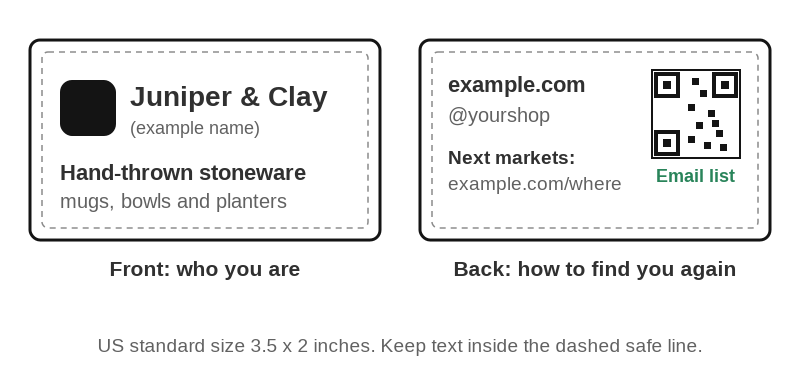
| Side | What to include | What to skip |
|---|---|---|
| Front | Shop name, a small logo or mark, what you make in a few words | A long tagline, every product you've ever made |
| Back | Website or shop link, one social handle, a link or QR code to your email list, where you'll be next | Five social platforms, your home address, dates you'll outgrow |
What you make, in a few words
"Juniper & Clay" means nothing to someone who met you once. "Juniper & Clay, hand-thrown stoneware mugs and bowls" does. Use the words a customer would use, not your studio's name for a collection.
One link that will still work in a year
Pick the address you'll keep longest: your own website, or your shop page if that's where people buy. A short address is easier to type from a card than a long marketplace link. If you have a website, a simple path like example.com/hello is easy to read and, as we'll see below, easy to measure.
Where you'll be next, without printing dates
Printed market dates go stale fast, and then the whole box of cards is out of date. Instead, print a link to a page you keep updated, like example.com/where. Some makers also leave a small blank area on the back and stamp or write the next market by hand.
A QR code, if it goes somewhere useful
A QR code that opens your email signup or your "where we'll be next" page is useful. One that opens your homepage adds little, because people can type that. One QR code guide recommends codes of at least 2 x 2 cm (about 0.8 inch) for close-up scanning. Use dark on light, keep the link short so the code stays simple, and test the printed card with two different phones before you order a full box.
Size and legibility
The standard US business card is 3.5 by 2 inches. Print files usually include a little extra around the edge (the bleed) that gets trimmed, and a safe area inside it; that same guide lists the safe area as 3.36 by 1.86 inches. Keep all text inside it, so nothing gets cut off.
A few practical checks before you order:
- Print one on your home printer at actual size and read it at arm's length. If you squint, the text is too small.
- Check contrast in dim light. Light gray on cream looks elegant on screen and disappears in a dim church hall.
- Leave room to write. A matte back lets you jot down a custom order or a discount code by hand; a glossy one often doesn't take pen well.
The same size also works as a hang tag or a product card if you punch a hole in it, which brings us to the most useful place for a card.
The best place for a card: in the bag
A card in a holder at the front of the table is for browsers. A card in every bag reaches the people who already bought from you, which is exactly who you want back. Two simple habits:
- One card in every bag, every sale, cash or card. Put a stack next to your bags so it becomes automatic.
- A reason to keep it. Care instructions on the back for things like ceramics, candles or wood, or a line like "Join the list for first pick of new pieces." A card that's useful stays on the fridge.
Package inserts and hang tags can do the same job. If you already print hang tags with prices, put your shop link on the back and you have a card on every product.
How many business cards to bring to a craft fair
Work it out from expected buyers, plus browsers who take one. An example for a one-day market:
| Example | |
|---|---|
| Expected sales | $900 |
| Average sale | $30 |
| Expected buyers (one card each in the bag) | 30 |
| Browsers who take a card from the holder | 40 |
| Subtotal | 70 |
| Buffer (about 40%) | 30 |
| Cards to bring | 100 |
The browser number is your guess at first; count what's left after a few markets and adjust. If you run out at noon, the card was working and you brought too few. If 80 come home every time, bring fewer and stop worrying about it.
For a season of 12 markets like this one, that's about 1,200 cards. Our printable craft fair checklist has a line for cards so they don't get left in the car.
What cards cost per customer
Cards are cheap per piece, but they're still a cost of doing markets. Count them with your packaging. An example with made-up prices:
| Example | |
|---|---|
| 500 cards | $40.00 |
| Cost per card | $0.08 |
| Cards used at one market | 100 |
| Card cost per market | $8.00 |
| As a share of $900 in sales | 0.9% |
So at this market, cards cost less than 1% of sales. Put them on the "bags, labels and packaging" line in our craft fair expenses checklist, and they'll show up in the market's profit when you run the numbers in the free craft fair profit calculator.
The more interesting number is what they bring back. If, say, three people per market find your shop through the card and each spends $35, that's $105 in sales from $8 of cards. You won't know that number unless you measure it.
How to tell whether your cards bring people back
You can't track a card in someone's drawer, but you can track what they do with it. Three ways, from simplest to most precise:
- A link only the card uses. Print example.com/hello (or a QR code to it) and nowhere else. Every visit to that page came from a card. Most website and shop platforms show visits per page.
- A code only the card has. "Use HELLO10 for 10% off your first online order." Every order with that code came from a card. Keep the discount small enough that it doesn't eat the profit on the order.
- Ask. At checkout, at your next market, ask returning customers how they found you again, and tally the answers.
Then keep one row per market:
| Market | Cards handed out | Visits to /hello | Code orders | Sales from code |
|---|---|---|---|---|
| Spring Makers (example) | 95 | 14 | 2 | $68 |
| Riverside Market (example) | 60 | 5 | 1 | $32 |
| Holiday Makers (example) | 140 | 31 | 6 | $214 |
(Example numbers to show the method.) Over a few markets you'll see which events produce customers who come back, which is a different question from which events sell the most on the day. Our guide on how to get repeat customers from craft fairs covers email lists and follow-ups, and the card is often where those start.
Common mistakes
- A card that only has your shop name. Add what you make.
- Every social platform you use. Pick one, the one you actually post on.
- Printed market dates. Link to a page you update instead.
- A QR code that's too small or never tested. Test the printed card before ordering hundreds.
- Cards only in a holder at the front. The bag is where they matter most.
- No way to measure them. One dedicated link or code is enough.
Your signs and your card should match: same name, same words for what you make. Our guide to vendor booth signs covers the name banner and the email signup sign that go with it.
FAQ
What should a business card for handmade crafts say?
Your shop name and what you make on the front. Your website or shop link, one social handle, and a link or QR code to your email list or upcoming markets on the back. Skip printed dates and long product lists.
What size is a standard business card in the US?
3.5 by 2 inches. Printers usually ask for a slightly larger file with bleed and a smaller safe area for text, so check the template before you design.
Should I put a QR code on my craft business card?
Yes, if it opens something useful, like your email signup or a page with your next markets. Keep it large enough to scan up close (one guide suggests at least about 0.8 inch square) and test it on the printed card.
How many business cards should I bring to a craft fair?
Add your expected number of buyers (one card per bag) to the browsers you expect to take one, then add a buffer. For a market with about 30 buyers, around 100 cards is a reasonable start; adjust after you see how many come home.