Questions to Ask Before Booking a Craft Fair: A Vendor Checklist
The best time to find out a market isn't worth it is before you pay for it. Booth fees are usually due months ahead and application fees are rarely refunded, so a few questions to ask before booking a craft fair can save you a whole weekend and a few hundred dollars. Vendors we talked to in craft fair groups bring this up again and again: the shows that disappointed them were the ones they booked without asking. Here's the list we'd use, grouped by what each answer tells you, plus an email you can copy and send to any organizer.
Why ask before you book
A craft fair has three things you can't fix once you're there: who walks in, who else is selling, and what it costs you to be in the room. Everything below is about those three things. Organizers who run good events usually answer these questions quickly and without fuss. The ones who can't or won't are telling you something too.
Questions about the crowd
These tell you whether enough of the right people will walk past your booth.
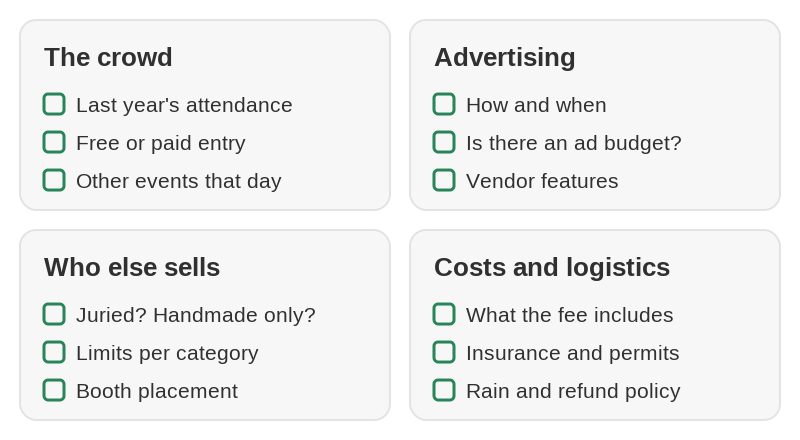
- How many people came last year, and how do you count them? Ticket sales or a door clicker are real numbers. "We expect thousands" is a guess.
- Is admission free or paid? Paid events tend to bring shoppers who came to buy. Free events bring more foot traffic, including people who are just strolling.
- What are the hours, and when is it busiest? A six-hour market with a two-hour rush is a different day from a steady one.
- Is anything else happening that weekend? A big festival or game across town can pull your crowd away.
- How many years has the event run? A tenth edition has a following. A first edition is a gamble, which can still be worth it if the booth fee is low.
Questions about advertising
A great venue with no promotion is an empty room. Ask:
- How do you promote the event, and when does it start? Social media, local press, posters, radio, an email list, paid ads.
- Do you have a budget for ads? You don't need the number, just whether there is one.
- Do you feature vendors? Some organizers post each vendor on social media before the show, which helps both of you.
- Is there signage on the day? People find markets by driving past a banner more often than you'd think.
If the only answer is "we'll post on Facebook," weigh the booth fee with that in mind.
Questions about who else is selling
This is where juried shows and category limits come in.
What is a juried craft show?
A juried craft show is one where a jury (the organizer, a committee or invited artists) reviews every application before accepting a vendor. You usually send photos of your work and your booth, a short description and sometimes a jury fee. The jury looks at quality, originality and whether the work is really handmade. Our craft fair vendor application guide covers the photos and description in detail.
For vendors, a juried show usually means fewer resellers selling mass-produced items next to you, and shoppers who expect handmade prices. It can also mean higher booth fees and a non-refundable jury fee, so run the numbers first with the booth fee rules vendors use.
Questions to ask about curation
- Is the show juried, and who is on the jury?
- Is it handmade only? How is that checked? A rule nobody enforces isn't a rule. Ask what happens when someone is caught reselling.
- Do you limit vendors per category? If you sell candles, it matters whether you're one of two candle makers or one of nine. Many organizers cap categories like jewelry, candles and soap.
- Who decides booth placement? Ask whether you can request a spot, whether returning vendors keep theirs, and whether your category will be spread out or grouped.
- Are there direct sales or food trucks? Neither is bad, but you should know the mix.
Questions about costs and logistics
These are the answers that end up in your profit math. Write them down; you'll need them for the craft fair expenses checklist.
- What's included in the booth fee? Size, table, chairs, tent, electricity, Wi-Fi.
- Is there an application or jury fee, and is it refundable?
- Is electricity extra? Lights help at evening and indoor markets.
- Do I need my own tent, and are weights required? Outdoor shows often require weights per leg.
- When can I load in and out, and how close can I park?
- Is liability insurance required? Some organizers require proof of a policy naming them.
- Do I need a sales tax permit for this event? Rules vary by state and sometimes by city. Ask the organizer what they've seen, then confirm with the state's department of revenue or an accountant.
- What's the rain and cancellation policy? Is the event rain or shine? Do you get a refund or credit if it's cancelled?
Red flags
None of these is an automatic no, but each one is worth a second look:
- No numbers from last year, or numbers that change every time you ask.
- No answer about advertising beyond "social media."
- "Handmade only" with no way of checking.
- No category limits at a show that's mostly jewelry or candles already.
- A high booth fee for a first-time event.
- Non-refundable fees with no rain policy for an outdoor show.
A copy-paste email for organizers
Most organizers appreciate a short, specific email. Feel free to copy this one:
Hi! I make handmade candles and ceramics and I'm thinking about applying to your fair. Before I do, could you tell me: about how many shoppers came last year and how you counted them, how you'll promote this year's event, whether the show is juried and handmade only, how many vendors you accept in my category, and what the booth fee includes? Thanks so much!
Keep the answers with the market's other notes. If the fair turns out well or badly, you'll know which answers predicted it.
After the market: check the answers
The questions matter most the second time around. After the fair, compare what the organizer told you with what happened: Was the crowd the size they said? Did you see the ads? Were there four other candle makers? Then work out the real profit with the free craft fair profit calculator and save it with your notes. A year from now, comparing the same market year over year is much easier when both years have numbers and notes.
FAQ
What is a juried craft show?
A juried craft show reviews every vendor's application, usually photos of the work and booth, before accepting them. The goal is quality and genuinely handmade work. Juried shows often charge a jury fee and higher booth fees.
Are juried craft shows worth the higher booth fee?
They can be, because shoppers expect handmade prices and there are fewer resellers. Check the fee against your expected sales: at the common 10x rule, a $300 booth needs about $3,000 in sales.
How do I find out how many people attend a craft fair?
Ask the organizer for last year's attendance and how it was counted. Ticketed events and door counts are the most reliable. Vendors who did the show before are also worth asking.
What if the organizer won't answer my questions?
Treat it as information. A good event usually has the answers ready. If you still want to try it, keep your expectations and your spending low for the first year.