Square vs Shopify POS for Craft Fairs: Fees, Offline and Fit
Square vs Shopify POS is one of the first choices a craft fair vendor makes, and it's easy to get lost in feature lists. For a maker who sells at markets, four things matter most: what each card sale costs, what you pay every month whether you sell or not, what happens when the signal drops, and whether your booth and your online shop share one inventory. This guide compares those four with sourced numbers (checked in November 2026) and a full weekend example.
A disclosure first: BoothVerdict, the app behind this blog, is being built for sellers who use Shopify POS. We've kept this comparison to published prices and documented features, linked below, so you can check every number yourself. Prices change, so confirm them on each company's site before you decide.
The short version
- You only sell in person, or barely online: Square's Free plan has no monthly fee, which is hard to beat for a few markets a year.
- You already sell online with Shopify: Shopify POS is included with your plan, uses the same products and inventory as your online store, and its in-person card rate is a few cents lower per sale.
- Card fees alone rarely decide it. The per-sale difference is small. The monthly plan cost and how you run the rest of your business matter more.
Card fees per sale
| Square (Free plan) | Shopify (Basic plan) | |
|---|---|---|
| In-person card rate | 2.6% + 15¢ | 2.6% + 10¢ |
| Source | Square pricing | Shopify pricing |
Both companies have higher plans with lower rates. Square lists Plus ($49 a month per location) at 2.5% + 15¢ and Premium ($149) at 2.4% + 15¢. Shopify lists Grow at 2.5% + 10¢ and Advanced at 2.4% + 10¢. Shopify's in-person rates apply when you use Shopify Payments. For most craft fair vendors, the entry plans are the fair comparison.
Because both charge a percentage plus a fixed amount, the fixed part hits small sales hardest:
| Sale | Square fee | Square % | Shopify Basic fee | Shopify % |
|---|---|---|---|---|
| $5 | $0.28 | 5.6% | $0.23 | 4.6% |
| $15 | $0.54 | 3.6% | $0.49 | 3.3% |
| $30 | $0.93 | 3.1% | $0.88 | 2.9% |
| $60 | $1.71 | 2.9% | $1.66 | 2.8% |
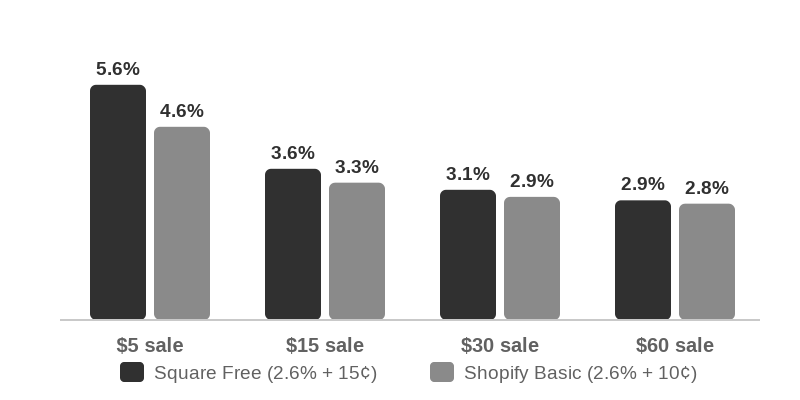
If you sell lots of $5 stickers on cards, either way the fixed part is a real cost. A card minimum or bundles help, as we explain in how to price items for a craft fair.
A full weekend: what the difference adds up to
A two-day fair with 70 card sales totaling $2,100 (about $30 each):
| Square (Free) | Shopify (Basic) | |
|---|---|---|
| Percentage part (2.6% of $2,100) | $54.60 | $54.60 |
| Fixed part (70 sales) | $10.50 | $7.00 |
| Card fees for the weekend | $65.10 | $61.60 |
The difference is $3.50 for the weekend. Over 12 markets like this, about $42 a year.
Monthly costs: where the real difference is
- Square Free plan: $0 a month.
- Shopify: POS for casual in-person selling is included in every plan, but you need a Shopify plan. Basic is listed at $39 a month billed monthly, or $29 a month billed yearly. POS Pro, with staff roles and more inventory tools, is $89 a month per location on top.
So if you don't sell online with Shopify, a Shopify plan just for markets costs about $348 to $468 a year, far more than the $42 saved on card fees. If you already pay for Shopify to run your online store, POS costs nothing extra at the casual level, and the comparison flips toward keeping everything in one place.
Offline payments: read the fine print on both
Fairgrounds, church halls and parks often have weak signal. Both systems can take card payments offline, with conditions, and on both the risk is yours:
- Square: you turn on offline mode, and payments upload when you reconnect. Square's help center says you're responsible for any expired, declined or disputed payments taken offline, and it recommends uploading within 24 hours.
- Shopify POS: you activate offline payments in the admin, set a daily limit and a per-transaction limit, and use a compatible reader. Shopify notes that swipe, Tap to Pay and manual card entry aren't supported offline, and that you might not know a payment failed until you reconnect.
Practical tips for either: set a modest per-sale limit for offline payments, collect an email or phone number on big offline sales, bring a hotspot, and reconnect as soon as you can.
Card readers
Shopify lists its Tap & Chip Card Reader at $49, and Tap to Pay on iPhone is available on every plan at the normal in-person rates. Square sells its own readers too; check its hardware page for current prices and phone tap options. For a first market, either company's small reader plus your phone is enough.
Inventory, products and reports
This is where your existing setup matters most:
- One inventory. If you sell the same products online and at markets, Shopify POS uses the same product list and stock counts as your Shopify store. Sell the last blue mug at the fair and it's sold out online too. With separate systems, you update counts by hand or with an integration.
- Reports by market. Neither system has a built-in "craft fair" or "event," so you separate markets by date and location. Our guide to tracking craft fair sales in Shopify POS shows how with Shopify; the same idea (date range plus location or device) works with most POS systems.
- Payment apps. If customers pay by Venmo, Zelle or Cash App, record those sales in your POS so they show up in your totals. Shopify lets you add custom payment types for this; check how your system handles them.
Whichever you choose, neither one tells you whether the market was worth it after the booth fee, gas and food. That part you do yourself, in the free craft fair profit calculator or with our guide on how to calculate craft fair profit.
Which should you choose?
| Your situation | Usually the better fit |
|---|---|
| Only markets, no online store | Square (no monthly fee) |
| A few markets, online sales on Etsy or elsewhere | Square, unless you plan to move your shop |
| Online store on Shopify, plus markets | Shopify POS (one inventory, included) |
| Many markets, high card volume, already on Shopify | Shopify POS; compare higher plans' rates |
| Weak signal at most markets | Either, with offline mode set up and tested at home |
Whatever you pick, test it at home the night before: a real card, a refund, and offline mode with Wi-Fi turned off.
FAQ
Is Square or Shopify POS cheaper for craft fairs?
Per card sale, Shopify's Basic in-person rate (2.6% + 10¢) is 5 cents cheaper than Square's Free plan (2.6% + 15¢). But Square's Free plan has no monthly fee, while Shopify requires a paid plan. If you don't already pay for Shopify, Square is usually cheaper overall.
Can I use Shopify POS without an online store?
You need a paid Shopify plan to use Shopify POS. If you only sell in person, compare the plan's monthly cost with the card fees you'd save.
Do Square and Shopify POS work offline at craft fairs?
Both can accept card payments offline with conditions and limits, and on both you carry the risk if an offline payment is later declined. Turn it on and test it before the market.
Which card reader is best for craft fairs?
The one that works with your POS and your phone, holds a charge all day, and takes tap and chip payments. A small Bluetooth reader is enough for most booths; bring a power bank.