SumUp vs Square for Craft Fairs: Fees, Readers and Payouts
SumUp vs Square is a common question for makers who sell at craft fairs and markets and don't run their shop on a big ecommerce platform. Both let you take cards with a small reader and your phone, both have a free plan with no monthly fee, and both charge a percentage plus a few cents per sale. The differences are in the details: the fixed cents per sale, what the reader costs, how fast the money reaches your bank, and what happens when the signal drops. This guide compares those with numbers from each company's own US pages, checked in November 2026, and works through a full weekend.
Prices and features change, so confirm them on the linked pages before you decide.
The short version
- Per sale, SumUp's US in-person rate (2.6% + 10¢) is 5 cents cheaper than Square's Free plan (2.6% + 15¢).
- Up front, SumUp's Solo reader ($99) costs $40 more than Square's reader ($59).
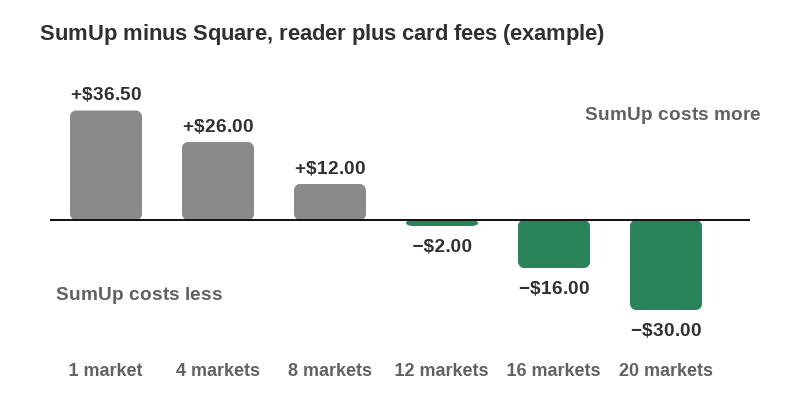
- Over a season, the 5 cents per sale add up. With 70 card sales per market, SumUp catches up on the reader price after about a dozen markets.
- Offline payments are documented for Square sellers; on SumUp they're described as a limited pilot, so ask SumUp before you count on them.
- If you already sell online with Shopify, compare Square vs Shopify POS for craft fairs instead, since one inventory may matter more than the card rate.
Card fees per sale
| SumUp (standard, no monthly fee) | Square (Free plan) | |
|---|---|---|
| In-person card rate | 2.6% + 10¢ | 2.6% + 15¢ |
| Keyed-in card | 3.5% + 15¢ | 3.5% + 15¢ |
| Monthly fee | $0 | $0 |
| Source | SumUp US pricing | Square pricing |
Both have paid plans. SumUp lists a POS plan at $49 a month with the same per-transaction fee; Square lists Plus at $49 a month per location (2.5% + 15¢) and Premium at $149 (2.4% + 15¢). For most makers doing a few markets a month, the free plans are the fair comparison.
Because the percentage is the same, the whole difference per sale is the fixed part: 10 cents versus 15 cents. That matters most on small sales:
| Sale | SumUp fee | Square fee | Difference |
|---|---|---|---|
| $5 | $0.23 | $0.28 | $0.05 |
| $15 | $0.49 | $0.54 | $0.05 |
| $30 | $0.88 | $0.93 | $0.05 |
| $60 | $1.66 | $1.71 | $0.05 |
A full weekend: what the difference adds up to
A two-day fair with 70 card sales totaling $2,100 (about $30 each), the same example we use in our Square vs Shopify comparison:
| SumUp | Square (Free) | |
|---|---|---|
| Percentage part (2.6% of $2,100) | $54.60 | $54.60 |
| Fixed part (70 sales) | $7.00 | $10.50 |
| Card fees for the weekend | $61.60 | $65.10 |
That's $3.50 for the weekend. Not much on its own, but it repeats at every market.
Reader prices: when the cheaper fee catches up
| Reader | Price | Source | |
|---|---|---|---|
| SumUp | Solo | $99 | SumUp US help center |
| Square | Reader for contactless and chip (2nd generation) | $59 | Square Shop |
SumUp starts $40 behind and gains $3.50 per weekend like the example. $40 ÷ $3.50 is about 11.4, so from the 12th market of that size, SumUp has cost you less in total. With fewer card sales per market, it takes longer; with more, it's faster.
If you'd rather not buy a reader at all, both companies let you take tap payments on a phone. SumUp's Tap to Pay page lists 2.6% + 10¢ for iPhone and Android with its free app, and Square's reader page offers Tap to Pay on iPhone with no hardware. A phone alone can't read chip cards that don't tap, though, so many vendors keep a reader anyway.
Getting paid
Money in your account by Monday matters when you've just paid for a booth, gas and stock.
- Square: card payments taken before 5 p.m. Pacific are available the next business day at no cost; later payments arrive by the second business day. Instant transfers are available for a 1.95% fee per transfer.
- SumUp: the US help center lists free next-day payouts into a SumUp Business Account for eligible card payments, and 1 to 2 business days for transfers to another bank account.
If you'd use a SumUp Business Account, the payout speed is similar. If you want money in your existing bank, Square's next business day is a little faster than SumUp's 1 to 2 days.
Offline payments
Weak signal at fairgrounds and church halls is normal, so check this before you choose.
- Square documents an offline mode. Its help center says you're responsible for any expired, declined or disputed payments taken offline and recommends uploading them within 24 hours.
- SumUp describes offline transactions on the Solo in its developer documentation as not enabled by default, with the merchant carrying the risk of payments declined later. Its help center calls the feature a pilot for a limited number of merchants. Ask SumUp whether it's available on your account before relying on it.
Whatever you use, bring a phone hotspot, set a modest limit for offline sales, and take an email or phone number on big offline payments.
Items, stock and reports
For a craft fair, you mostly need to ring up items quickly and see what sold afterward.
- Square's Free plan includes an item library and basic inventory, and its reports break sales down by item. That covers a product-by-product count after each market. More detailed inventory reports are on paid plans.
- SumUp lists barcode scanning, preset discounts and other advanced features in its $49-a-month POS plan, according to its Tap to Pay page. Check which item and reporting features the free app includes for the way you sell.
Either way, the app tells you sales, not profit. After a market you still subtract the booth fee, gas, food and product costs. The free craft fair profit calculator does it in a minute, and our guide to what sells best at craft fairs shows how to use the item counts.
Which one fits you
| Your situation | Leans toward |
|---|---|
| A few markets a year, small number of card sales | Square (cheaper reader, documented offline mode) |
| Many markets, lots of card sales | SumUp (5 cents less per sale adds up) |
| Lots of tiny sales ($5 stickers, cards) | SumUp, or a card minimum with either |
| Weak signal at most markets | Square, unless SumUp confirms offline payments on your account |
| You also sell online with Shopify | Compare Square vs Shopify POS |
Whichever you pick, test it at home before the first market: a real card sale and refund, a tap payment, and offline mode with Wi-Fi turned off. Our printable craft fair checklist has the rest of the payment list. And if small sales make up most of your day, our guide on how to price items for a craft fair shows how bundles and a card minimum keep fees down.
FAQ
Is SumUp cheaper than Square?
Per in-person card sale, yes: SumUp's US rate is 2.6% + 10¢ and Square's Free plan is 2.6% + 15¢, both checked in November 2026. But SumUp's Solo reader costs $99 against Square's $59, so with 70 card sales per market, SumUp only comes out ahead after about 12 markets.
Do SumUp and Square charge a monthly fee?
Neither charges one on its standard plan. Both offer paid plans with extra features, listed at $49 a month on each company's US pages.
Can SumUp and Square take payments without internet?
Square documents an offline mode, with the seller responsible for payments that are later declined. SumUp describes offline payments on the Solo as a limited pilot that isn't on by default, so check with SumUp first.
Which is better for craft fairs, SumUp or Square?
It depends on volume and signal. For a few markets a year, Square's cheaper reader and documented offline mode are hard to beat. For many markets with lots of card sales, SumUp's lower fixed fee per sale adds up over a season.