How Much Inventory to Bring to a Craft Fair (With a Formula)
How much inventory to bring to a craft fair is a question with two bad answers: "everything I have" (a car you can't see out of, a cluttered table, hours of packing) and "a bit of each" (selling out of your best item by noon). There's a better way that takes about fifteen minutes: start from a sales target, turn it into units, adjust each product by how it usually sells, and add a buffer where it pays. This guide walks through the method with a full example, then covers first markets with no history, multi-day shows, and what to do with what comes home.
Step 1: Set a sales target for the market
Everything starts from how much you expect, or need, to sell. Two good ways to set it:
- From the booth fee. Many vendors want sales of at least 10 times the booth fee. A $150 booth means a target of $1,500.
- From last year. If you did this market before, use last year's sales, adjusted for anything you know has changed.
If the two disagree, plan for the realistic one and use the other as a check on whether the market is worth it. Our guide is a craft fair worth it explains the 10x rule.
For the example below, the target is $1,500 for a one-day holiday market.
Step 2: Turn dollars into units, product by product
Split the target by how your sales usually divide between products. If you've tracked past markets, use those shares. If not, estimate.
Then divide each product's share of the target by its price to get units you expect to sell.
Step 3: Divide by sell-through to get units to bring
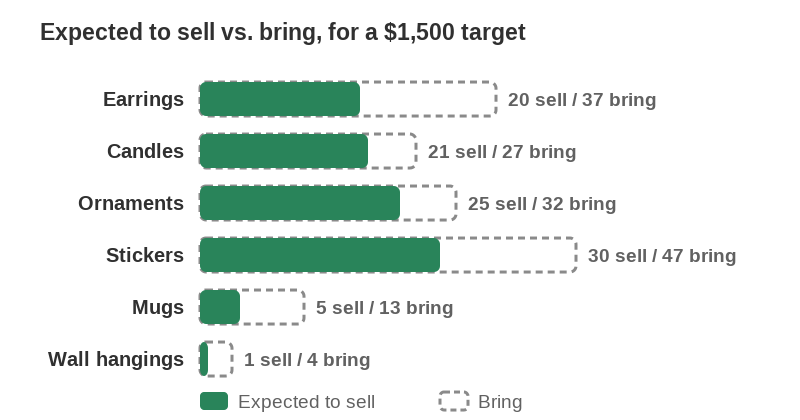
Sell-through is the share of what you bring that you sell. If earrings usually sell 55% of what you bring, and you expect to sell 20 pairs, bring about 20 ÷ 0.55 = 37 pairs.
This is the key step, and it's why "bring double" is only a rough guess. A product that sells 80% of what you bring needs a small cushion; a product that sells 40% needs a lot of extra stock just to sell the same number. Our guide to what sells best at craft fairs shows how to measure sell-through after each market.
A full example
Here's the whole calculation for the $1,500 holiday market. Shares, prices and sell-through rates are example numbers, the same products as in our product-ranking guide.
| Product | Price | Share of sales | Target $ | Expected to sell | Past sell-through | Bring |
|---|---|---|---|---|---|---|
| Earrings | $22 | 30% | $450 | 20 | 55% | 37 |
| Candles | $18 | 25% | $375 | 21 | 78% | 27 |
| Ornaments | $12 | 20% | $300 | 25 | 80% | 32 |
| Stickers | $4 | 8% | $120 | 30 | 64% | 47 |
| Mugs | $34 | 12% | $180 | 5 | 40% | 13 |
| Wall hangings | $85 | 5% | $75 | 1 | 13% | 4 (display limit) |
| Total | 100% | $1,500 | 102 | 160 |
Two adjustments the formula can't make for you:
- Display limits. One wall hanging at 13% sell-through would mean bringing eight, but the back wall only holds four. Bring what the display can show well.
- Minimum for a full display. A design with only two pieces looks like leftovers. Many vendors bring at least four to six of each design they show, even if the math says fewer.
Step 4: Add a buffer where it pays
Running out of a slow item costs you little. Running out of your best seller at 1 p.m. costs real sales. So add the buffer selectively:
- Stars (high sell-through and good profit per item): add 20% to 30%. In the example, earrings go from 37 to about 45.
- Traffic builders (cheap items that sell fast): add enough to keep the display full all day.
- Big pieces: no buffer. Bring what the display holds.
With the earrings buffer, the example comes to about 168 items. That's a car you can see out of and a table that still looks full in the afternoon.
Your first market: no history yet
Without past sales, use a simpler version:
- Target: 10 times the booth fee. Say the booth is $85, so the target is $850.
- Average item price: look at your prices and the mix you expect to sell. Say $20.
- Units you might sell: $850 ÷ $20 is about 43 items.
- Bring about double: roughly 85 to 90 items, spread across your designs, with at least four to six of each design you show.
Then count everything you bring and everything that comes home. After one market you'll have real sell-through rates, and the second market can use the full method. The printable craft fair checklist has a table for exactly this count.
Multi-day shows
For a two- or three-day show, plan the total for the whole show, then decide what goes on the table each day:
| Day | Share of the show's sales (example) | Target at $4,500 total |
|---|---|---|
| Friday | 25% | $1,125 |
| Saturday | 45% | $2,025 |
| Sunday | 30% | $1,350 |
- Bring the whole show's stock, but keep the reserve in labeled boxes under the table or in the car.
- Restock at the end of each day, using that day's sales. If something sold out on Friday, it will likely sell again on Saturday.
- Recheck the plan Saturday night. If you're far ahead or behind the daily target, move stock between products, not just more of everything.
Our guide to multi-day craft show goals explains how to set the daily split and track it during the show.
What to do with what comes home
Leftovers aren't a failure; they're data, and some of them are next market's stock.
- Count them the same night. Brought minus came home is what sold, product by product.
- Update sell-through for each product. That's your input for the next plan.
- Seasonal items like ornaments go into storage for next year, or into a clearly seasonal online listing.
- Don't discount your stars to avoid carrying them home. Discount only items you've decided to drop.
- Look for patterns over two or three markets of the same type before cutting a product.
Check the plan against the money
Inventory ties up money in materials and time. Before you make more stock for a market, check that the market can pay for it. With the target, the booth fee and your product costs, the free craft fair profit calculator shows the expected profit, and our guide on how to sell at craft fairs shows where inventory planning fits in the rest of the process.
FAQ
How much inventory should I bring to a craft fair?
Work it out per product: split your sales target by product, divide by price to get the units you expect to sell, then divide by each product's usual sell-through. Add 20% to 30% for your best sellers and respect what your display can hold.
How much inventory should I bring to my first craft fair?
Divide 10 times the booth fee by your average item price to get the number of items you might sell, then bring about double, with at least four to six of each design. Count what comes home to learn your real sell-through.
What is a good sell-through rate at a craft fair?
There's no standard. Many vendors are comfortable around 50% to 80% on their main products. Selling out early usually means you could have brought more or charged more.
Should I bring all my inventory to a craft fair?
Usually not. Bringing everything makes packing slow, the display cluttered and restocking harder. Bring what the plan says, plus a reserve of your best sellers.