Multi-Day Craft Show Goals: Per Day, Per Hour, Cash vs Card
A multi-day craft show is a different animal from a Saturday market. The booth fee covers all the days, but the hotel, the food and your energy are paid day by day, and the crowd is rarely the same on Friday afternoon as on Saturday at noon. If you only look at the weekend total, you'll miss the most useful information: which day carried the show, how much each hour was worth, and how much of it came in as cash. This guide shows how to set goals per day before the show and how to read the numbers after it, with a complete three-day example.
Start with a total goal, then split it by day
Begin with the same rule many vendors use for any market: sales should be at least 10 times the booth fee. (Some use 8x for big shows and 15x for small ones. Our guide on whether a craft fair is worth it covers the variations.)
For a three-day show with a $450 booth, 10x means a goal of $4,500 in sales.
Now split it by day. Don't divide by three: days at a multi-day show are usually uneven. A common pattern vendors describe is a lighter first day (often a weekday afternoon), a strong Saturday and a Sunday that slows down in the afternoon. If you've done the show before, use your own split. If not, start with something like this and adjust next year:
| Day | Hours open | Share of goal | Sales goal | Goal per hour |
|---|---|---|---|---|
| Friday, noon to 6 | 6 | 25% | $1,125 | $188 |
| Saturday, 9 to 6 | 9 | 45% | $2,025 | $225 |
| Sunday, 10 to 4 | 6 | 30% | $1,350 | $225 |
| Total | 21 | 100% | $4,500 | $214 |
Writing goals per day does two things. It tells you how much stock to bring for each day, and it gives you a check-in point every evening instead of a surprise on Sunday night.
Track each day separately
At the end of each day, write down five numbers. If you sell with Shopify POS, the date filter in the reports gives you the day's sales; our guide to tracking craft fair sales in Shopify POS shows where to find them.
- Sales for the day, all payment types.
- Number of transactions.
- Average sale (sales ÷ transactions).
- Sales per hour (sales ÷ hours open that day).
- Cash vs card (and payment apps).
Here's how the example show actually went:
| Day | Sales | Goal | Transactions | Average sale | Sales per hour | Cash |
|---|---|---|---|---|---|---|
| Friday | $860 | $1,125 | 37 | $23.24 | $143 | $190 |
| Saturday | $1,940 | $2,025 | 74 | $26.22 | $216 | $600 |
| Sunday | $1,180 | $1,350 | 45 | $26.22 | $197 | $210 |
| Total | $3,980 | $4,500 | 156 | $25.51 | $190 | $1,000 |
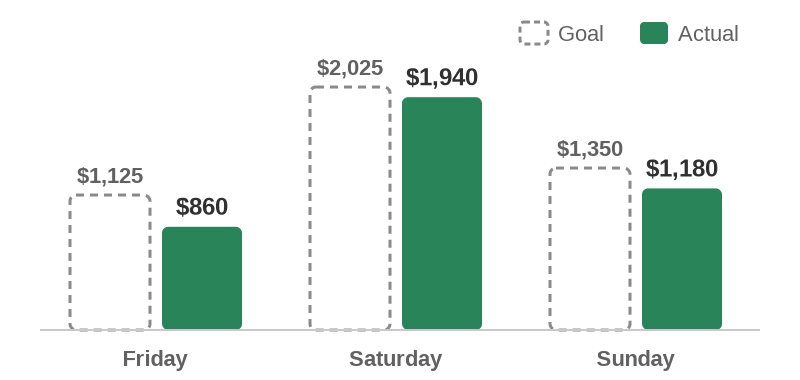
The show reached 88% of its goal ($3,980 of $4,500), an 8.8x booth fee multiple. Saturday nearly hit its number. Friday was the weak day by a wide margin: fewer transactions and a lower average sale. That's useful next year: maybe Friday deserves a smaller display and lower-priced items up front, or maybe the show is worth doing as Saturday and Sunday only if the organizer offers it.
Cash vs card: why the split matters
Out of $3,980, $1,000 came in as cash (25%) and $2,980 by card and payment apps. The split matters for three reasons:
- Change and float. If a quarter of your sales are cash, a busy Saturday needs plenty of small bills. Use last year's cash share to decide how much change to bring.
- Card fees. Fees only apply to card payments, so a higher cash share means lower fees. In this example, at about 3% of card sales, fees come to $89.40.
- Keeping every payment in one place. If you take Venmo or Zelle, record them as custom payment types in your POS, or log them the moment they arrive. The craft fair expenses checklist has a simple log for payments outside the card reader.
If you keep cash in a box, count it each evening and compare it with your records for the day. A small difference is normal. A big one is worth finding while you still remember the day.
The real cost of the extra days
Multi-day shows bring costs that a one-day market doesn't have. Here's the full list for the example show:
| Cost | Detail | Amount |
|---|---|---|
| Booth fee | Three days | $450.00 |
| Hotel | Two nights at $129 | $258.00 |
| Food | $25 a day | $75.00 |
| Gas | Round trip | $60.00 |
| Parking | $10 a day | $30.00 |
| Event costs | $873.00 |
Event costs were 22% of sales, above the 15% many vendors aim for. The hotel alone is more than half the booth fee. That's typical for shows far from home, and it's why some vendors share a room with another vendor or only take far-away shows with a strong history.
The full profit picture
| Line | Amount |
|---|---|
| Sales | $3,980.00 |
| Cost of products sold (30%) | −$1,194.00 |
| Card fees | −$89.40 |
| Event costs | −$873.00 |
| Profit | $1,823.60 |
Count the hours too: 21 hours selling, 4 hours of setup the day before, 2 hours of teardown and 5 hours of driving, 32 hours in all. That's about $57 an hour.
So the show missed its sales goal and its expense target, but the hourly pay is solid. Our craft fair profit guide explains each of these lines, and you can check your own show in the free craft fair profit calculator.
Adjusting during the show
The best thing about daily goals is that you can act on them before the show ends:
- After day one, compare sales with the day's goal and look at what sold. Move bestsellers to the front and restock them from your car or hotel room.
- If the average sale is low, add a bundle or a "two for" price on small items.
- If transactions are low, the issue may be visibility. Rearrange the front of the booth, add signage or ask the organizer about foot traffic.
- Plan breaks. A long Saturday alone is hard. If you bring a helper, add their pay to your costs, but count the extra sales you make when someone can cover the booth.
Bringing enough stock for each day
Divide each day's sales goal by your average sale to estimate items. With an average sale of about $25, Saturday's $2,025 goal means roughly 80 items, plus a buffer for the pieces that don't sell. Keep Saturday's extra stock in the car or the hotel so you can restock overnight instead of overloading Friday's display.
FAQ
How much inventory should I bring to a multi-day craft show?
Estimate items per day from each day's sales goal divided by your average sale, then add a buffer of about a third for choice and display. Bring the biggest share for the strongest day and restock overnight.
Is Saturday always the best day at a multi-day craft show?
Often, but not always. Some shows peak on Friday evening or Sunday morning. Track sales per day and per hour for each show, and use your own numbers next time.
How much change should I bring to a craft show?
Look at last year's cash share. If about 25% of sales were cash, plan for that share of your expected daily sales and bring a mix of small bills for making change.
Should I count hotel nights as a cost of the show?
Yes. Hotel nights, food and parking are costs of doing that show, just like the booth fee. Leaving them out makes far-away shows look better than they are.