What Sells Best at Craft Fairs? Find Out From Your Own Sales
What sells best at craft fairs? Search for it and you'll find long lists: candles, jewelry, stickers, ornaments, soap. Those lists aren't wrong, but they can't tell you what sells best at your booth, with your prices, your style and the markets you actually do. The good news is that you already have better data than any list. This guide shows how to rank your own products after a market with three numbers, using a full example, and what to do with the ranking before the next one.
Why "top 50 items" lists don't help much
A list of popular craft fair items tells you what categories exist. It says nothing about:
- Your price. Earrings at $18 and earrings at $65 are different products to a shopper.
- Your markets. A holiday fair in a church hall and a summer farmers market draw different crowds with different budgets.
- Your costs. A product can sell out every time and still make you very little.
- Your table. Every product takes space, and you only have about 10 by 10 feet.
So instead of copying a list, count. After each market you need, per product: how many you brought, how many you sold, the price, and what one item costs you to make.
The three numbers that rank your products
1. Sell-through rate
Sell-through is the share of what you brought that you sold:
Sell-through = units sold ÷ units brought
Brought 40 candles, sold 31: 77.5%. High sell-through means demand at that price. Very high sell-through (you sold out by noon) can also mean you brought too few or priced too low.
2. Profit per item
Profit per item = price − cost of one item
Use the cost of materials and packaging for one item. If you sell through Shopify and fill in the "cost per item" field on your products, this number is already in your reports. If not, a rough number is far better than none.
3. Profit per foot of table
This is the one most vendors skip. Add up the profit a product made during the market and divide by how many feet of table (or wall) it took:
Profit per foot = (units sold × profit per item) ÷ feet of display
A product with modest sales can be your best performer if it lives in a tiny rack. A big piece that sells once a day may be using space that something else would earn more from.
A full example: one holiday market
Here's a two-day holiday market with six products. These are example numbers to show the math, not averages from real fairs.
| Product | Price | Cost | Brought | Sold | Sell-through | Revenue | Profit |
|---|---|---|---|---|---|---|---|
| Ornaments | $12 | $3.00 | 80 | 64 | 80% | $768 | $576.00 |
| Earrings | $22 | $5.00 | 60 | 33 | 55% | $726 | $561.00 |
| Candles | $18 | $6.00 | 40 | 31 | 78% | $558 | $372.00 |
| Mugs | $34 | $11.00 | 30 | 12 | 40% | $408 | $276.00 |
| Stickers | $4 | $0.60 | 150 | 96 | 64% | $384 | $326.40 |
| Wall hangings | $85 | $28.00 | 8 | 1 | 13% | $85 | $57.00 |
| Total | $2,929 | $2,168.40 |
Profit here is price minus product cost only. Card fees and the market's own costs (booth, gas, food) come off later, the way it's done in our guide on how to calculate craft fair profit.
Ranked by revenue, ornaments and earrings win. Now add the space each product took:
| Product | Display space | Profit per foot |
|---|---|---|
| Stickers | 0.5 ft (one small rack) | $652.80 |
| Earrings | 1.5 ft | $374.00 |
| Ornaments | 2 ft | $288.00 |
| Candles | 1.5 ft | $248.00 |
| Mugs | 2 ft | $138.00 |
| Wall hangings | 3 ft of back wall | $19.00 |
The $4 stickers, the cheapest thing on the table, earned the most for the space they used. The wall hangings earned $19 per foot. That doesn't automatically mean "stop making wall hangings," but it does mean they need a reason to be there.
Sort products into four groups
Put sell-through on one axis and profit per item on the other, and pick two lines that fit your shop. In this example: 50% sell-through and $15 profit per item.
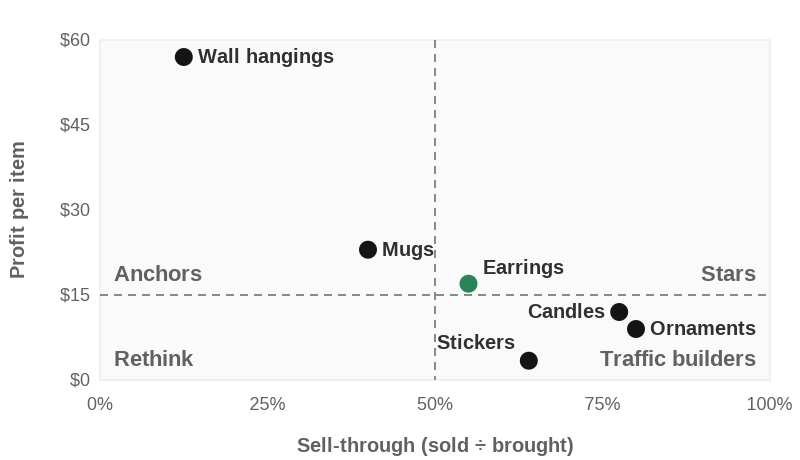
- Stars (high sell-through, high profit): earrings. Bring more, give them the best spot at the front of the table, and consider a second design at a higher price.
- Traffic builders (high sell-through, low profit): ornaments, candles, stickers. They pull people into the booth and add up fast. Keep them stocked, place them where people browse, and watch that their price still covers your time.
- Anchors (low sell-through, high profit): mugs, wall hangings. Big or pricey pieces make the booth look like a real shop and help small items feel affordable. Bring fewer, and decide whether each one earns its space.
- Rethink (low sell-through, low profit): nothing landed here this time. When something does two markets in a row, cut it, change the price, or try it at a different kind of event.
The same product sells differently at different events
What sells best at craft fairs in December isn't what sells best at a Saturday farmers market in June. Ornaments would land at zero in summer. Here's the kind of comparison worth keeping (again, example numbers):
| Top 3 by profit | Holiday market | Summer farmers market |
|---|---|---|
| 1 | Ornaments ($576) | Stickers ($190) |
| 2 | Earrings ($561) | Earrings ($170) |
| 3 | Candles ($372) | Candles ($84) |
Keep your rankings by event type: holiday, summer outdoor, indoor craft show, convention. When you pack for a market, use the ranking for that type, not your overall one. Our guide on comparing craft fair sales year over year explains why the season matters so much when you compare markets.
How to get the numbers without extra work
You need two lists for each market: what you brought and what you sold.
What you sold. If you ring up sales on a card reader app that records items, the item list is already there. In Shopify POS, the admin reports include sales by product for POS, and you can narrow them to the market's dates and location. Our step-by-step guide to tracking craft fair sales in Shopify POS shows where. If you take cash and write sales on paper, a tally sheet with one column per product works fine.
What you brought. Count before you pack the car. A packing list with quantities does double duty: it's your inventory for the day and your sell-through denominator afterward. Our craft fair checklist has a space for it.
Display space. Measure once with a tape measure. It rarely changes from market to market unless you redo the booth.
Then do the math once per market. Ten minutes on Sunday night beats guessing for a whole season.
Turning the ranking into decisions
After two or three markets of the same type, patterns show up. A few rules of thumb:
- Restock stars first. If you only have time to make one thing before the next market, make the star.
- Price-test traffic builders. Candles sold 31 of 40 at $18, for $372 in profit ($12 each). Try $20 at the next market of the same type. If you sell 28 (70%), that's $392 at $14 each: more profit from fewer candles. If you sell only 24 (60%), it's $336: less. Check sell-through and profit together, never just one.
- Limit anchors to the space they earn. One or two big pieces on the back wall can stay. Five can't.
- Give new products two markets. A first appearance is noisy. Judge it on the second.
For multi-day events, look at the ranking by day too. Some products sell on Friday night to people who know what they want, and others sell on Sunday afternoon to browsers. Our guide to multi-day craft show goals shows how to split a show by day.
The best sellers still have to pay for the booth
A great product mix can still lose money at an expensive market. Once you know your profit per item, check how many items you need to sell just to cover the booth, gas and food. At a $250 booth plus $105 in gas and food, and an average profit of about $9 per item, that's around 40 items before you make anything. The free craft fair profit calculator does this math with your own numbers in a minute.
FAQ
What sells best at craft fairs in general?
Small, giftable items at impulse prices (often under $25) tend to move in volume: jewelry, candles, stickers, ornaments, prints, soap. But what sells best at your booth depends on your price, style and markets, so rank your own products by sell-through and profit per item.
What is a good sell-through rate at a craft fair?
There's no standard number. Many vendors aim to bring enough that they don't sell out early, so 50% to 80% on core items is a comfortable range. Selling out by midday usually means you left sales on the table.
Should I stop selling items that don't sell?
Not after one market. Give a product two markets of the same type, try a different price or spot on the table, and then decide. Big pieces can earn their place by making the booth look like a shop, as long as you don't bring too many.
How many products should I bring to a craft fair?
Bring the quantities your past sell-through suggests for that type of event, plus a buffer of your stars. If you have no history, estimate sales from the booth fee and your target (for example 10x the booth), divide by your average price, and bring about double that many items. Our guide on how much inventory to bring to a craft fair works through it product by product.