2026 Business Mileage Rate: A Guide for Craft Fair Vendors
The 2026 business mileage rate changed halfway through the year, which makes it easy to get wrong. The IRS started 2026 at 72.5 cents per mile, then raised the rate to 76 cents for miles driven from July 1. If you drive to craft fairs, farmers markets and holiday shows, mileage is often one of your biggest costs after the booth fee and the products themselves. This guide explains both rates, shows how to turn miles into a cost for each market (with a full season worked out), what records the IRS expects, and how counting mileage can change whether a market was worth the trip.
This is general information, not tax advice. Whether your trips are deductible, and which method suits your car, depends on your situation. Ask a tax professional before you file.
The 2026 business mileage rate: two numbers
| Period | Business rate | IRS source |
|---|---|---|
| January 1 to June 30, 2026 | 72.5 cents per mile | IRS news release and Notice 2026-10 |
| July 1 to December 31, 2026 | 76 cents per mile | Announcement 2026-11 in Internal Revenue Bulletin 2026-29 |
The January rate was up 2.5 cents from 2025. The IRS then revised the rate for expenses on or after July 1, 2026, citing recent increases in the price of fuel. Miles driven before July 1 stay at 72.5 cents; miles from July 1 on use 76 cents. The IRS keeps all current and past rates on its standard mileage rates page.
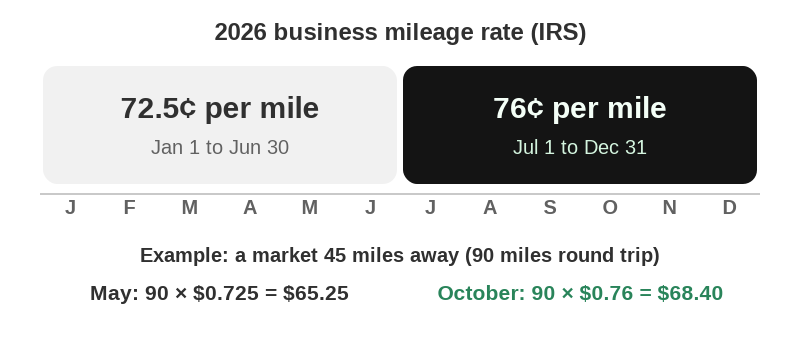
So the month of the market matters. A spring fair and a fall fair at the same distance don't cost the same in 2026.
How miles turn into a cost per market
The math is simple:
Mileage cost = round-trip miles × the rate for the date you drove
Count the whole trip: home to the market and back, plus any business stops on the way, like picking up supplies. If the market is two days and you drive home between them, that's two round trips.
Two example markets, 45 miles from home (90 miles round trip):
| Market in May | Market in October | |
|---|---|---|
| Round-trip miles | 90 | 90 |
| Rate | 72.5 cents | 76 cents |
| Mileage cost | $65.25 | $68.40 |
Parking and tolls are separate. The IRS notes in Publication 463 that business parking fees and tolls can be deducted whether you use the standard mileage rate or actual expenses, so log them as their own line.
A full season, worked out
Here's an example season of 12 markets, with made-up distances, split by the two rates:
| Date | Market | Round-trip miles | Rate | Mileage cost |
|---|---|---|---|---|
| Mar 14 | Indoor craft fair | 24 | $0.725 | $17.40 |
| Apr 11 | Spring makers market | 60 | $0.725 | $43.50 |
| May 2 | Saturday farmers market | 18 | $0.725 | $13.05 |
| May 23 | Downtown art walk | 40 | $0.725 | $29.00 |
| Jun 13 | Summer festival | 120 | $0.725 | $87.00 |
| Jun 27 | Saturday farmers market | 18 | $0.725 | $13.05 |
| Jul 18 | Brewery pop-up | 22 | $0.76 | $16.72 |
| Aug 15 | County fair craft tent | 96 | $0.76 | $72.96 |
| Sep 19 | Fall festival | 70 | $0.76 | $53.20 |
| Oct 24 | Harvest craft show | 150 | $0.76 | $114.00 |
| Nov 21 | Holiday market | 50 | $0.76 | $38.00 |
| Dec 5 | Holiday bazaar | 24 | $0.76 | $18.24 |
| Total | 692 | $516.12 |
That's 280 miles at 72.5 cents ($203.00) and 412 miles at 76 cents ($313.12). Over $500 a year is real money, and it's spread so thinly across markets that it's easy to forget when you judge any one of them.
Standard mileage rate or actual expenses?
There are two ways to count car costs for a business, and the IRS explains both in Publication 463. In plain language:
- Standard mileage rate: multiply business miles by the rate. Under this method you don't also deduct the car's depreciation, lease payments, maintenance and repairs, gas, oil, insurance or registration fees; the rate stands in for those. Parking and tolls are still separate.
- Actual expenses: add up what the car really costs (gas, repairs, insurance, depreciation and so on) and deduct the business share, based on business miles divided by total miles.
Two rules from Publication 463 worth knowing before you choose:
- The first year matters. For a car you own, if you want to use the standard mileage rate, you must choose it in the first year the car is used in your business. In later years you can pick either method.
- Five or more cars rule it out. If you use five or more cars in the business at the same time, you can't use the standard rate for any of them.
Which is better depends on your car, how much you drive and what it costs to run. That's a good question for a tax professional, especially if you're buying a vehicle mainly for markets.
What records to keep
Publication 463 is clear that you can't deduct amounts you approximate or estimate. For each business trip, the IRS expects records of:
- The date of the trip.
- The destination (the city, town or area).
- The business purpose, for example "Harvest craft show, vendor."
- The miles for the trip, and your total miles for the year.
A log kept weekly is treated as timely, and a record kept on a computer counts as adequate. Publication 463 even includes a sample daily mileage log with columns for date, destination, purpose, odometer readings and trip miles.
A simple habit that covers it: when you book a market, add a row to your log with the date, the market's name and town, and the purpose. After the market, fill in the miles from your odometer or a map app, plus any parking and tolls. Keep the booth confirmation email with it as backup. If you already keep a craft fair profit spreadsheet, a "miles" column next to each market does most of the job.
Mileage can change whether a market was worth it
Here's where mileage matters even if you never think about taxes. Gas money is what most vendors count after a far-away market. The mileage rate is a fuller picture of what driving costs, because it stands in for wear, maintenance and insurance too.
Take the Harvest craft show from the season above (made-up sales and costs):
| Counting gas only | Counting mileage at 76 cents | |
|---|---|---|
| Sales | $1,100 | $1,100 |
| Booth fee | $120 | $120 |
| Food | $25 | $25 |
| Driving (150 miles round trip) | $21 (6 gallons at $3.50) | $114 |
| Event expenses | $166 | $259 |
| Event expenses as % of sales | 15.1% | 23.5% |
The gas price here is an example, not a current average. With gas only, the show looks close to a common target of keeping event expenses under 15% of sales. Counted at the mileage rate, it's well over. Neither number is "the" truth for taxes, but for deciding whether to drive 150 miles again next October, the fuller number is the honest one.
Two ways to use this:
- Compare markets fairly. A nearby market with a higher booth fee can beat a cheap one two hours away once miles are counted. Our craft fair expenses checklist lists mileage next to the booth fee for that reason.
- Set a distance budget. Decide how far a market has to be before it needs bigger sales. At 76 cents, every 10 extra round-trip miles is $7.60 the market has to cover.
Put each market's sales, booth fee, mileage and other costs into the free craft fair profit calculator to see profit, expense share and booth fee multiple in one place. Our guide is a craft fair worth it explains the rules many vendors use to decide whether to rebook, and how to calculate craft fair profit walks through every cost line.
Quick checklist for 2026
- Use 72.5 cents for business miles driven January 1 to June 30, 2026.
- Use 76 cents for business miles driven July 1 to December 31, 2026.
- Log date, destination, purpose and miles for every market trip.
- Keep parking and tolls as separate lines.
- Count mileage in each market's costs when you decide whether to go back.
- Check the IRS standard mileage rates page for the 2027 rate before the new year starts.
FAQ
What is the 2026 business mileage rate?
The IRS set it at 72.5 cents per mile for business miles driven from January 1 to June 30, 2026, and raised it to 76 cents per mile for miles driven from July 1 to December 31, 2026, citing higher fuel prices.
Do I use one rate for the whole year?
No. For 2026, miles driven before July 1 use 72.5 cents and miles driven on or after July 1 use 76 cents. That's why a dated mileage log matters: you need to know which half of the year each trip falls in.
Can I deduct gas and the mileage rate for the same trip?
Not under the standard mileage rate. According to IRS Publication 463, the rate replaces costs like gas, repairs, insurance and depreciation. Business parking and tolls can still be deducted separately. Ask a tax professional which method fits your car.
What should a mileage log for craft fairs include?
For each trip: the date, the destination, the business purpose (for example, selling at a named market) and the miles driven, plus your total miles for the year. Estimates don't count, so record trips at or near the time you drive them.