Craft Fair Refund Policy: Options, Wording and the Math
A craft fair refund policy is one of those things nobody thinks about until a shopper comes back at 3 p.m. holding a mug and a receipt, or sends a message a week later saying the earrings were a gift that didn't fit. Deciding the answer in advance saves you from making it up on the spot, keeps you consistent from customer to customer, and lets you put it on a small sign so nobody is surprised. This guide covers the common options, wording you can copy, how returns work after the market, refunds at the card reader, and what refunds do to a market's profit.
A quick note: this is practical advice, not legal advice. Some states have rules about posting or disclosing refund policies. Check with your state's consumer protection office if you're unsure what applies where you sell.
Why decide before the market
Three reasons:
- Consistency. If you give one person a refund and tell the next person "all sales final," you'll feel it in reviews and word of mouth.
- Speed. A clear rule means a 20-second answer at a busy booth instead of a negotiation.
- Trust. A short, friendly policy on a sign often makes people more comfortable buying, especially gifts.
The common options
There's no single right policy. These are the usual choices; pick one, write it down, and use it everywhere you sell.
| Policy | How it works | Fits when |
|---|---|---|
| All sales final (defects excepted) | No refunds for change of mind; you fix or replace anything defective | Personalized or custom items, food, consumables, earrings for hygiene reasons |
| Exchanges only | Swap for another item or size within a set time | Clothing, rings, items where fit is the usual problem |
| Refunds within a set time | Unused items returned within, say, 14 or 30 days get a refund | Higher-priced pieces, gifts, items that ship well |
| Store credit | Return for credit to use at a future market or online | When you want to keep the sale but stay flexible |
Whatever you pick, two lines make any policy fairer:
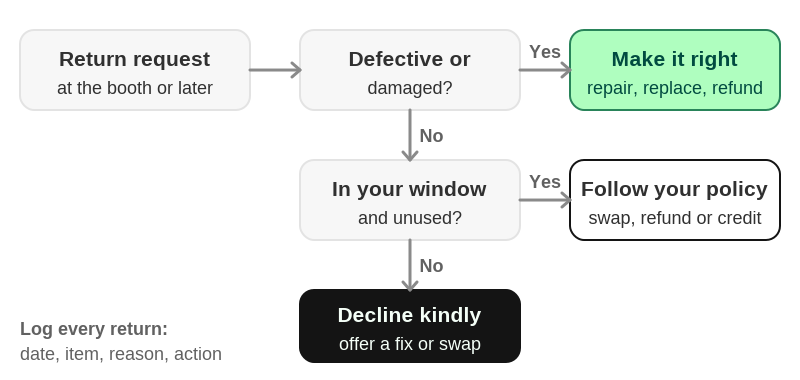
- Defective or damaged items are always made right, with a repair, a replacement or a refund. That's separate from change-of-mind returns.
- Custom and personalized orders follow their own terms, agreed when the order is placed.
Wording for the sign and the bag
Keep it short enough to read from the edge of the table. Some examples:
All sales final. Something wrong with your piece? Message us within 14 days and we'll make it right.
Exchanges within 30 days with your receipt. Bring it to our next market or message us.
Unused items can be returned within 14 days for a refund. Keep your receipt and message us at the address on our card.
Put the same words on your receipt or a small card in the bag, along with how to reach you. Our guide to vendor booth signs shows where small policy and payment signs fit on the table, and our guide on what to say to customers at a craft fair has a few friendly ways to mention the policy at checkout without sounding defensive.
Returns after the market
Most return requests don't happen at the booth. They come days later, by message, from someone who is now far away. Decide ahead of time which of these you'll offer:
- Bring it to the next market. Easy if you sell at the same market every week. Say which markets count.
- Mail it back. Decide who pays postage. A common middle ground: you pay for defective items, the customer pays for change of mind.
- Refund without a return. For a low-priced item, sometimes the postage costs more than the item. A refund and "please keep it or pass it on" can be the cheapest answer.
Ask for the receipt, the order number or the date and market, and a photo if something arrived broken. Write down each return: date, item, reason and what you did. After a few months that list tells you whether a product has a quality problem or whether one market's crowd tends to change their minds.
Refunds at the card reader
How you refund depends on how the customer paid.
- Card payments: refund back to the card through your POS app, so the money goes to the account it came from and your records stay matched to the sale.
- Cash: refund in cash from your box, and note it so your cash count at the end of the day still adds up. Our guide on how much change to bring to a craft fair explains how to count cash in and out.
- Payment apps: refund through the same app the customer used, and record it against the original sale.
If you use Shopify POS, the Help Center explains that you start from the order, choose to return the items and then refund, and decide per item whether to restock it. Restocked items go back into the inventory of the location you've assigned. The same page notes that the most you can refund to a payment method is what the customer paid with it, and that orders paid with a custom payment type (for example one you named "Venmo") can only be refunded with that custom payment type, which means the actual money moves in the app itself. Exchanges in Shopify POS need the POS Pro plan. (Checked in November 2026.)
Whatever system you use, do one test refund at home before your first market so you know where the button is.
One cost to check: ask your card processor whether the original processing fee comes back when you refund a card payment. If it doesn't, count it as a small cost of that refund.
What refunds do to a market's profit
A refund after the market changes that market's numbers, so update them instead of leaving the original totals in place. An example with made-up numbers, starting from a one-day market with $1,240 in sales and $672 in profit:
| Change | Effect on profit |
|---|---|
| A $36 pair of earrings returned unused, refunded and restocked (product cost $9 back in stock) | −$36 + $9 = −$27 |
| A $34 mug arrived chipped; you send a replacement (product cost $11, postage $8) | −$19 |
| Profit after returns | $672 − $27 − $19 = $626 |
The market went from $672 to $626, about 7% less. That's not a reason to refuse fair returns, but it's a reason to log them. If one market's returns keep eating its profit, that belongs in the decision to rebook. Our guide on how to calculate craft fair profit explains each line, and the free craft fair profit calculator lets you rerun the numbers with refunds taken out of sales.
Defective items vs change of mind
Keep the two apart, in your head and in your records.
Defective or damaged: a crack, a broken clasp, a seam that came undone, a candle that won't stay lit. Fix it quickly and without arguing. It costs you a little now and saves you a bad review and a lost customer. Then look at why it happened: packing, a material, a step in making it.
Change of mind: wrong color, didn't fit, found something else. This is where your policy applies. Be friendly either way; even when the answer is "no," offering help ("we can resize it for $10" or "want to swap for a different pair at our next market?") often turns a complaint into another sale.
A simple policy you can adapt
If you don't know where to start, this version is clear and fair for most handmade booths:
- Defective items: repair, replacement or refund within 30 days. We pay postage.
- Unused items: exchange or store credit within 14 days with your receipt, at a market or by mail at your cost.
- Custom, personalized and earrings: final sale unless defective.
- Questions: message us at the address on our card.
Print it on a small card for the bag, put the short version on a sign, and use the same words on your website so in-person and online customers get the same answer.
FAQ
Do craft fair vendors have to accept returns?
It depends on where you sell and what your policy says. Many vendors choose their own policy and post it clearly. Some states have rules about disclosing refund policies, so check with your state's consumer protection office. Defective items should always be made right.
What should a craft fair refund policy say?
Whether you offer refunds, exchanges or store credit, the time limit, what condition items must be in, which items are final sale, how defective items are handled, and how to contact you. Keep the sign version to one or two lines.
How do I refund a customer after a craft fair?
Refund the same way they paid: back to the card through your POS app, in cash at your next market, or through the same payment app. Note the refund against the original sale and update that market's numbers.
Should I put my refund policy on a sign?
Yes. A short sign at checkout and the same words on a card in the bag avoid surprises later. One or two lines is enough; put the details on the card or your website.