How Much Change to Bring to a Craft Fair (Cash Float Math)
How much change to bring to a craft fair is one of those questions that sounds small until the first customer of the day hands you a $20 for a $5 item and your cash box holds three ones. Bring too little and you lose sales or run to the coffee stand for change. Bring too much and you're guarding a pile of cash all day for no reason. This guide works out the cash float from your own prices, with a worked table of bills and coins, then covers counting in and out, keeping big bills safe, and how the float shows up (and doesn't) in your records.
The short version: for a typical one-day fair with whole-dollar prices, many vendors land somewhere around $100 to $150 in small bills. But your number depends on your prices and how many people pay cash, so let's do the math instead of guessing.
Why the first two hours decide your float
Change runs out early, not late. In the first hours of a market, nearly every cash customer pays with a bill bigger than the price, and your box has nothing coming in yet to give back. By midday, the fives and ones customers hand you start refilling the box on their own.
So the float only has to cover the change you'll give before the box starts feeding itself. That's why a market with $400 in cash sales doesn't need a $400 float. It needs enough small bills for the first handful of cash sales, plus a buffer.
Step 1: Write down the change for your common prices
Take your three or four most common prices and write the change for the bill people most often pay with. Plan for a $20, since that's often what people carry. Here's an example for a booth with whole-dollar prices:
| Price | Customer pays | Change | Bills you hand back |
|---|---|---|---|
| $5 | $20 | $15 | $10 + $5 |
| $12 | $20 | $8 | $5 + three $1 |
| $18 | $20 | $2 | two $1 |
| $22 | two $20s | $18 | $10 + $5 + three $1 |
| $34 | two $20s | $6 | $5 + $1 |
Look at what keeps coming up: ones and fives, with a ten now and then. That's the shape of your float. If your prices were $14 and $27 instead, you'd see more ones; if everything were $10 or $25, you'd barely need ones at all. This is one reason pricing in round numbers helps at the booth, which our guide on how to price items for a craft fair covers along with the rest of the pricing math.
Step 2: Estimate your early cash sales
Next, estimate how many cash sales you'll make in the first two hours. Use your own history if you have it: your cash sales from past markets divided by your total sales gives your cash share. If you don't have history yet, start with a cautious guess and adjust after the first market.
An example with made-up numbers:
| Amount | |
|---|---|
| Expected sales for the day | $900 |
| Cash share (from your past markets) | 30% |
| Expected cash sales | $270 |
| Average sale | $25 |
| Expected cash sales (count) | about 11 |
| Cash sales in the first two hours | about 4 to 5 |
Five early cash sales, each needing up to $15 in change, is about $75 in small bills. Add a buffer of roughly double for the unlucky morning when everyone pays with a $20, and you're near $150.
Step 3: Build the float, bill by bill
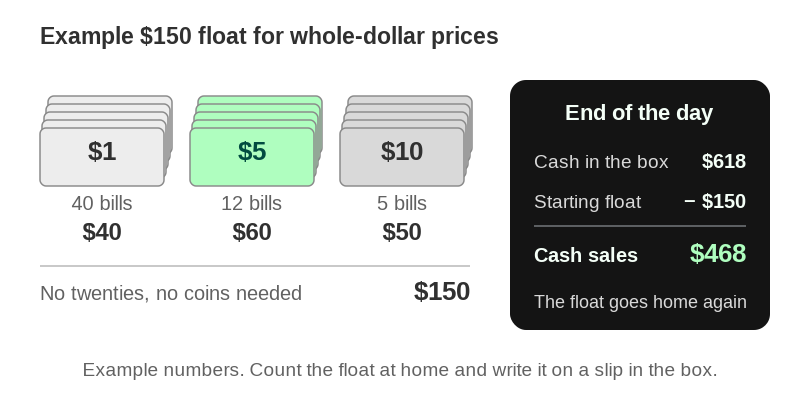
Here's that $150 float as a worked example for whole-dollar prices. It's the same starting float used in the cash example in our craft fair expenses checklist, so the numbers line up.
| Bill | How many | Amount |
|---|---|---|
| $1 | 40 | $40 |
| $5 | 12 | $60 |
| $10 | 5 | $50 |
| Total float | $150 |
No twenties: customers bring those to you. No coins: with whole-dollar prices and no tax added at checkout, you won't need any.
When you need coins
If your prices end in .50, or you add sales tax at checkout so totals come out like $26.81, you need coins. The U.S. Mint's coin glossary lists the standard roll sizes: 40 quarters ($10), 50 dimes ($5), 40 nickels ($2) and 50 pennies ($0.50). One roll of each adds $17.50 to the float.
Pennies are getting harder to count on: the Federal Reserve notes that after the Treasury's decision to end production of new pennies, where pennies are available will vary over time. That's another good reason to set prices that don't need them. Some vendors include sales tax in their sign prices so every total is a round number; whether and how you can do that depends on your state, so check first. Our craft fair sales tax guide shows the math of both ways.
How float size changes with your market
The worked example is a starting point. Here's how the same logic plays out in different situations (rules of thumb, not requirements):
| Situation | Example float |
|---|---|
| Small market, whole-dollar prices, most people pay by card | $75 to $100 |
| Typical one-day fair, whole-dollar prices | about $150 |
| Same fair, prices with cents or tax added at checkout | about $150 plus $17.50 in coin rolls |
| Big multi-day show with lots of cash | $200 to $300, rebuilt each night from the day's cash |
Two things push the float up: a high cash share (your own past markets will show which ones lean on cash) and low prices, because a $4 sticker paid with a $20 needs $16 in change. Two things push it down: round prices and signs that tell people you take cards and payment apps.
For multi-day shows, you don't need three days of float. At the end of each day, take the day's cash sales out, set the float back to its starting bills, and you're ready for the next morning.
Getting the change
Ask your bank for small bills and coin rolls a few days before the market rather than the morning of. Then count the float at home, by denomination, and write the total on a slip of paper that stays in the box. That slip is what makes the end-of-day count work.
Add the float to your craft fair checklist so it's packed with the card reader and not left on the kitchen counter.
Keep big bills out of the box
A cash box full of twenties sitting on a table is a temptation, and you'll be busy. A few habits that keep it simple:
- Skim as you go. When the box holds more than a set amount above the float (say $200 of extra cash, as an example), move the twenties and larger bills to a zipped pouch you keep on you.
- Wear the cash, or keep the box out of reach. An apron or belt bag keeps cash on your body. A box should sit behind the table, never on the edge of it.
- Never leave the box alone. If you need a break, take the box or the pouch with you, or ask a neighbor you trust to watch the booth, not the cash.
- Check big bills. The U.S. Currency Education Program's guide to checking a $100 note comes down to three steps you can do in seconds: feel the paper, tilt the note, and check it against the light.
Counting in and counting out
At the end of the day, count the box the same way you counted it at home. Then:
Cash sales = cash at the end − starting float − cash you added + cash you took out
An example: you start with $150, add nothing, take nothing out and end with $618. Your cash sales were $468. If you'd paid $12 for lunch from the box, add it back: $618 − $150 + $12 = $480 in cash sales.
Write the cash sales down before you leave, along with your card and payment app totals. If you ring cash sales up in your POS as they happen, compare the POS cash total with the count. A small gap usually means a sale that wasn't rung up or change that went out wrong; a big gap means it's time to recount.
The float in your records
The float isn't a cost and it isn't income. It's your own money that goes to the market and comes home again, ready for the next one. So:
- Don't add the float to your sales.
- Don't list it as an expense.
- Do add the day's cash sales to your card and app sales, so your market total is complete.
Then run the full numbers (sales, product costs, card fees, booth fee, gas, food) through the free craft fair profit calculator. Leaving cash out makes a market look worse on paper than it really was.
Need less change: signs and prices
The easiest way to need less change is to need less cash:
- Payment signs. A clear sign that says you take cards, tap and phone payments, plus your payment app handles, moves more customers away from cash. Our guide to vendor booth signs covers where to put it and what to write.
- Round prices. $12 and $20 need far less change than $11.50 and $19.75.
- Bundles that land on round totals. "3 for $30" turns three separate change-making moments into one, often with no change at all from a $20 and a $10.
FAQ
How much change should I bring to a craft fair?
Work it out from your prices: write the change for a $20 on your most common prices, estimate your cash sales in the first two hours, and add a buffer. For a typical one-day fair with whole-dollar prices, many vendors end up around $100 to $150 in ones, fives and a few tens.
What bills should be in a cash float?
Mostly ones and fives, with a few tens. In our example, 40 ones, 12 fives and 5 tens make a $150 float. Leave twenties at home; customers will hand you plenty.
Do I need coins at a craft fair?
Only if your prices end in cents or you add sales tax at checkout. One roll each of quarters, dimes and nickels adds $17. Setting round prices avoids coins entirely.
How do I count cash sales with a float?
Count the float before you open and the box at the end. Cash sales are the ending cash minus the float, plus any cash you took out during the day and minus any you added.