Craft Fair Bundle Pricing: When 3 for $30 Earns More
Craft fair bundle pricing looks simple: put up a "3 for $30" sign and watch people grab three instead of one. Sometimes that's exactly what happens and the market earns more. Other times the same people who were going to buy three anyway just pay less, and the bundle quietly gives away profit. This guide shows the math behind a bundle, a break-even rule you can do in your head, which products to bundle, and how to test an offer across two similar markets so you know which case you're in.
All numbers here are made-up examples to show the method. Card fees are left out of most of the math to keep it readable; they barely change the comparison, and we come back to them near the end.
The basic math of one bundle
Take an item you sell for $12 that costs you $3 to make. Each one sold leaves $9 before card fees and market costs. Now offer 3 for $30.
| What the buyer takes | Pays | Your cost | Left for you |
|---|---|---|---|
| 1 item at $12 | $12 | $3 | $9 |
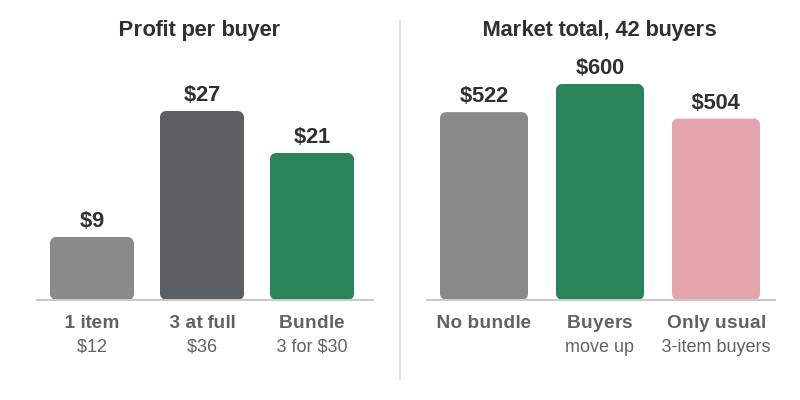
| 3 items at full price | $36 | $9 | $27 |
| 3 items as the bundle | $30 | $9 | $21 |
The bundle gives away $6 compared with three full-price items. Whether that's a good trade depends entirely on who takes it:
- A buyer who would have bought one and now takes three: you go from $9 to $21, a gain of $12.
- A buyer who would have bought two and now takes three: you go from $18 to $21, a gain of $3.
- A buyer who was going to buy three anyway: you go from $27 to $21, a loss of $6.
That's the whole game. A bundle earns more only when enough people move up from one or two items to cover the discount you give to people who would have paid full price.
A break-even rule you can do in your head
From the table above:
Extra profit = (one-item buyers who move up × $12) + (two-item buyers who move up × $3) − (buyers who'd have taken three anyway × $6)
So with this offer, every one-item buyer who moves up to the bundle pays for two "anyway" buyers ($12 ÷ $6 = 2). Two-item buyers who move up barely help: you need two of them to cover a single "anyway" buyer.
The general version, for any item and bundle:
- Discount per bundle = full price of the items − bundle price
- Gain per one-item buyer who moves up = bundle profit − one item's profit
- Break-even: one-item buyers who move up × gain ≥ "anyway" buyers × discount
If your bundle discount is large compared with what one item earns, the rule gets hard to meet. "3 for $30" on a $12 item gives away $6, less than one item's $9 profit. "3 for $25" would give away $11, more than one item's profit, and you'd need far more people to move up.
Two markets, two outcomes
Here's what the rule looks like at a real-looking Saturday market with 42 buyers at the table.
Without a bundle:
| Buyers | Items each | Items | Profit |
|---|---|---|---|
| 30 | 1 | 30 | $270 |
| 8 | 2 | 16 | $144 |
| 4 | 3 | 12 | $108 |
| 42 | 58 | $522 |
With "3 for $30", case A: people move up. Eight one-item buyers and two two-item buyers take the bundle, plus the four who were going to buy three anyway.
| Buyers | Takes | Items | Profit |
|---|---|---|---|
| 22 | 1 item | 22 | $198 |
| 6 | 2 items | 12 | $108 |
| 14 | the bundle | 42 | $294 |
| 42 | 76 | $600 |
Check it with the rule: 8 × $12 + 2 × $3 − 4 × $6 = $96 + $6 − $24 = $78 more, and $522 + $78 = $600.
Case B: only the usual three-item buyers take it. Nobody moves up from one item; two two-item buyers do.
| Buyers | Takes | Items | Profit |
|---|---|---|---|
| 30 | 1 item | 30 | $270 |
| 6 | 2 items | 12 | $108 |
| 6 | the bundle | 18 | $126 |
| 42 | 60 | $504 |
The rule: 0 × $12 + 2 × $3 − 4 × $6 = $18 less. Same sign, same table, same crowd size, and the bundle lost money. The difference is only in who took it.
Which products to bundle
Bundles work best on products that are already easy to say yes to:
- Low cost per item. The more each item earns, the more room you have for a discount that still leaves a healthy profit.
- Similar prices. "Any 3 for $30" is simple when everything in the group is $12. Mixing $8 and $16 items in one offer gets confusing at checkout.
- Things people like to buy several of: earrings, stickers, cards, ornaments, small soaps, mini candles.
- Your traffic builders. In our guide to what sells best at craft fairs, these are the items with high sell-through and modest profit per item. A bundle turns their volume into bigger tickets.
Products to keep out of bundles:
- Stars that already sell at full price. If a product sells out at full price, a bundle mostly hands buyers a discount they didn't need.
- Big anchor pieces. A discount on an $85 piece gives away real money and rarely changes the decision.
- Anything you're short on. A bundle can empty a product line by noon.
Gift sets: a different kind of bundle
For holiday markets, a fixed gift set (say a candle, a soap and a card in a box) does a different job. It saves the shopper time rather than money, so it doesn't need a discount.
| Sold separately | As a gift set | |
|---|---|---|
| Price | $18 + $8 + $5 = $31 | $32 |
| Your cost | $6 + $2 + $1.50 = $9.50 | $9.50 + $2 box = $11.50 |
| Left for you | $21.50 | $20.50 |
Priced at about the sum of the parts, the set covers its own packaging and earns nearly the same per sale, while making the gift decision easy. If sets bring in buyers who wouldn't have picked three separate items, they add profit without any discount at all. Our Christmas craft fair ideas cover gift sets in more detail.
Signs that make the offer obvious
A bundle nobody notices is just a lower price for the few who ask. Put the offer on its own sign, next to the products it applies to, and show the single price too, so the saving is clear:
- "Earrings $12 each · any 3 for $30"
- "Mix and match: 3 for $30"
Keep it to one offer per product group; three different deals on one table are hard to read from the aisle. Our guide to vendor booth signs covers sizes and placement. At checkout, a short "they're 3 for $30 if you'd like to pick two more" is enough; our guide on what to say to customers at a craft fair has more example lines.
Bundles vs end-of-day discounts
An end-of-day discount is a bundle without the "buy more" part. Take 20% off the $12 item after 3 p.m. and each sale leaves $9.60 − $3 = $6.60 instead of $9. For any shopper who would have paid full price later in the day, that's $2.40 given away, and nothing asks them to take more. Regular shoppers can also learn to wait for the discount.
A bundle asks for something in return: more items. If you want to move stock at the end of a long day, a bundle on the items you have too many of usually does it with less damage to your prices.
Tracking bundle sales in your POS
To test a bundle you need to see how many people took it and how many items went out. Two simple ways that work with most card reader apps:
- Ring up each item separately and apply a discount to get to $30. Your item counts stay correct, and the discount line tells you how many bundles you sold.
- Create the bundle as its own item ("Earrings, any 3", $30). It's faster at checkout, but you'll need to adjust the individual items' stock yourself, or your product counts will be off.
Either way, write down the number of buyers (orders) and items at each market. Those two numbers are what tell you whether the bundle helped.
Card fees change the picture only slightly. At an example rate of 2.6% plus 10 cents, three items at $36 cost about $1.04 in fees, and the $30 bundle about $0.88. Our comparison of the best card reader for craft fairs lists current rates.
Test it across two similar markets
Don't judge a bundle on one day. Compare two markets of the same kind, one with the offer and one without, using three numbers:
| Without bundle | With bundle (case A) | |
|---|---|---|
| Buyers | 42 | 42 |
| Items per buyer | 1.38 | 1.81 |
| Average sale | $16.57 | $19.71 |
| Profit per buyer (before market costs) | $12.43 | $14.29 |
If items per buyer and profit per buyer both go up, keep the bundle. If items per buyer barely moves and profit per buyer drops, you're in case B: drop the offer or make the discount smaller. Weather and crowd size move sales too, so look for the same result over two or three markets.
Then check the whole market, not just the products: put sales, product costs, the booth fee and your other costs in the free craft fair profit calculator. And if you're setting the single prices themselves, start with our guide on how to price items for a craft fair, since a bundle only works on top of a price that already earns enough.
FAQ
Is "3 for $30" a good deal for the seller?
It depends on who takes it. With a $12 item that costs $3, each shopper who moves up from one item to the bundle adds $12 in profit, and each shopper who would have bought three anyway costs you $6. If at least one buyer moves up for every two "anyway" buyers, the bundle earns more.
How much of a discount should a craft fair bundle give?
Keep the discount on the whole bundle smaller than the profit of one item. On a $12 item that earns $9, a $6 discount ("3 for $30") leaves room; an $11 discount ("3 for $25") needs many more shoppers to move up to break even.
Should I bundle my best-selling items?
Usually not the ones that already sell out at full price. Bundles work best on items with low cost and high volume that people like to buy several of, such as earrings, stickers, cards or small soaps.
How do I know if my bundle is working?
Track buyers, items and profit at two or three similar markets with and without the bundle. If items per buyer and profit per buyer both go up, it's working. If profit per buyer drops, shrink the discount or drop the offer.