What to Say to Customers at a Craft Fair (Without Being Pushy)
Knowing what to say to customers at a craft fair is the part of selling many makers dread most. You spent months making the work, and now you're supposed to talk about it to strangers who are walking past without slowing down. The good news: you don't need a sales script or a big personality. You need a handful of short, honest lines for the moments that come up at every market, and the habit of listening more than you talk. This guide gives you those lines, the ones to avoid, and a simple way to see whether they're working.
Why "let me know if you need help" goes nowhere
It's the line almost everyone uses, and it's polite. The trouble is that it doesn't give the shopper anything to answer except "thanks, just looking." The conversation is over before it started.
A better opening is about the work, not about helping. It gives people something to react to and lets them keep browsing without feeling watched. You're not trying to start a sale in the first sentence. You're trying to start a conversation that can turn into one.
Greetings that open a conversation
Say hello when someone slows down or picks something up, not while they're still walking past. Then pick one line that fits your booth:
- "Hi! Everything here is made by me, in my studio in town."
- "Those are fresh from the kiln this week."
- "That one's my favorite glaze right now."
- "Feel free to pick them up. They're heavier than they look."
- "If you like that color, there's a matching set on the end."
Notice what these have in common: they're true, they're short, and they invite a look or a touch rather than a yes or no. If someone answers with a question, you're in a conversation. If they just smile and keep browsing, let them. Many people buy after a quiet browse, and hovering makes that less likely.
Stand up if you can, and put the phone away while people are in the booth. A vendor reading behind the table looks closed, even when the booth is open.
One-line product stories
People remember a detail better than a description. For each of your main products, write one sentence that answers "what makes this one different?" Keep it to something you'd say naturally:
- "Each mug is thrown on the wheel, so no two handles are exactly alike."
- "The scents are blended in small batches. This one is cedar and orange."
- "I cut the earrings from recycled sterling, then hammer them by hand."
- "The prints start as watercolors of local trails."
Use the story when someone picks a product up or asks about it. Don't recite it to everyone who walks by. One sentence, then stop and let them look. If they want more, they'll ask, and then you can tell them about the process.
Answering price questions without apologizing
When someone asks "how much is this?", say the price plainly and then say one thing about the item. Don't apologize, don't explain why it isn't cheaper, and don't offer a discount nobody asked for.
- Say: "That one is $34. It's dishwasher safe, so it's an everyday mug."
- Avoid: "It's $34, sorry, I know that's a lot, but the clay went up..."
If people ask the price often, that's a sign your price signs aren't easy to see. Our guide to vendor booth signs covers sizes and placement. And if you're not sure the price is right, the place to fix it is the pricing math, not the conversation; our guide on how to price items for a craft fair walks through it.
Mentioning bundles and custom orders
Two offers are worth mentioning out loud, once, at the right moment:
- Bundles when someone is choosing between two items: "If you can't decide, it's 3 for $30 on the small ones." Then let them decide.
- Custom orders when someone says "do you make it in blue?" or "I wish it were bigger": "I take custom orders. I can write down what you're looking for and send you a quote."
Keep an order form or a notebook at the checkout spot so you can take a name and contact details right away. A custom order taken at a quiet market can be worth more than the market's sales.
When they say "I'll come back later"
Most people who say this mean it at the moment and then get swept along by the rest of the fair. You can't change that, but you can make it easy to find you again:
- "Sounds good. I'm here until 4. Here's a card in case you think of it later."
- "No problem. If you'd like, I can set it aside for an hour."
Don't push for a decision. A card with your website or a QR code to your shop gives them a second chance after the market. Our guide to how to get repeat customers from craft fairs covers what to put on it.
When they say "I could make that myself"
It happens, and it stings. The best answer is friendly and short:
- "You totally could! It took me a while to get the glaze right. Have fun with it."
Then turn your attention to the next person. Arguing or explaining your costs won't change their mind, and other shoppers are listening. A calm answer makes your booth feel relaxed, which is good for everyone else browsing.
Checkout small talk and the email signup
The checkout is the easiest moment in the whole exchange. The person has decided, and a few friendly words make it feel good:
- "Great choice. That glaze is my favorite to make."
- "Is it a gift? I can wrap it or add a little card."
- "Would you like to get an email when I'm at the next market? It's about once a month."
That last line is the one most makers skip. Ask it the same way every time, at checkout, and point to a sign-up sheet or QR code. Asking at checkout feels natural because the person already likes what you make.
What to listen for
Listening is half of what to say to customers at a craft fair. The questions people ask are product research you don't pay for. Keep a small notebook and write down:
- Requests: "Do you have this in a larger size?" "Do you make anything for dogs?"
- Objections: "It's beautiful, but I don't have room." "I already have too many mugs."
- Price reactions: items people pick up, check the price, and put back.
- Compliments that point somewhere: "I love this color" said about the same glaze five times.
After a few markets, the notes show patterns. If ten people asked for larger sizes, that's worth testing. Our guide to what sells best at craft fairs shows how to rank products after each market, and these notes tell you what to try next.
Example lines to keep at the booth
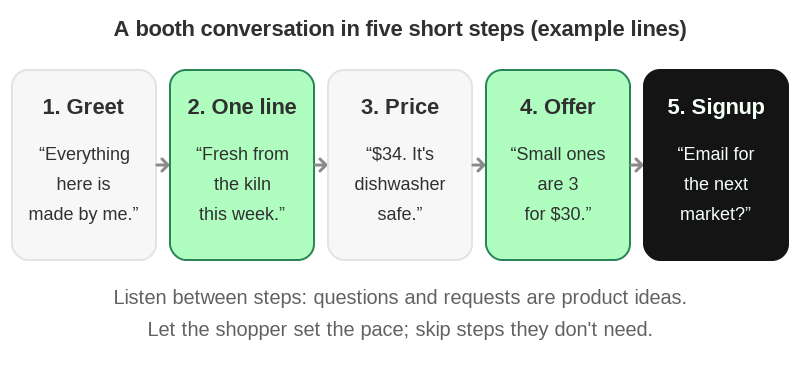
| Situation | Say | Avoid |
|---|---|---|
| Someone slows down | "Hi! Everything here is made by me." | "Let me know if you need help." |
| They pick something up | "That one's from my newest batch." | Silence, or reading your phone |
| They ask the price | "$34. It's dishwasher safe." | "Sorry, I know it's a lot..." |
| They can't decide | "Small ones are 3 for $30." | "I can do it cheaper if you want." |
| They want a variation | "I take custom orders. Can I take your email?" | "No, I only have what's here." |
| "I'll come back later" | "I'm here until 4. Here's a card." | "Are you sure? It might sell out." |
| "I could make that" | "You could! Have fun with it." | Explaining your costs |
| At checkout | "Want an email when I'm at the next market?" | Skipping the signup ask |
Print it, or write your own version on an index card. Having the words ready matters most at your first few markets, when nerves make the obvious line hard to find.
Measure it simply
You can tell whether new lines are working without any special tools. For a few markets, keep a tally on a sticky note: one mark for each real conversation (more than a hello) and one mark for each sale. Then compare. Here's an example with made-up numbers:
| Market | Conversations | Sales | Conversations that became sales | Average sale | Sales total |
|---|---|---|---|---|---|
| May, old greeting | 60 | 18 | 30% | $28 | $504 |
| June, product stories | 58 | 23 | 40% | $27 | $621 |
| July, stories plus bundle line | 70 | 26 | 37% | $31 | $806 |
In this example, the product stories turned more conversations into sales, and mentioning the bundle raised the average sale. Weather and crowd size move these numbers too, so look for a pattern over two or three markets of the same kind rather than reading too much into one day.
Then check what the market made after the booth fee, gas and food. Better conversations only matter if the market is worth doing; the free craft fair profit calculator turns each market's sales and costs into profit and profit per hour.
FAQ
What should I say when someone walks into my craft fair booth?
Something short and true about the work, not an offer to help. "Hi! Everything here is made by me" or "That glaze is fresh from the kiln this week" gives them something to react to and lets them keep browsing.
How do I talk about prices without sounding defensive?
Say the price plainly and add one fact about the item, like "$34, and it's dishwasher safe." Skip apologies and unasked-for discounts. If the price feels wrong, fix it in your pricing, not in the conversation.
Should I follow customers around my booth?
No. Say hello, offer one line about the work, then give them room. Stay nearby and available, and answer questions when they come. Many people prefer to browse quietly before buying.
How do I ask for email signups at a craft fair?
Ask at checkout, the same way every time: "Would you like an email when I'm at the next market?" Point to a sign-up sheet or QR code, and tell them how often you send emails.