Craft Fair Helper: When It Pays and How to Run the Booth
A craft fair helper sounds like an easy win: someone to cover lunch, help with the rush and lift the tent at 6 a.m. Sometimes it is. Other times the extra pay quietly eats most of the profit the help was supposed to protect. This guide shows how to tell which one you're looking at, with a worked break-even example, then covers training a helper in 15 minutes, handling cash and cards with two people at the booth, friends and family who help for free, and the questions to ask before you pay anyone.
When a helper usually pays off
A second person earns their place when the booth loses sales without them. Common cases:
- Rushes you can't serve alone. If people wait, then wander off while you wrap a mug and run a card, those are lost sales.
- Breaks. A solo vendor at a 10-hour market either closes the booth for lunch and bathroom trips or skips them. Neither is great.
- Multi-day shows. Three long days alone is a lot. Even one helper on the busiest day can make the whole show easier. Our guide to multi-day craft show goals shows how to split sales by day, which tells you which day needs the extra hands.
- Setup and teardown. A big tent, shelves and heavy bins go up much faster with two people.
- Products that need explaining or trying on. Jewelry, clothing and custom work take time per customer.
And when it usually doesn't: small, slow markets where you're rarely with more than one customer at a time, or booths where the products sell themselves off the table.
What a helper really costs
The helper's cost is more than the hourly rate. Count everything you pay because they came:
- Pay for every hour they work, including setup and teardown.
- Food and drinks for the day.
- Their travel or parking, if you cover it.
- A second badge or wristband, if the event charges for one.
All of it belongs in the market's costs, next to the booth fee and gas. Our craft fair expenses checklist has a line for helper pay for exactly this reason.
The break-even: how much more you need to sell
Every extra dollar of sales doesn't turn into a dollar of profit. Product costs and card fees take their share first. So the question is: how much more do you need to sell to cover the helper?
Extra sales needed = helper cost ÷ what's left from each extra dollar of sales
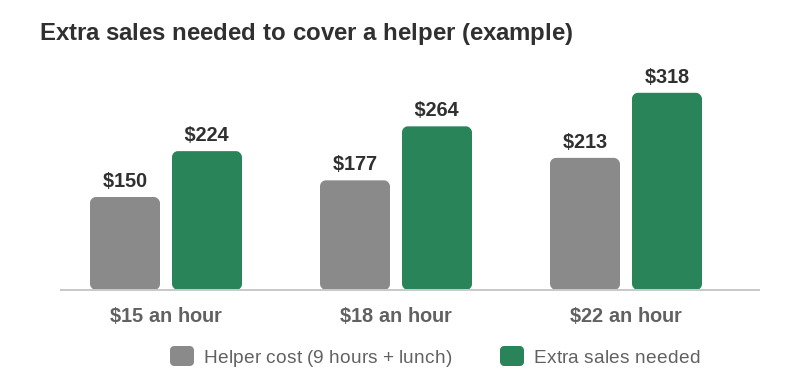
If your products cost about 30% of their price and card fees take about 3%, each extra dollar of sales leaves about 67 cents. Here's the math at three pay rates for a 9-hour day plus $15 for lunch (example numbers):
| Helper pay | Pay for 9 hours | Plus lunch | Extra sales needed |
|---|---|---|---|
| $15 an hour | $135 | $150 | about $224 |
| $18 an hour | $162 | $177 | about $264 |
| $22 an hour | $198 | $213 | about $318 |
A full example
A one-day market, alone and with a helper at $18 an hour. These are example numbers to show the math.
| Alone | With a helper | |
|---|---|---|
| Sales | $1,100.00 | $1,350.00 |
| Product costs (30%) | $330.00 | $405.00 |
| Card fees (about 3%) | $33.00 | $40.50 |
| Booth fee | $120.00 | $120.00 |
| Gas and food | $40.00 | $55.00 |
| Helper pay (9 hours) | $162.00 | |
| Profit | $577.00 | $567.50 |
The helper brought in $250 more in sales, which is close to the $264 needed, but not quite there. On the money alone, this market was a wash. That doesn't mean the helper was a mistake: you got a lunch break, an easier teardown and a day that didn't wear you out before the next one. It does mean you should know the number, and decide on purpose.
Two ways to make the math work better:
- Bring help only for the peak. Four hours on a Saturday afternoon costs much less than a full day and covers the rush.
- Use the helper to sell more, not just to stand there. Let them handle wrapping and payment while you talk to customers, or the other way around.
Put your own numbers into the free craft fair profit calculator, with the helper's pay in the other costs field, and compare it with the same market alone. Our guide on how to calculate craft fair profit explains each line.
Train a helper in 15 minutes
A helper who doesn't know the prices sends customers away. A short briefing before the market opens fixes most of it:
- Prices. Walk the table together. If you use group price signs ("All earrings $22"), most questions answer themselves. Give them a small price list for anything without a sign.
- Bundles and offers. "3 for $30" and what counts toward it.
- Payments. How to take a card on your reader, how to record cash and payment apps, and what to do if the card reader drops offline.
- What they can't do. Refunds, discounts and custom order promises go through you. A helper agreeing to "two weeks for a custom piece" is how commitments you can't keep get made.
- Your story in one sentence. "Everything here is made by the owner in a home studio" is enough. They don't need to know your glaze recipes.
- Where things are. The restock box, bags, business cards, the email signup sheet and the first aid kit.
Write the essentials on one card and keep it by the register. Our vendor booth signs guide helps here too: the clearer your signs, the fewer questions your helper has to answer.
Cash and cards with two people at the booth
Two people and one cash box is where mistakes happen. A few simple habits:
- Count the float together at the start, write the amount down, and count again together at the end. Cash sales are the end amount minus the float. Our guide on how much change to bring to a craft fair shows how to size it.
- One person handles cash at a time, if you can. Pass the box, not loose bills.
- Ring up every sale, cash and payment apps included, so the day's total matches the box.
- Separate logins if your POS has them. Many POS systems let you add staff with their own PIN, which shows who rang up what. Shopify, for example, lists staff roles and permissions as part of POS Pro, while its basic in-person selling includes limited staff access. Check what your own system allows.
- Keep big bills out of the box during the day, in a place only you know.
Friends and family who help for free
Many vendors start with a partner, parent or friend at the booth. That's great, and it still has a cost: their day. Two habits keep the numbers honest:
- Write down their hours, even unpaid. If the market only works because someone helped for free, you'll want to know that before you book it again without them.
- Count what you spend on them, like lunch or gas. It belongs in the market's costs.
When you look at profit per hour, try it both ways: your hours only, and your hours plus theirs. If the market only looks good when the helper's time is free, that's worth noticing.
Paying a helper: ask the right questions first
Once you pay someone, there are tax questions to sort out, starting with whether the helper is an employee or an independent contractor. The IRS decides that under common-law rules, looking at behavioral control, financial control and the relationship between you, and its guidance says that no one factor decides it. The IRS page Independent contractor (self-employed) or employee? explains the test and what each answer means for taxes.
This is not tax or legal advice. Before you pay a helper regularly, ask a tax professional how to classify and pay them, what records to keep, and whether any state requirements apply where you sell.
A quick checklist before you bring a helper
| Question | Why it matters |
|---|---|
| Does this market have rushes or long hours? | Slow markets rarely need two people |
| How much more do I need to sell to cover them? | Helper cost ÷ what's left from each extra dollar |
| Do I need them all day or just for the peak? | Partial days cost far less |
| Do they know prices, bundles and payments? | A 15-minute briefing prevents lost sales |
| Who handles cash, refunds and custom orders? | Clear roles avoid mistakes |
| How am I paying them, and is that set up correctly? | The IRS classification question comes first |
FAQ
How much should I pay a craft fair helper?
There's no standard rate. Whatever you pay, add it to the market's costs along with food and travel, then check how much more you need to sell to cover it: the helper's total cost divided by what's left from each extra dollar of sales after product costs and card fees.
Do I need a helper at a craft fair?
Not always. A helper pays off at busy markets, long or multi-day shows, and booths with products that take time per customer. At small, slow markets, one person can usually handle the booth.
Is a craft fair helper an employee or an independent contractor?
The IRS decides that under common-law rules that look at behavioral control, financial control and your relationship, and no single factor settles it. Read the IRS guidance and ask a tax professional before you start paying someone.
How do I keep cash safe with a helper at the booth?
Count the cash float together at the start and end, have one person handle cash at a time, ring up every sale, and keep large bills out of the cash box during the day.