Craft Fair Booth Security: Protect Stock, Cash and Your Phone
Craft fair booth security is mostly about habits, not gadgets. You want shoppers to pick things up, try things on and linger, and you also want the same number of earrings, the same cash and the same phone at the end of the day. The two goals fit together better than you'd think. This guide covers how to lay out the booth so the risky items sit where you can see them, how to handle cash, cards and your phone, what to do on breaks and at multi-day shows, how to check a bill you're unsure about, what to do if something goes missing, and how to count losses in your records.
A note before we start: this is practical advice for a small booth, not a security plan for a big event. Follow the organizer's rules and, if something serious happens, the instructions of the event staff and local police.
Layout: keep the small, pricey items near you
The booth layout does most of the work. A few placements make a big difference without making the booth feel guarded:
- Small, high-value items within arm's reach of where you stand. Rings, fine jewelry, small electronics, anything that fits in a pocket and costs a lot. Put them on the table closest to your chair or checkout spot, not at the far corner by the aisle.
- Large, low-risk items at the edges. Mugs, prints in sleeves, bulky pieces and anything that's hard to slip away are fine near the aisle, where they pull people in.
- Restock from boxes, not from the table. Show two or three of each design and keep the rest in a labeled box under the table cover. A full table looks generous, but forty loose pairs of earrings are impossible to watch. Our craft fair jewelry display ideas post has a table plan that works this way.
- Clear sight lines. Tall displays at the back, low ones at the front, so you can see the whole table from your seat. If a tall rack blocks your view of one corner, move the pricey pieces out of that corner.
- One way in, one way out in walk-in layouts, with your checkout near it. People leave past you, which is also where you say thanks.
None of this needs signs or locked cases. Shoppers see a tidy, well-stocked booth; you see everything that matters.
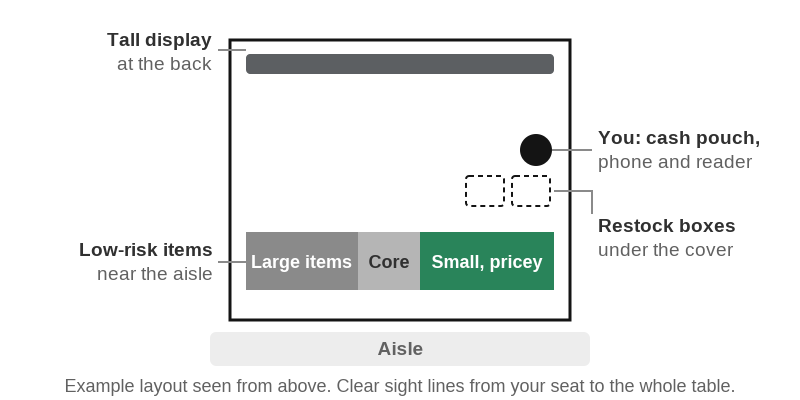
Cash: a small float, and big bills on you
Cash is the easiest thing to lose and the hardest to trace. A few habits keep the risk small:
- Start with a modest float. Bring what you need for change and no more. Our guide on how much change to bring to a craft fair works through an example float of $150 in ones, fives and tens.
- Skim the big bills. When you take a $20 or larger, move it to a zipped pouch or apron you're wearing instead of leaving it in the box. A simple rule (example): once the box holds more than about $100 beyond your float, move the extra to the pouch.
- Never leave the box unattended. Not for a minute, not "just to grab a coffee." If you step away, the cash goes with you or with your helper.
- Count at home, not at the booth. Counting a stack of bills in public advertises it. Write the end total at home and subtract the float to get cash sales.
- Keep the box out of reach of the aisle. Behind you or under the table on your side, never on the front edge.
Phone, card reader and payment accounts
Your phone is often worth more than your best day of sales, and it's also the key to your payment accounts:
- Screen lock on, with a short auto-lock time. If your POS or payment app supports a passcode or staff PIN, use it.
- Don't hand your phone to a shopper. If someone needs to enter an email for a receipt, turn the screen toward them and keep it in your hand. For card payments, let them tap or insert their card on the reader while you hold the phone.
- Keep the phone and reader on you or right next to you, not on the front of the table. A lanyard or a small pouch for the reader helps at busy moments.
- Payment app handles on a sign, not on your phone screen. Shoppers who pay by Venmo, Zelle or similar apps can read your handle from a sign, and you check the payment arrived before they walk off.
- Know how to remove a lost device. Before the season, find out how to sign a device out of your POS or payment account from another device, so a lost phone doesn't become an open register.
Breaks and helpers
Most problems happen when the booth is short-staffed: lunch, the bathroom, a long chat with the neighbor. Plan for it:
- Ask a neighbor to watch, but take the valuables. A friendly neighbor can keep an eye on your table for five minutes. Cash, phone and reader still go with you.
- Use a "back in 10 minutes" sign and drape a cloth over the small, pricey items if you have to step away alone.
- With a helper, split the jobs: one person takes payment and handles cash, the other talks to shoppers and restocks. Two people both reaching into the cash box is how counts go wrong.
- Count the float together at the start and the cash together at the end, so nobody has to wonder about a difference.
If you're thinking about bringing someone along, our craft fair helper guide shows how to work out whether the extra sales cover their pay.
Overnight at multi-day shows
At two- and three-day shows, your stock spends the night at the venue. Before you book, ask the organizer:
- Is there overnight security, and what hours does it cover?
- Are the doors locked overnight, and who has access?
- Can you leave the tent up and closed outdoors, or must you pack everything?
Then plan as if nobody is watching: take cash, your phone and reader, and the small, pricey pieces home or to the hotel each night. Cover the table, close the sidewalls and leave only what you're comfortable losing. Our guide to multi-day craft show goals covers the rest of planning a multi-day show.
Counterfeit bills: three quick checks
Counterfeit bills are rare enough that most vendors never see one, which is exactly why it helps to know the basics. The U.S. Currency Education Program suggests three steps: feel, tilt and check with light:
| Check | What to look for |
|---|---|
| Feel | Genuine notes have raised printing and feel slightly rough |
| Tilt | On $10 bills and up, the numeral in the lower right corner shifts color |
| Check with light | Hold the note up to a light to see the security thread and the portrait watermark ($5 and up) |
Its cashier toolkit also covers what to do if you think you've received a counterfeit, including contacting local law enforcement or the U.S. Secret Service. At a market, that usually starts with telling the organizer. Taking card and app payments for larger sales, and keeping bills small, both reduce the chance of meeting one.
If something is stolen
If you notice something missing:
- Don't chase or confront anyone. Your safety matters more than any item on the table.
- Tell the organizer or event staff right away. They may have security on site and know what to do at their event.
- Report it to local police if the loss is significant, and ask for a report number. You may need it for insurance.
- Write down what happened: what's missing, roughly when, and anything you noticed.
- Check your insurance. Liability insurance is about claims from other people and often doesn't cover your own stock or cash; some vendor policies offer add-ons for inventory or theft. Our craft fair insurance guide lists the questions to ask before you buy.
Count losses in your records
Losses are a real cost of the market, and they only show up if you count. The craft fair inventory sheet does it with three numbers per product: what you brought, what came home and what your POS or tally says you sold.
An example with made-up numbers:
| Earrings | Count |
|---|---|
| Brought | 60 |
| Came home | 22 |
| Gone from the table (60 − 22) | 38 |
| Sold, according to the POS and cash tally | 35 |
| Unaccounted | 3 |
Three pairs unaccounted at a $5 product cost is $15 of loss. Count it at what the items cost you, not at the price, because that's what you actually lost. Before calling it theft, rule out the usual suspects: a gift, a sample, a breakage, a sale rung up as a different design, a miscount. If the same product goes missing at several markets, move it closer to you.
Add the loss to the market's costs when you work out profit in the free craft fair profit calculator, as part of product cost or other costs. A $15 loss on a market with $1,200 in sales won't change your decision, but a pattern across the season might.
A short checklist
- Small, pricey items next to you; restock from boxes.
- A modest float; big bills to a pouch on you.
- Phone locked, reader and phone on you, never handed over.
- Valuables go with you on every break.
- Ask about overnight security; take valuables home each night.
- Feel, tilt, check with light for bills you're unsure about.
- Count what comes home and note anything unaccounted.
FAQ
How do I keep my craft fair booth secure without scaring shoppers away?
Use layout rather than barriers: keep small, high-value items within arm's reach of where you stand, put large items near the aisle, restock from boxes and keep clear sight lines. Shoppers see an open, tidy booth while you can watch what matters.
Where should I keep cash at a craft fair?
Keep a small float in a cash box on your side of the table and move larger bills to a zipped pouch or apron you're wearing during the day. Never leave the box unattended, and count the cash at home.
What should I do if something is stolen from my booth?
Stay safe and don't confront anyone. Tell the organizer or event staff, report significant losses to local police, write down what happened and check whether your insurance covers stock or cash. Then record the loss at product cost in your market's numbers.
Is it safe to leave my stock at a multi-day craft show overnight?
Ask the organizer about overnight security and access before you book. Even with security, take cash, devices and small, pricey items with you each night, and cover or close up whatever stays.