Farmers Market Vendor Permit: What to Check Before You Sell
Searching for "the" farmers market vendor permit usually leads to a surprise: there isn't one. What you need depends on what you sell, where the market is, and the market's own rules, and it usually comes from three or four different offices. This guide breaks the paperwork into layers, shows what each layer looks like with examples from official state pages, and ends with a way to count permit costs in your market's numbers. It goes deeper than the quick overview in our guide on how to become a vendor at a farmers market.
This is general information, not legal or tax advice. Rules change and vary by state, county and city. The examples below show what to look for; confirm your own requirements with the offices named and with the market manager.
Why there's no single permit
Think of it as layers. Each one can add a requirement:
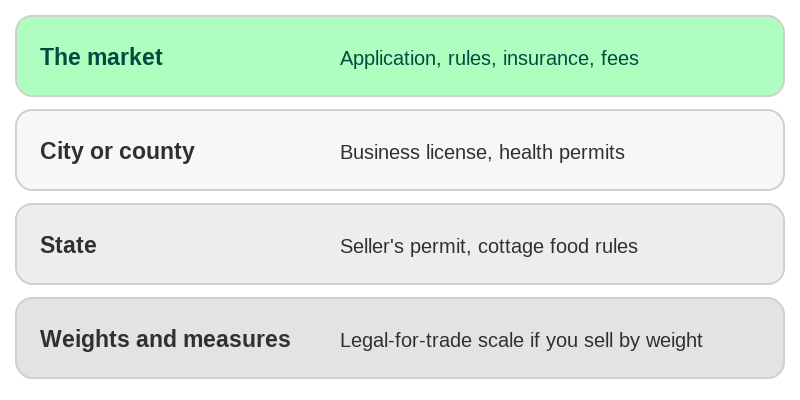
| Layer | What it can require |
|---|---|
| The market | Application, product list, producer-only rules, insurance, fees |
| City or county | Business license, health permits for food, local tax rules |
| State | Seller's permit or sales tax registration, cottage food rules |
| Weights and measures | Approved, inspected scales if you sell by weight |
The market manager is the best first call. Markets often know exactly which permits their vendors need, because they've seen every combination.
1. The market's own rules
Start with the vendor application and rules. Markets commonly ask for a product list, where and how you grow or make it, proof of any permits, and a certificate of insurance. Some only accept vendors who produce what they sell. Our craft fair vendor application guide covers photos and descriptions, and our craft fair insurance guide explains the certificate many markets ask for.
2. Business license (city or county)
Many cities and counties require a general business license or registration, even for part-time sellers. It's usually a short form and a small fee. Search your city or county website for "business license," and check whether the market's city has its own rule if it's not where you live.
3. Seller's permit and sales tax (state)
Whether you need a seller's permit depends on what you sell and the state. A few examples from official state pages:
- Wisconsin says vendors selling taxable items need a Wisconsin seller's permit unless their sales are exempt, and lists sellers of nontaxable items such as vegetables or fruits among the exceptions.
- Idaho reminds sellers at farmers markets and events to work with the event promoter to get a temporary seller's permit, valid for 90 days.
- California treats anyone selling at a location for less than 90 days as a temporary seller who needs a temporary seller's permit.
So a vegetable grower and a soap maker at the same market can have different answers. Our craft fair sales tax guide explains permits, rates and records in more detail.
4. Cottage food rules (state)
If you make food at home, such as bread, cookies or jam, your state's cottage food rules decide what you can sell, how to label it and sometimes how much you can sell in a year. Three examples:
| State | Example of what the official page says |
|---|---|
| California | Two classes of cottage food operations with gross annual sales caps that are adjusted every year (for 2025 they were $86,206 for Class A and $172,411 for Class B; check the current year's figures). Labels need the common name, ingredients and net quantity, among other things. |
| Texas | Cottage food can be sold directly to consumers at a farmers' market. Labels need the operation's name and address (or registration number), the product name, major allergens and a disclaimer that it was made in a home kitchen that isn't government-inspected. |
| Florida | Gross sales of a cottage food operation must not exceed $250,000 a year. |
Many states limit cottage food to foods that don't need refrigeration, so check your state's list of allowed foods before planning a product.
5. Health permits for prepared food and samples (local)
Selling meals or ready-to-eat food usually needs a health permit from the local health department, often a temporary food permit for each event or an annual one for mobile units. Michigan's agriculture department, for example, says a farmers market booth that serves full meals needs a temporary food establishment license from the local health department, and its application guidance asks for the form and fee at least 30 days before the event.
Samples have their own rules too. Michigan's sampling guidelines for farmers markets cover keeping hot samples at 135°F or above and cold ones at 41°F or below, and no bare-hand contact with ready-to-eat food. If you plan to hand out tastes, ask the market and the health department what applies.
6. Scales (weights and measures)
If you sell by the pound, your scale matters. Examples from state agencies:
- Washington: vendors who sell produce by weight must provide their own scales, which must be legal for trade and are subject to inspection by the state's weights and measures program. Portion scales and scales marked "not legal for trade" aren't suitable for sales.
- California: commercial scales are inspected, tested and sealed by county weights and measures offices, and most counties require annual registration.
A simple way around it: sell by the piece, bunch or basket instead of by weight, if that works for your product and your market allows it.
A permit checklist with timing
| Requirement | Who to ask | Start |
|---|---|---|
| Market application and rules | Market manager | When applications open |
| Business license | City or county | 4 to 6 weeks before |
| Seller's permit | State revenue department | 4 to 6 weeks before |
| Cottage food registration or labels | State agriculture or health department | Before you make stock |
| Health permit for prepared food | Local health department | 30+ days before (check yours) |
| Scale check | State or county weights and measures | Before your first market |
| Insurance certificate | Your insurer | 2 weeks before |
Count the paperwork in your market's costs
Permits and registrations are real costs of selling at markets, even if some are small. Here's an example first season with made-up amounts, for a baker doing 20 Saturdays:
| Cost | Amount |
|---|---|
| City business license | $50 |
| Seller's permit | $0 |
| Cottage food registration | $100 |
| Food handler course | $15 |
| Printed labels | $45 |
| Total for the season | $210 |
| Per market (20 Saturdays) | $10.50 |
$10.50 a market looks small, but on a $350 Saturday with a $35 stall fee and $15 in gas, it moves event expenses from 14.3% to 17.3% of sales. Add it to "other costs" in the free craft fair profit calculator so your numbers tell the truth. Our craft fair expenses checklist has a line for permits.
FAQ
Do I need a permit to sell at a farmers market?
Usually at least one, but it depends on what you sell and where. Common ones are a city or county business license, a state seller's permit for taxable products, cottage food registration or labeling for home-made food, and health permits for prepared food. Ask the market manager first.
Do I need a permit to sell fresh produce?
Often less paperwork than for prepared food. Some states don't require a seller's permit for nontaxable items like fruits and vegetables, but you may still need a business license, and a legal-for-trade scale if you sell by weight.
Can I sell home-baked goods at a farmers market?
In many states, yes, under cottage food rules that limit which foods you can make at home, set labeling requirements and sometimes cap yearly sales. Foods outside your state's allowed list need a licensed kitchen. Check your state's agriculture or health department.
Do I need a certified scale at a farmers market?
If you sell by weight, many states require a scale approved for trade and inspected by weights and measures officials. Selling by the piece or by the bunch avoids the need for one, where the market allows it.