Craft and Vendor Show: Is It Worth It for Handmade Sellers?
A craft and vendor show sounds like a craft fair with a longer name, but for a handmade seller it can be a very different day. Next to your table there may be a reseller with imported scarves, a direct-sales consultant with a catalog of candles, and a small bakery. Shoppers are often locals who came for the fundraiser as much as the shopping. This guide explains what a craft and vendor show usually is, how it differs from a juried craft fair, what to check before you book, how to stand out when most tables aren't handmade, and a quick way to tell with numbers whether one was worth it.
What is a craft and vendor show?
There's no official definition, and every organizer uses the name a little differently. In practice, a craft and vendor show (also written "craft & vendor show" or "vendor and craft show") is usually an event that welcomes two kinds of sellers:
- Crafters and makers who sell what they make.
- Vendors who sell products they didn't make: resellers, small shops, and consultants for direct-sales or home-party companies.
Many of these shows are one-day events in a school gym, church hall, fire station or community center, often run by a PTA, a church group or a club as a fundraiser. Holiday craft and vendor shows in November and December are common, because they double as a place for families to buy gifts and support a cause at the same time.
That mix is the defining feature. It shapes who shows up, what they expect to pay, and what you're competing with.
Craft and vendor show vs juried craft fair
Here's how the two often compare. Individual events vary, so treat this as a starting point, not a rule.
| Craft and vendor show | Juried craft fair | |
|---|---|---|
| Who can sell | Makers plus resellers, small shops and direct-sales consultants | Usually makers only, checked by a jury |
| How vendors are chosen | Often first come, first served, sometimes with category limits | Applications reviewed for quality and mix |
| Booth fee | Often lower | Often higher |
| Typical setting | School, church or community hall, one day | Fairgrounds, convention center or park, one to three days |
| Shoppers | Many locals, families, people supporting the cause | Many people who came specifically to buy handmade |
| Price range that fits | Impulse and small-gift prices | A wider range, including higher-priced pieces |
The lower booth fee is the main draw. The trade-off is that you're no longer the obvious choice in your category: a shopper looking for a candle may see three candle tables, and only one of them is handmade. Our guide on questions to ask before booking a craft fair explains what a jury does at the other kind of show.
Is a craft and vendor show worth it for a handmade seller?
It can be, for the right products and the right reasons. A few things tend to work in your favor:
- Low booth fees make it easier for modest sales to cover the cost of being there.
- A local crowd that may come back to you at other markets or online, especially if you collect their emails.
- A good testing ground. New products, new prices and a new display are cheaper to try at a $40 booth than at a $250 one.
- Holiday gift shopping, where small, giftable items at impulse prices are exactly what people are looking for.
And a few things work against you:
- Price comparison with mass-produced items. If the table next to you sells imported earrings at $10, your $28 handmade pair needs a reason to cost more, and the shopper needs to see it in a few seconds.
- Direct-sales tables in your category. Candles, jewelry, skincare and kitchen items are common categories for consultants. Ask how many are booked in yours.
- Shoppers who came for the cause, not to shop. They may buy one small thing and leave.
- Short hours. A four- or five-hour show limits what even a great booth can sell.
How to check a show before you book
The questions that matter most at a craft and vendor show are about the mix of vendors. Ask the organizer, by email so you have the answers in writing:
- How many vendors will there be, and how many are handmade? "40 vendors, about half handmade" is a very different show from "40 vendors, 6 handmade."
- Do you limit categories? Some shows accept only one consultant per company or a set number per category. Ask how many sellers are booked in yours.
- Can I see last year's vendor list or a map? It's the fastest way to see the real mix.
- How is the show advertised, and how many shoppers came last year? Ask how they counted, too: a door count, a raffle entry count or a guess.
- What's included? A table and chairs, electricity, Wi-Fi or cell signal in the building.
- What are the hours and the refund policy? Including weather, for winter shows.
- Where does the money go? For a fundraiser, knowing the cause helps you talk about it at your table.
If you can, visit the show as a shopper the year before. Twenty minutes walking the aisles tells you more than any listing. Our guide on how to find vendor events has a simple way to vet events and track the ones you want to try.
How to stand out when most tables aren't handmade
At a mixed show, your job is to make "handmade" obvious from the aisle, and to make the higher price feel fair.
- Say it on a sign. A short story sign at eye level ("Handmade by me in Springfield" or "Every mug thrown and glazed in my garage studio") does more than a logo. Our guide to vendor booth signs has wording examples and sizes.
- Show the process. A photo of your workspace, a work-in-progress piece, or a short demo stops people who walked past three resale tables.
- Offer an easy first purchase. A $6 to $12 item lets a shopper support a maker without a big decision, and a "3 for $25" bundle lifts the average sale.
- Group and price clearly. Big group price signs, so people don't have to ask. A booth that looks organized reads as "small shop," not "garage sale." Our craft fair display ideas cover layouts and table plans.
- Collect contacts. A local crowd is a good base for repeat buyers; an email signup or a card in every bag helps you reach them before the next show.
Don't compete with the reseller next to you on price. Compete on what they can't offer: your story, custom work, and pieces nobody else at the show has.
A quick worth-it check with numbers
After the show, run the same numbers you'd use for any market. Here's an example comparing a one-day craft and vendor show with a juried craft fair (all numbers are made up to show the method; product costs are 30% of sales, card fees about 2.6% plus 10 cents per card sale):
| Craft and vendor show | Juried craft fair | |
|---|---|---|
| Booth fee | $40 | $175 |
| Sales | $520 | $1,400 |
| Gas and food | $25 | $45 |
| Product costs | $156 | $420 |
| Card fees | $12 | $33 |
| Profit | $287 | $727 |
| Hours (packing, driving, setup, selling, teardown) | 8 | 10 |
| Profit per hour | about $36 | about $73 |
| Sales ÷ booth fee | 13x | 8x |
| Event expenses as % of sales | 12.5% | 15.7% |
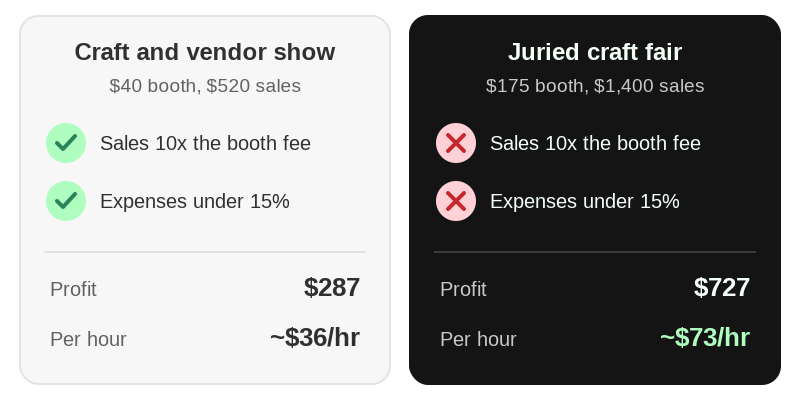
This is the pattern to watch for. The craft and vendor show passes the two ratio rules many vendors use (sales of at least 10 times the booth fee, event expenses under 15% of sales) because the booth was cheap. The juried fair misses both ratios but earns twice as much per hour. Neither is automatically better:
- If you have more free weekends than stock, the small show is a fine way to sell and meet local customers.
- If your weekends are limited, the bigger fair earns more for each one.
- If the small show's profit per hour is below what your time is worth to you, it only makes sense for another reason, like testing products or growing your email list.
Our guide is a craft fair worth it explains these rules and two more, and the free craft fair profit calculator does this math with your own numbers in a minute. For the full calculation line by line, see how to calculate craft fair profit.
FAQ
What is a craft and vendor show?
It's usually an event that welcomes both makers selling handmade goods and vendors selling products they didn't make, such as resellers and direct-sales consultants. Many are one-day events in schools, churches or community halls, often run as fundraisers.
Do I have to sell handmade items at a craft and vendor show?
Usually not, which is what separates it from a handmade-only craft fair. Each organizer sets its own rules, though, and some limit categories or the number of direct-sales vendors, so read the vendor rules before you apply.
How much does a booth at a craft and vendor show cost?
It varies by event. Booth fees at small community shows are often lower than at large juried fairs, but check what's included (a table, chairs, electricity) and compare the fee with the sales you can realistically make there.
Is a craft and vendor show worth it for handmade sellers?
It can be, especially for small, giftable products at impulse prices and for meeting local customers. Ask how many handmade sellers and how many vendors in your category are booked, then check the results with numbers: sales against the booth fee and profit per hour.