Craft Fair Booth Lighting: Battery, Plug-In and Run-Time Math
Craft fair booth lighting is easy to skip until the first indoor show in a gym with half the ceiling lights off, or the first evening market where the sun goes down at 5:30 and your table turns gray. Good light doesn't make a product better, but it lets shoppers see what you made from the aisle, in its real colors. This guide covers when lighting is worth it, battery vs plug-in, the main types of lights, where to put them, the run-time math for batteries (with worked examples), safety rules to check, what lighting costs per market, and how to test it all at home before the show.
Why lighting matters at a booth
Three situations make lighting more than decoration:
- Dim indoor halls. School gyms, church halls, convention centers and hotel ballrooms are often lit for walking, not for looking at small details. Booths along the walls or under a balcony can be noticeably darker than the center aisle.
- Evening and night markets. Once the sun goes down, an unlit booth looks closed, even with you standing in it.
- Products that depend on color or sparkle. Jewelry, glass, ceramics, prints and paintings look flat under dim or uneven light. Our craft fair jewelry display ideas and our guide on how to sell art at art fairs both come back to this: if shoppers can't see the detail, they won't pay for it.
Outdoors in daylight, lighting matters much less. A light-colored canopy and a booth facing away from the low afternoon sun usually do more than any lamp.
First question: is there power, and what does it cost?
Before you buy anything, ask the organizer:
- Is electricity available at my booth? Some shows include it, some sell it as an add-on, and many outdoor markets don't have it at all.
- If it's extra, how much, and do I need to request it in advance? At some shows, power is only available at booths near outlets, so ask early.
- What can I plug in? Some venues limit the number of devices or the total wattage per booth.
- What cord and tape rules apply? Venues usually have rules about extension cords, power strips, where cords can run and what tape can go on the floor. Check the venue's rules for cords, extension cords and tape before the show, not at setup.
If power isn't included, you have two choices: pay for it, or bring your own with batteries. A battery setup works at every event, including the ones with no outlets at all, which makes it worth considering if you do both indoor shows and evening outdoor markets. Our craft fair checklist already lists "lights and a power bank or extension cord (only if the market provides power)" for this reason.
Types of lights for a booth
| Type | Good for | Watch out for |
|---|---|---|
| Clip lights (small LED spots that clamp to a shelf, grid wall or canopy frame) | Pointing light at one display, a hero product or a sign | Glare in shoppers' eyes if aimed too low; clamps that slip on round poles |
| LED strips or light bars | Lighting a whole shelf edge, the back wall or the underside of a canopy | Adhesive that won't stick to fabric; a separate power source for each strip |
| Small table lamps | Warm, "living room" feel for home goods; lighting a counter | Easy to knock over in a busy booth; take up table space |
| Battery packs and portable power stations | Running lights with no outlet nearby | Weight; capacity (see the math below); charging them before every show |
LED lights use much less power than older bulbs for the same brightness, which is what makes battery setups practical. When you compare lights, look at the watts each one draws (on the label or in the listing). You'll need that number for the battery math.
Where to put the lights
A simple rule: light the products, not the shoppers. Lights that shine into people's eyes make them squint and step back.
- Back wall or top of the canopy first. A light along the top of your back wall makes the whole booth visible from down the aisle and lights the tallest displays.
- Angle down onto the table from above or from the front edge of a shelf, so light lands on the products and not on the shopper's face.
- Hero products get their own light. One clip light on your best piece or your best seller draws people in.
- Avoid harsh reflections. Glossy ceramics, glass and framed art can throw glare back at the shopper. Move the light to the side until the reflection disappears from where a shopper stands.
- One color of light for the whole booth. Mixed warm and cool lights make the same product look different from one end of the table to the other. Pick one and stick with it, and check how your actual products look under it.
- Keep the signs readable. If shoppers can't read prices after dark, they won't ask. Our guide to vendor booth signs covers sizes and placement.
Battery run-time math
The math is short. Add up the watts of every light you'll run at the same time, multiply by the hours you'll run them, and you get watt-hours (Wh) needed. Then compare that with the battery's capacity.
Watt-hours needed = total watts × hours
Battery packs are usually labeled in watt-hours. Phone-style USB power banks are often labeled in milliamp-hours (mAh) instead; you can convert with Wh = mAh × voltage ÷ 1,000, using the battery's internal voltage (often printed on the label, commonly 3.6 or 3.7 volts for these packs).
As a rule of thumb, plan to use only about 80% of a battery's rated capacity, so you're not counting on the last drop and have a margin for losses and cold halls. That 80% is a planning margin, not a spec.
Example 1: four clip lights at an indoor show
These are example numbers to show the math.
| Amount | |
|---|---|
| Lights | 4 clip lights × 5 watts = 20 watts |
| Hours on | 6 (selling hours) |
| Watt-hours needed | 20 × 6 = 120 Wh |
| Battery rated capacity | 256 Wh |
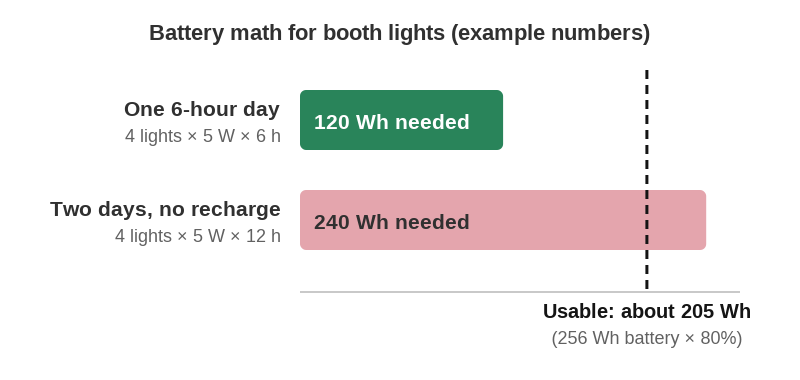
| Usable at 80% | about 205 Wh |
| Run time | 205 ÷ 20 = about 10 hours |
One day fits easily. For a two-day show without charging overnight, you'd need 240 Wh, more than this battery gives. Either recharge it at the hotel or at home overnight, bring a second battery, or turn off some lights while the hall is bright. Our guide to multi-day craft show goals covers other things that change on day two.
Example 2: two USB lights at an evening market
| Amount | |
|---|---|
| Lights | 2 USB lights × 3 watts = 6 watts |
| Hours on | 5 |
| Watt-hours needed | 6 × 5 = 30 Wh |
| Power bank | 20,000 mAh × 3.7 V ÷ 1,000 = 74 Wh |
| Usable at 80% | about 59 Wh |
| Run time | 59 ÷ 6 = about 10 hours |
A single power bank covers an evening market with room to spare. Just don't use the same power bank for your phone and card reader all night unless you've done the math for those too.
Safety and venue rules
Lighting adds cords, heat and weight to a booth, so it's worth a few minutes of care:
- Follow the venue's rules for extension cords, power strips, cord covers and floor tape. Check them before the show; they vary by venue.
- Keep cords out of the aisle and away from where shoppers walk. Tape or cover any cord that has to cross the floor of your booth, using the method the venue allows.
- Secure lights so they can't fall onto products or people. Clamp them to something solid, and check clamps again after the booth gets bumped.
- Outdoors, keep electrical gear dry and off the ground, and take lights down before packing a wet canopy. Our craft fair rain plan covers keeping gear dry.
- Charge everything the night before, and pack the chargers in case the venue lets you top up.
What lighting costs per market
Lighting is a cost like any other, and it's easy to forget when you add up a market. Here's an example season of 10 indoor or evening markets, with made-up prices to show the math:
| Pay for power at each show | Bring your own battery | |
|---|---|---|
| Lights (one time) | $60 | $60 |
| Battery or power station (one time) | $150 | |
| Electricity add-on per show | 10 × $35 = $350 | |
| Season total | $410 | $210 |
| Per market | $41 | $21 |
In this example, the battery pays for itself within the first season, and it keeps working the next year. If most of your shows include power for free, the math flips and plugging in is cheaper. Use your own prices and count of shows.
Add the per-market share to each market's costs. On a $900 market, $21 of lighting adds about 2.3 points to your expense share. That's small, but it belongs in the numbers, along with the booth fee, gas and food. Our craft fair expenses checklist has a line for equipment shares, and the free craft fair profit calculator shows profit and the expense percentage for any market.
Test it in a dark room at home
The best time to find out your lights don't work is not 15 minutes before the doors open. Before the first indoor or evening show:
- Set up your display at home in a room with the lights off or dimmed, the way you'd set it up at the show. Our guide to setting up a craft fair booth has a practice-run checklist.
- Turn on your lights and look from 10 feet away, where a shopper in the aisle would stand. Can you see every product? Can you read the prices?
- Look for glare and shadows from where a shopper would stand, and adjust angles.
- Run the lights for an hour on the battery and check how much charge is left. Multiply out to your selling hours to confirm the math.
- Take a photo, so you can set it up the same way next time.
If you're still working out the layout itself, our craft fair display ideas guide has four booth layouts and an indoor vs outdoor comparison.
FAQ
Do I need lights for an indoor craft fair?
Not always, but many indoor halls are dimmer than they look in the organizer's photos, especially along the walls. If you sell jewelry, glass, ceramics or art, a few small LED lights aimed at your products usually make a visible difference. Ask the organizer about power before you buy anything.
How do I light a craft fair booth without electricity?
Use battery-powered LED lights, or plug lights into a battery pack or portable power station. Add up the watts of your lights, multiply by the hours you'll sell, and make sure the battery's usable capacity (plan on about 80% of the rating) covers it with a margin.
How long will a battery run my booth lights?
Divide the battery's usable watt-hours by the total watts of your lights. In our example, about 205 usable watt-hours running four 5-watt lights (20 watts total) lasts about 10 hours. Test it at home to confirm.
Is it worth paying for electricity at a craft show?
It depends on the price and how often you need it. If a show charges for power and you do many indoor or evening shows, a battery setup can pay for itself in a season. If most of your shows include power, plugging in is usually cheaper. Run both through your own numbers.