Craft Fair Expenses for Taxes: What to Record at Every Market
Tracking craft fair expenses for taxes is mostly a habit problem, not a math problem. The booth fee was paid by card in February, the parking was cash, the mileage is in your head, and by April the shoebox of receipts has no labels. This guide shows what to record at every market, what the IRS says about business expenses and records, where a sole proprietor reports business income, and a simple per-market log and year-end checklist so tax season takes an evening instead of a weekend.
This is general information, not tax advice. Tax rules depend on your situation, and they change. Everything below about the IRS links to the IRS's own pages. For how the rules apply to you, ask a tax professional.
Why record expenses at the market, not in April
The IRS's guide for new businesses, Publication 583, gives the practical reason: if you don't record expenses when they happen, you may forget them when you prepare your return. It also makes a point many people miss: proof that you paid something isn't enough on its own. You also need documents, such as an invoice or a sales slip, showing what the cost was for.
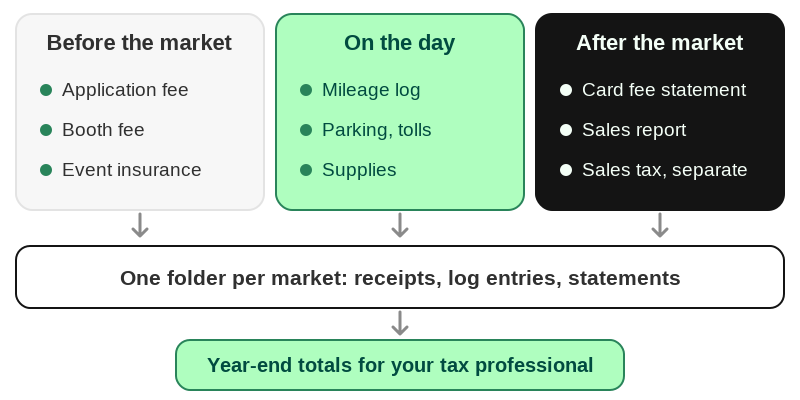
At a craft fair that means three moments to capture:
- Before: application and jury fees, the booth fee, insurance for the event, supplies bought for that market.
- On the day: mileage, parking, tolls, small cash purchases.
- After: card processing fees from your payment statement, and your sales for that market.
The IRS lets you choose any recordkeeping system that clearly shows your income and expenses. A folder per market plus one spreadsheet is a system. So is a notes app plus photos of receipts, as long as you use it every time.
What the IRS means by a business expense
The IRS's small business tax guide, Publication 334, says that to be deductible, a business expense must be both ordinary and necessary. An ordinary expense is common and accepted in your field of business. A necessary expense is helpful and appropriate for your business; it doesn't have to be indispensable.
The same guide also explains that an expense meeting that test may still be handled differently: some costs can't be deducted in the year you pay them, and personal expenses aren't business expenses at all. Which category each of your costs falls into is exactly the kind of question a tax professional answers quickly once your records are clean.
What to keep for each kind of market cost
The IRS's page on what kind of records to keep says supporting documents for expenses should show the payee, the amount paid, proof of payment, the date, and a description of what you bought or the service you received. Here's how that maps to typical market costs:
| Market cost | What to keep |
|---|---|
| Application or jury fee | The receipt or confirmation email, even if you weren't accepted |
| Booth fee | The invoice or confirmation, plus the card or bank statement line |
| Event insurance | The policy or certificate and the payment receipt |
| Mileage | A log entry: date, destination, purpose, miles |
| Parking and tolls | Receipts, or a note with date, place and amount if no receipt was given |
| Hotel for multi-day shows | The hotel folio showing dates and amount paid |
| Bags, tags, signs, display supplies | Store receipts or order confirmations |
| Materials for products | Supplier receipts and invoices |
| Card processing fees | Your payment processor's statement or report |
| Helper pay | A record of who, when, hours and amount paid |
For mileage, the IRS's travel and car expense guide, Publication 463, lists what to record for each business trip: the date, the business destination and purpose, and the mileage, plus your total miles for the year. It describes two ways to figure car expenses, the standard mileage rate or actual car expenses, and says business parking and tolls can be deducted under either method. Our guide to the 2026 business mileage rate explains this year's rate, which changed in the middle of the year.
Food on market day is a gray area for many sellers. Publication 463 covers meals along with travel and car costs; ask your tax professional how it applies before you count it.
A per-market expense log
Keep one row per cost, grouped by market, and file the receipts in a folder with the same name. An example for one Saturday (made-up numbers):
| Date | Market | Cost | Paid to | Amount | Proof |
|---|---|---|---|---|---|
| Feb 3 | Spring Makers Market | Application fee | Market organizer | $25.00 | Email receipt |
| Mar 1 | Spring Makers Market | Booth fee | Market organizer | $85.00 | Invoice + card statement |
| May 9 | Spring Makers Market | Mileage, 62 miles round trip | $44.95 | Mileage log | |
| May 9 | Spring Makers Market | Parking | City garage | $8.00 | Receipt photo |
| May 6 | Spring Makers Market | Bags and price tags | Craft supply store | $14.00 | Receipt |
| May 9 | Spring Makers Market | Card processing fees | Payment processor | $21.84 | Monthly statement |
| Total recorded | $198.79 |
The mileage line uses the IRS's standard rate for that date (62 miles × $0.725 = $44.95). If you use the actual-expense method instead, you'd log the miles the same way and work out the cost differently, so ask which method fits you before your first return with the business.
Two columns worth adding on the sales side: total sales for the market and sales tax collected, kept separately. More on that below.
This is the same information you need to know whether the market was worth it. Our craft fair expenses checklist lists every cost to look for, a craft fair profit spreadsheet keeps one row per market with the totals, and the free craft fair profit calculator turns one market's numbers into profit, expense share and profit per hour.
Where a sole proprietor reports it: Schedule C
If you sell as a sole proprietor, the IRS's Instructions for Schedule C describe the form as the place to report income or loss from a business you operated or a profession you practiced as a sole proprietor. The instructions also explain that an activity counts as a business when your primary purpose is income or profit and you're involved with continuity and regularity. A sporadic activity or a hobby doesn't qualify. If you do two craft fairs a year mostly for fun, that's a conversation to have with a tax professional before you file anything.
For makers, the product side has its own part of the form. The Schedule C instructions and Publication 334 explain cost of goods sold for businesses that make or buy products to sell, and Publication 334 notes that a small business taxpayer can choose not to keep an inventory but must still use a method that clearly reflects income. In plain terms: keep your materials receipts separate from your market costs, and keep a rough count of finished stock at the start and end of the year. Our craft fair inventory sheet helps with the count.
A practical way to sort your log for your tax professional, without guessing at form lines:
- Selling costs of each market: application and booth fees, event insurance, parking, card processing fees, helper pay.
- Car: your mileage log for the year.
- Supplies: bags, tags, signs, display pieces bought for markets.
- Product costs: materials and packaging that become part of what you sell.
- Equipment that lasts: a canopy, weights, shelving. Larger items that last for years may be handled differently from supplies; list them with date and price and ask.
Sales tax you collect isn't the same as your sales
At the booth, sales tax is easy to blur into the total. Keep it in its own column. For your profit, the tax you collect belongs to the state, so leave it out of your market's sales, as our craft fair sales tax guide explains.
On the federal side, the Schedule C instructions say how to treat it depends on whether your state's sales tax is imposed on the seller or on the buyer. When the tax is imposed on the buyer and you just collect and pay it over, the instructions say it isn't included in gross receipts and isn't a deductible expense. When it's imposed on you as the seller, the treatment is different. Your state's rules decide which case you're in, which is another reason to keep the number separate all year.
How long to keep the receipts
The IRS's page on how long to keep records says you generally keep records that support an item on your return until the period of limitations for that return runs out. The standard period is 3 years, and it's longer in some cases (the page lists them). Records about property, such as equipment, have their own timing. A simple habit: one folder per year, per market inside it, and don't throw a year away until you've checked the IRS page or asked your tax professional.
Year-end checklist
- Every market from the year has a row in your log and a folder of receipts.
- Mileage log totaled for the year, with the rate period noted for each trip.
- Card processor statements downloaded for all 12 months.
- Sales per market totaled, with sales tax collected kept separate.
- Materials receipts separated from market costs.
- Rough count of finished stock at the end of the year.
- Equipment bought this year listed with date and price.
- Questions written down for your tax professional (meals, equipment, hobby or business).
Thirty minutes after each market keeps this list short. Our craft fair season review uses the same numbers to decide which markets to rebook.
FAQ
Are craft fair booth fees tax deductible?
The IRS allows deductions for business expenses that are ordinary and necessary, and a booth fee paid to sell your products is the kind of cost that test is about. Whether and how you deduct it depends on your situation, such as whether your selling counts as a business. Keep the receipt and ask a tax professional.
What if I paid cash and didn't get a receipt?
Write it down right away: who you paid, the amount, the date, what it was for, and how you paid. The IRS says supporting documents should show those details. A photo of a handwritten note or a log entry is far better than trying to remember in April.
How long should I keep craft fair receipts?
The IRS generally says to keep records that support your return until the period of limitations runs out, usually 3 years, with longer periods in some cases. Check the IRS's "How long should I keep records?" page or ask your tax professional.
Is the sales tax I collect at markets part of my income?
For your own profit math, keep it out of your sales because it goes to the state. For your federal return, the Schedule C instructions treat it differently depending on whether the tax is imposed on the buyer or on you as the seller, so keep it in a separate column and ask a tax professional.