Craft Fair Bags and Packaging: What to Buy and What It Costs
Craft fair bags and packaging are easy to treat as an afterthought: grab a stack of bags the night before and hope they fit. But packaging does three jobs at a booth. It gets the item home in one piece, it makes checkout fast, and it puts your name in front of the buyer again when they unpack. It also costs money on every sale, which most vendors never count. This guide covers sizes, paper versus plastic, branding, fragile items and gift wrap, then works out what packaging really costs per sale and per market with example numbers.
Match bag sizes to what you actually sell
The most common packaging mistake is one bag size for everything. A tiny pair of earrings rattles around in a big bag, and a mug doesn't fit in a small one. Look at your product list and group items by size. Most booths need two or three sizes, not ten.
| Product size | Examples | What usually works |
|---|---|---|
| Small and flat | Earrings, cards, stickers, small prints | Small paper bags or kraft envelopes, roughly 5 by 7 inches |
| Medium | Candles, soap, mugs, small bowls | Medium bags with a flat bottom so items stand up |
| Large or flat and stiff | Large prints, framed pieces, textiles | Large flat bags, or prints in sleeves with a stiff backer |
| Fragile | Ceramics, glass, anything with a thin edge | A small box or wrap plus a medium bag |
The sizes in the table are a starting point, not a standard. Put your three most popular products on the kitchen table, try them in a few bag sizes, and pick the smallest one each fits in with a little room. Smaller bags cost less and take less space in the car.
Paper, plastic or reusable
There's no single right answer. Each option has trade-offs:
| Paper bags | Plastic bags | Reusable totes | |
|---|---|---|---|
| Look | Simple, takes a stamp or sticker well | Varies; can look less handmade | Can carry your name for years |
| Weather | Weak in rain unless kept dry | Holds up in rain | Holds up |
| Cost per bag | Low | Low | Much higher, so usually sold, not given |
| Best for | Most handmade booths | Wet markets, food, heavy items | Selling as a product, or for big purchases |
One thing to check before you buy: some cities and states ban single-use plastic bags or require a fee for bags at checkout, and those rules can apply at markets and events. They differ by place, so check your city or county rules and ask the organizer, especially if you sell in more than one town.
A simple habit that saves both bags and money: ask "Do you need a bag?" Many shoppers already carry a tote, and a pair of earrings fits in a pocket.
Branding that costs almost nothing
You don't need custom-printed bags to make packaging feel like yours. Cheap options that work on plain paper:
- A rubber stamp with your name or logo on each bag. A stamp and an ink pad last a long time.
- A sticker to seal the bag or the tissue. It looks finished and carries your name.
- A card inside every bag, with your website and where you'll be next. Our guide to business cards for handmade crafts covers what to print on it.
The card is the piece that does the most work after the market. A bag gets recycled; a card on the fridge reminds someone to visit your shop or come back to your booth.
Protecting fragile items
If you sell ceramics, glass or anything that chips, packaging is part of the product. A mug that breaks on the way home is a lost sale and an awkward email.
- Wrap first, then bag. A couple of sheets of tissue or packing paper around a mug, then the bag.
- Use boxes for the most fragile pieces. A small box costs more per sale, but only for the items that need it.
- Pre-cut your wrap at home so wrapping takes seconds, not minutes, when there's a line.
- Show the buyer how it's wrapped. People handle a package more carefully when they've seen it's fragile.
If something does break, decide in advance how you'll handle it. Our guide to a craft fair refund policy has wording you can adapt.
Gift wrap at holiday markets
At holiday markets many purchases are gifts, and wrapping becomes a real question. Three ways to handle it:
- Free simple wrap: tissue plus a sticker inside the bag. Fast, cheap and good enough for most gifts.
- Paid gift wrap: a box and ribbon for a small extra charge. It adds work at the booth, so it suits quieter moments or a helper.
- Pre-wrapped gift sets: bundles that are ready to give, wrapped at home before the market. This saves time at the busiest moments.
Wrapping takes time at the booth, and time is when you're not serving the next customer. If lines are common at your holiday markets, wrap ahead or keep the free version simple. Our Christmas market vendor guide covers the rest of the holiday season, from stock to staffing.
What packaging costs per sale and per market
Here's where most vendors underestimate. Packaging is a small cost per order, but it adds up over a market and a season. An example with made-up prices, just to show the math:
| Per order (example prices) | Cost |
|---|---|
| Paper bag | $0.25 |
| Sheet of tissue | $0.05 |
| Sticker seal | $0.06 |
| Business card | $0.08 |
| Packaging per order | $0.44 |
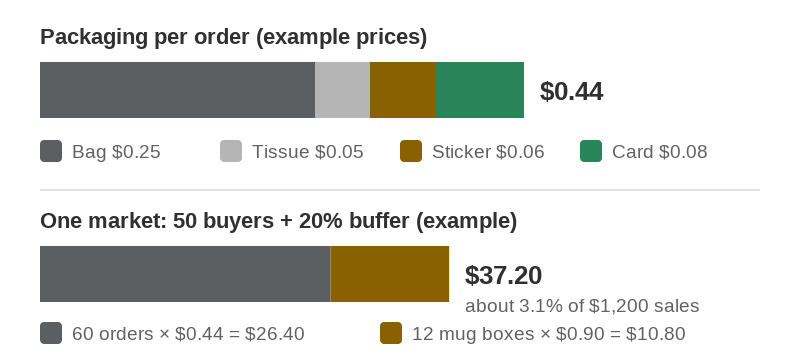
Now one market. Say you expect $1,200 in sales at an average of $24 per buyer: that's 50 buyers. Bring a buffer of about 20%, so packaging for 60 orders.
| One market (example) | Cost |
|---|---|
| 60 orders × $0.44 | $26.40 |
| 12 small boxes for mugs × $0.90 | $10.80 |
| Packaging for the market | $37.20 |
| Share of $1,200 in sales | about 3.1% |
About 3% of sales sounds small, but on a market where event costs already sit near 15% of sales, it's the difference between passing and missing the target. It's also money you spent whether or not you noticed.
How many bags to bring
Work backward from the number of buyers you expect, the same way you plan stock:
- Expected sales ÷ average sale = expected buyers. In the example, $1,200 ÷ $24 = 50 buyers.
- Add a buffer of about 20% for a better-than-expected day: 60 orders.
- Split by size using last market's sales. If most sales are small items, the split might be 40 small, 15 medium and 5 large bags.
- Bring boxes only for the fragile items you expect to sell, plus a few extra.
Our guide on how much inventory to bring to a craft fair explains how to estimate expected sales and average sale from past markets. After each market, count what's left in the packaging box. Two markets of leftovers tell you to bring less; running out tells you to bring more.
Put packaging in your profit math
Packaging is a real cost, so count it. You have two consistent ways:
- Inside product cost. Add the per-order packaging to each product's cost when you price it. Simple, and it's already covered by your prices.
- As a market expense. Add the market's packaging total to that market's costs, next to the booth fee and gas.
Either works; just don't do both, and don't do neither. Our craft fair expenses checklist lists packaging with the other costs vendors forget, and the free craft fair profit calculator has a field for other costs where the market's packaging total fits.
Eco-friendly choices without overpromising
Many shoppers like less packaging, and less packaging also costs less. A few practical choices:
- Ask before bagging. "Do you need a bag?" saves bags on every sale where the answer is no.
- Reuse boxes and paper from your own supply deliveries for wrapping fragile items.
- Choose plain paper and stickers over printed plastic.
- Be careful with labels. If a sign at your booth says your packaging is recyclable or compostable, make sure the supplier's own packaging or product page says so for that exact item. Don't guess.
A small packing station at the booth
Set up a corner of the table, or a box under it, for packaging, near where you take payment:
- Bags sorted by size, open side up.
- Tissue and wrap pre-cut.
- Stickers and cards in a small tray.
- A few boxes for fragile items.
When packaging lives in one spot, checkout is fast, and you can see at a glance when something is running low. Our printable craft fair checklist includes bags and tissue so they don't stay on the kitchen table.
FAQ
What kind of bags should I use at a craft fair?
Most handmade booths do well with plain paper bags in two or three sizes that match their products, a stamp or sticker with their name, and a card inside. Use boxes or extra wrap for fragile items, and check local rules before using plastic bags.
How many bags do I need for a craft fair?
Divide your expected sales by your average sale to estimate buyers, then add about 20%. For example, $1,200 in expected sales at $24 per buyer is about 50 buyers, so bring packaging for around 60 orders, split by size.
How much does packaging cost per sale?
It depends on what you use. In our example, a paper bag, tissue, a sticker and a business card came to $0.44 per order, and packaging for a whole market came to about 3.1% of sales once boxes for fragile items were added.
Should I offer gift wrap at a holiday market?
You can, but wrapping takes time at the booth. Many vendors keep it simple with tissue and a sticker, charge for fancier wrap, or bring pre-wrapped gift sets so busy moments stay fast.