How to Sell Art at Art Fairs: Prices, Display and Real Profit
Learning how to sell art at art fairs is different from selling candles or earrings. A painting can take weeks to make, a single original may be most of your weekend's income, and the shows with the best buyers often have the most expensive booths. This guide is for painters, illustrators and photographers: how to build a price ladder from cards to originals, how to display and protect the work, what juried applications look for, how to talk about your art without a sales pitch, and how to tell whether a show actually paid you once the booth, hotel and gas are counted.
Originals, prints and small items: build a price ladder
Most artists who sell at fairs don't rely on originals alone. A booth with only $800 paintings asks every visitor for a big decision. A booth with a ladder of prices gives everyone a way to take something home, and the smaller sales often cover the booth while the originals make the weekend.
Here's an example ladder for a painter (made-up prices to show the structure):
| Step | Example items | Example price | Role |
|---|---|---|---|
| Small | Cards, stickers, bookmarks | $5 to $15 | Impulse buys, gifts, a first purchase |
| Prints | 8x10 and 11x14 prints, matted in sleeves | $25 to $60 | Most of the units you sell |
| Large prints | Limited editions, canvas prints | $80 to $200 | Wall pieces for people who love the work |
| Originals | Paintings, drawings, framed photographs | $300 and up | The reason people stop, and the biggest sales |
A few pricing habits help:
- Price originals consistently. One common approach is a size-based formula (for example a rate per square inch) so similar pieces have similar prices and buyers can see the logic. Whatever method you choose, use it everywhere, including online.
- Count framing and materials in the cost. A $90 frame on a $400 painting is a real cost. Our guide on how to price items for a craft fair shows how to build cost into a price.
- Make print pricing simple. One price per size ("All 8x10 prints $30") is faster to read and sell than individual tags.
Display: let the work be seen from the aisle
Art sells when people can see it from a distance and then step closer. A few principles that apply to most art booths:
- Vertical space is your wall. Panels or grid walls on three sides turn a 10 by 10 booth into a small gallery. Hang the strongest originals at eye level on the back wall, where people see them from the aisle.
- Leave space around originals. A crowded wall makes every piece look smaller. Fewer pieces, well spaced, read as more valuable.
- Prints in bins at waist height. Browsers flip through bins at their own pace, which is how many print sales happen. Keep sizes together and the price sign above each bin.
- Light the work indoors. Indoor halls can be dim, and dim light flattens color. Clip lights or small track lights on the panels make a visible difference.
- A clear path in. If people can't step into the booth, they'll look at your art from the aisle for two seconds and walk on.
Our guide to craft fair display ideas has layouts for a 10 by 10 space, and our artist alley display guide covers table setups for conventions, where you get one table instead of a booth.
Juried applications: the images do the work
Many art fairs are juried, which means a panel reviews images of your work and your booth before accepting you. The show's prospectus (the document with its rules) lists what it wants: how many images, what size, whether a booth image is required, and what counts as original work. Read it before you shoot anything.
What usually helps:
- A consistent body of work. Images that look like one artist made them, rather than a sampler of different styles.
- Clean, accurate photos. Even light, no glare on glass, square to the camera, nothing in the background.
- A booth image that looks like a gallery. Set up your panels at home if you have to.
- Honest categories. If the show separates originals from prints, or painting from photography, apply in the right one.
Our craft fair vendor application guide covers photo sets, descriptions and how to budget for jury fees, which are often not refunded if you aren't accepted.
Packing and protecting the work
Art is easy to damage between the studio and the booth. A packing system pays for itself the first time it saves a painting:
- Prints in clear sleeves with a backing board, so they stay flat and clean while people flip through them.
- Originals in padded boxes or wrapped with corner protectors, standing upright in the car, not stacked flat.
- Glass and frames wrapped individually; consider acrylic glazing for pieces that travel a lot.
- A weather plan for outdoor shows: sidewalls, tarps and bins with lids, and a way to cover the walls fast. Paper and canvas don't forgive a sudden shower. Our craft fair rain plan covers the full kit.
- Wrapping for buyers: sleeves, kraft paper, tape and a bag big enough for your largest piece, so a sale isn't lost because someone can't carry it home.
Talking about the work
People who stop at an art booth often want to know who made it and how. You don't need a pitch, just a few honest lines:
- A greeting that isn't a question about help. "Hi, these are all my paintings" opens a conversation better than "Let me know if you have questions."
- One sentence about each series. Where it was painted, what it's about, what medium.
- Answer prices plainly. "That one is $650, framed." No apology.
- Offer the next step down the ladder. "If that one's too big for your wall, the same image comes as an 11x14 print."
Our guide on what to say to customers at a craft fair has more example lines, including how to respond to "I'll come back later."
Sales tax and paperwork
Selling art in person is still selling taxable goods in most states that have a sales tax, and art fairs often ask for your seller's permit or tax ID on the application. The rules depend on the state where the show takes place, so check before you sell, especially for shows outside your home state. Our craft fair sales tax guide explains how a few states handle one-day events. This isn't tax advice; confirm with the state or a tax professional.
Is the show worth it? Do the math with every cost
Art fairs with strong buyers often have high booth fees, and the best ones may be far from home. That's why you need to count everything, not just the booth. Here are two example shows (made-up numbers):
| Regional art fair (2 days) | Local market (1 day) | |
|---|---|---|
| Sales | $3,200 | $1,150 |
| Booth fee | $450 | $120 |
| Jury fee | $35 | $0 |
| Hotel, gas, food | $410 | $35 |
| Event costs | $895 | $155 |
| Product costs (framing, prints, cards) | $598 | $200 |
| Card fees (about 3%) | $96 | $35 |
| Profit | $1,611 | $760 |
| Hours (packing, travel, setup, selling, teardown) | 35 | 12 |
| Profit per hour | about $46 | about $63 |
| Sales ÷ booth fee | 7.1x | 9.6x |
The regional fair made twice the profit, but the local market paid more per hour and used half a weekend. Neither number counts the hours you spent creating the originals, so if most of your sales come from originals, keep in mind that those hours happened before the show.
Both shows fall short of the "sales at least 10 times the booth fee" rule many vendors use, and the regional fair's event costs are 28% of sales. That doesn't automatically mean skip it: if the regional show brings commissions, gallery contacts or buyers who come back, write those down next to the numbers (our guide to custom orders at craft fairs covers pricing and deposits for commissions). Our guide is a craft fair worth it explains the rules and how to weigh them, and the free craft fair profit calculator does this math for any show in a minute.
A simple plan for your first art fair
- Choose a show that fits your price range. Visit it first if you can, and look at what other artists charge.
- Build the ladder so there's something at every step, with prints making up most of the stock.
- Set up the booth at home, take the booth photo for applications and time the setup.
- Pack in sleeves, boxes and bins, with a rain plan for outdoor shows.
- Track every cost and every hour, then compare shows by profit per hour after the season.
FAQ
What sells best at art fairs, originals or prints?
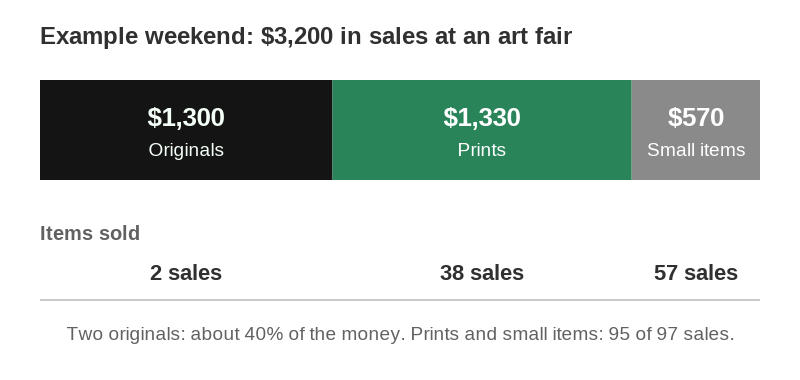
It depends on your work and the show's buyers. In the example in this guide, prints and small items were 95 of the 97 items sold, while two originals brought about 40% of the money. Track both for each show to see your own pattern.
How should I price my art for an art fair?
Start from your costs, including framing and materials, and use a consistent method for originals, such as a rate based on size, so similar pieces have similar prices. Keep the same prices at fairs and online, and build a ladder from small items to originals.
Do I need to collect sales tax when selling art at a fair?
In most states with a sales tax, art is taxable when you sell it in person, and many shows ask for your seller's permit. Rules depend on the state where the show takes place, so check with that state before you sell.
How do I know if an art fair was worth it?
Add up every cost (booth, jury fee, travel, hotel, food, framing and card fees), subtract it from sales, and divide by all the hours you spent. Compare that profit per hour across shows, and note any commissions or contacts that came from the show.