Farmers Market Vendor Application: How to Get Accepted
A farmers market vendor application is usually short, but it does a lot of work. The market manager has to decide from a few pages whether you really grow or make what you'll sell, whether your products fit the market's mix, and whether your paperwork will hold up if something goes wrong. This guide goes through what applications usually ask for, how markets choose between applicants, a product list and description you can adapt, the paperwork to gather and when, and what to do if you land on a waitlist.
Every market writes its own rules, and they vary a lot from city to city and state to state. To keep this concrete, the examples below come from three official sources: the City of Ann Arbor's market in Michigan, the Town of Carmel's market in New York, and California's rules for certified farmers' markets. Use them as examples of what to expect, then read your own market's rules.
What a farmers market vendor application usually asks
Most forms ask for some version of the following:
- Who you are: your name, business name, contact details, and sometimes a website or social account.
- That you produce what you sell. Many markets are producer-only. Ann Arbor's 2026 applicant FAQ says applicants must be the grower, producer or maker of the items they apply to sell.
- Where it's grown or made: farm address and what you grow there, or the kitchen or studio where you make your products.
- A product list, often with the season for each item.
- Photos of your products and sometimes of your stand.
- Permits and licenses for what you sell. Ann Arbor asks for all applicable certifications and licensing with each application.
- Proof of insurance. Carmel's application asks for $1,000,000 in general liability coverage with the Town named as additional insured, plus proof of product liability.
- A sales tax certificate if you sell taxable items. Carmel lists this too.
- Attendance: full season, part of the season, or single days.
- Stall needs: tent size, vehicle, power, and whether you'll bring your own table and canopy.
If you sell food that shoppers can buy with food assistance benefits, the market may ask whether you'll take its tokens. Ann Arbor's market, for example, explains that only vendors selling eligible foods can accept SNAP tokens, that vendors don't give change on them, and that vendors should display signs showing which tokens they take.
How markets choose vendors
Knowing what the manager is weighing helps you write a better application.
Proof that you're the producer. This is the big one at many markets. California is the strictest example: to sell your own produce at a certified farmers' market, you need a Certified Producer's Certificate from the county agricultural commissioner, the commissioner inspects the property before issuing a first certificate, the certificate lasts up to 12 months, and you can only sell the products listed on it. Buying from another producer to resell isn't allowed. Other states are less formal, but managers in many markets still visit farms or ask detailed questions.
Product mix. A market wants shoppers to find a bit of everything. If three bakers already sell bread, a fourth faces a harder decision than a grower with cut flowers or mushrooms. Ask the manager what the market is missing before you apply.
A complete application. Carmel's checklist says it won't accept applications that are missing the certificate of insurance and permits. A missing page can cost you a spot even when your products are a perfect fit.
Seniority and lists. Long-running markets often give stalls to returning vendors first. Ann Arbor's rules give stalls on each market day to annual vendors first and then to daily vendors in order of seniority, and new vendors join the end of the daily vendor list. Getting accepted and getting a stall every week are two different steps.
A product list you can adapt
A clear product list answers the manager's questions before they ask. Here's a format with example rows (made-up products, to show the level of detail):
| Product | Grown or made by you? | Where | Season | Price range | Notes |
|---|---|---|---|---|---|
| Heirloom tomatoes | Grown | Our farm, 4 acres | July to September | $4 to $6 per lb | Sold by weight |
| Cut flower bouquets | Grown | Our farm | June to October | $12 to $25 | |
| Sourdough loaves | Made | Home kitchen | All season | $9 to $12 | Cottage food label |
| Beeswax candles | Made | Home studio | All season | $8 to $22 | Only if the market allows non-food items |
Two details make a list stronger. First, the season column shows the manager when you'll have something to sell, which matters for planning the mix week by week. Second, the notes column shows you've thought about the rules: selling by weight means a scale that meets your state's rules, and home-kitchen food means your state's cottage food rules apply. Our farmers market vendor permit guide covers those requirements with official examples.
A short description that answers the real questions
Most forms have a box for a description. Skip the adjectives and answer what the manager wants to know: what you sell, that you produce it, where, and what makes your stand different. A template:
We grow [crops] on [size] in [county], and sell [products] from [month] to [month]. Everything at our stand is grown or made by [who]. We'd add [what's missing at the market, if you know] and can attend [full season, half season or specific dates].
For example:
We grow heirloom tomatoes, peppers and cut flowers on 4 acres in Washtenaw County, and sell from June to October. Everything at our stand is grown by our family. We'd add bouquets to the market's mix and can attend the full season.
If you also sell at craft fairs, the description there does a different job; our craft fair vendor application guide covers jury photos and descriptions for that side.
The paperwork checklist, with timing
Gather everything before the application opens, so you can submit a complete file on day one. A simple timeline:
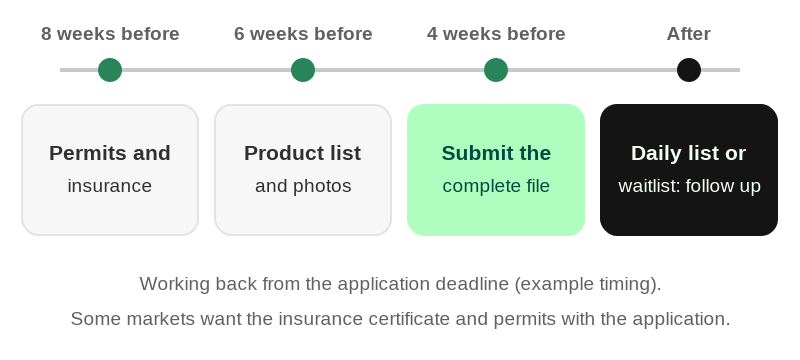
| Item | When to start | Note |
|---|---|---|
| Insurance certificate naming the market | 8 weeks before the deadline | Some markets want it with the application; see our event vendor insurance guide |
| Sales tax certificate or seller's permit | 8 weeks before | Only if you sell taxable items |
| Product permits (cottage food, health, certified producer) | 8 weeks or more before | Inspections take time |
| Product list and description | 6 weeks before | Use the format above |
| Photos of products and your stand | 6 weeks before | Set the stand up at home if you have to |
| Application and fees | As soon as it opens | Check what's refundable |
Season, half season or single days
Many markets price attendance in tiers. Carmel's 2026 market, for example, lists $720 for the full season of 18 Sundays, $360 for half a season and $200 for one day a month. If you attend every week of the full season, that's $720 ÷ 18 = $40 per market day.
Before you choose, compare that daily cost with what you expect to sell. If you think you'll sell about $400 on a typical Sunday, a $40 stall is a tenth of your sales, in line with the rule of thumb many vendors use. If you expect $200, the same stall takes 20%, and single days may be the safer start. The free craft fair profit calculator works for market days too: put in your sales, stall fee, gas and product costs to see what a day actually leaves. Our guide on how to become a vendor at a farmers market compares daily, season and percentage fees in more detail.
If you land on a waitlist or a daily list
Being accepted but not getting a weekly stall is common at established markets. A few things help:
- Ask how the list works. In Ann Arbor, daily-vendor seniority starts on the date a complete application is approved, and the market's operating rules ask daily vendors to attend a minimum number of market days to keep their place. Your market may count differently.
- Show up when you can. Being available for open stalls, especially early and late in the season, is how many vendors move up.
- Keep paperwork current. An expired insurance certificate or permit can quietly take you off the list.
- Fill gaps you can actually fill. If the manager mentions a missing product you could grow next season, say so on your next application.
- Sell elsewhere meanwhile. A smaller market, a farm stand or a craft fair keeps your sales going and gives you photos for the next application.
Common reasons applications get turned down
- Missing pages, especially insurance and permits.
- Reselling products the vendor didn't grow or make at a producer-only market.
- A product category the market already has enough of.
- Non-food products at a market that doesn't allow them.
- A vague product list that doesn't show what you'll bring and when.
FAQ
What do I need for a farmers market vendor application?
Usually your contact details, a product list with seasons, proof that you grow or make what you sell, photos, the permits and licenses your products need, an insurance certificate and a sales tax certificate if you sell taxable items. Check your market's checklist, since requirements vary.
Do farmers markets require insurance?
Many do. The Town of Carmel's market, for example, asks for $1,000,000 in general liability coverage with the Town named as additional insured, plus proof of product liability. Read your market's rules for the exact limits.
Can I resell produce at a farmers market?
At producer-only markets, no. California's certified farmers' markets, for example, only allow certified producers to sell the products listed on their certificate and don't allow buying from another producer to resell. Some markets allow a limited amount of resale; ask the manager.
What should I do if I'm put on a waitlist?
Ask how the list is ordered and what keeps your place, make yourself available for open stalls, keep your insurance and permits current, and keep selling at other markets in the meantime.