How to Sell Handmade Crafts Online: Options, Fees and Math
If you already sell at craft fairs and markets, learning how to sell handmade crafts online is less about starting over and more about adding a second door to the same shop. The products, prices and stock are mostly there. What changes is who brings the shoppers, what each sale costs you, and how many hours go into photos, listings and packing. This guide compares the main options using each company's own published fees, works through what a $30 item actually leaves you on each, and shows how to tell whether online or in-person selling earns more for your time.
A disclosure first: BoothVerdict, the app behind this blog, is being built for sellers who use Shopify POS. To keep this comparison fair, every fee below comes from the provider's own page, linked and checked in November 2026. Fees change, so confirm them before you decide.
The main ways to sell online
- A marketplace for handmade goods, such as Etsy or Amazon Handmade. Shoppers are already there searching; you pay per listing or per sale.
- Your own online store, built on a platform like Shopify or similar services. You pay a monthly plan and card fees, keep more of each sale, and bring your own shoppers.
- Social selling: posting on Instagram, Facebook or TikTok and sending people to your store or a payment link. The fees are whatever your store or payment service charges; the cost is mostly your time.
Many makers combine them: a marketplace for discovery, their own store for repeat customers, and social posts to point people to both.
Websites for selling handmade crafts: how to choose
When people search for websites for selling handmade crafts, they usually want a list. The more useful question is which job you need the website to do, because the same site can be a great fit for one maker and a poor one for another:
| What you need most | Look for | Questions to ask before you sign up |
|---|---|---|
| Shoppers who don't know you yet | A marketplace with search traffic for handmade goods | What's the fee per listing and per sale? Are there ads fees you can't turn off? |
| A home for repeat customers from markets | Your own store with your own address | What's the monthly plan? Can it share inventory with your card reader at markets? |
| Selling a few items between markets | A simple store page or payment links | What does each sale cost? Can you take preorders for market pickup? |
| Custom orders | Any option that lets you quote and invoice | Can you take a deposit? How do refunds work? |
Whichever sites you pick, check three things on their own pages before you list a single product: the full fee schedule (listing, transaction, payment processing, ads), whether you can export your orders, and how payouts work. Fees change, which is why every number in this guide links to the page it came from.
What each option charges (published US fees)
| Etsy | Amazon Handmade | Own store (Shopify Basic) | |
|---|---|---|---|
| Monthly cost | None required | $39.99 Professional plan, waived after the first month for approved Handmade sellers | $39 a month, or $29 a month billed yearly |
| Listing fee | $0.20 per listing; a listing lasts 4 months or until the item sells | None listed | None |
| Fee on each sale | 6.5% transaction fee, including the shipping you charge | Referral fee of 15% or $0.30, whichever is greater | None |
| Payment processing | 3% + $0.25 per order (Etsy Payments, US) | Not listed separately on the Handmade page | 2.9% + 30¢ online card rate |
| Optional or extra | Offsite Ads fee of 15% or 12% on orders from those ads, depending on shop sales | ||
| Source | Etsy fees policy, payment processing | Amazon Handmade | Shopify pricing |
Square also offers a free online store plan, but its own pages showed two different online card rates when we checked, so it isn't in the table. Look at its online store plans page for the current number.
A $30 item on each: what's left
Here's one sale worked through on each option. The numbers for postage, packaging and product cost are examples; the fees use the published rates above. To keep it simple, shipping is built into the $30 price (so the customer sees "free shipping") and sales tax is left out.
| Etsy | Amazon Handmade | Own store (Shopify Basic) | |
|---|---|---|---|
| Customer pays | $30.00 | $30.00 | $30.00 |
| Listing fee | $0.20 | ||
| Transaction or referral fee | $1.95 | $4.50 | |
| Payment processing | $1.15 | $1.17 | |
| Fees on this sale | $3.30 | $4.50 | $1.17 |
| Postage and packaging (example) | $6.00 | $6.00 | $6.00 |
| Product cost (example) | $9.00 | $9.00 | $9.00 |
| Left before monthly costs | $11.70 | $10.50 | $13.83 |
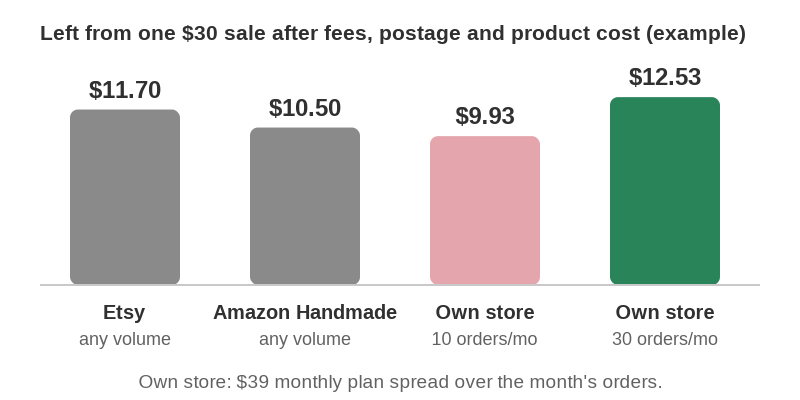
Your own store keeps the most per sale, but it has a monthly plan to cover. Spread $39 a month over your orders:
- At 10 orders a month, that's $3.90 per order, leaving $9.93: less than either marketplace.
- At 30 orders a month, it's $1.30 per order, leaving $12.53: more than either.
The own store pulls ahead of Etsy once its $2.13 per-order advantage covers the plan: about 19 orders a month on monthly billing, or about 14 on yearly billing ($29 ÷ $2.13).
The math leaves out the biggest difference: traffic. On a marketplace, shoppers who have never heard of you can find you in search. On your own store, almost every visitor is someone you sent there, from a market, an email or a social post. That's why many makers start on a marketplace and add their own store once they have repeat customers to send to it.
Can you sell crafts online for free?
Not entirely. Some options have no monthly fee, but every one charges something when you sell:
- Etsy has no required monthly fee, but charges $0.20 per listing plus the transaction and processing fees on each sale.
- Amazon Handmade waives the monthly plan after the first month for approved sellers, but takes a 15% referral fee (at least $0.30) per item. Our guide to selling on Amazon Handmade covers approval and the math in more detail.
- Free store plans from payment companies usually have no monthly cost but a higher card rate per sale.
- Social posts cost nothing to publish, but you still need a way to take payment, and that service charges a fee.
So "free" usually means "no monthly fee." For a maker with a few online sales a month, that's often the right starting point.
Make online and market sales work together
Selling in both places works best when they feed each other instead of running as two separate businesses.
- Same products, one stock count. If the same mug can sell at your booth and online, you need to know when it's gone. Some systems share one inventory between the POS and the online store; with separate systems, update counts after every market.
- Markets bring the repeat buyers. People who met you at a booth are the easiest online customers you'll ever get. Collect emails at the booth and give them a reason to visit your shop later; our guide on how to get repeat customers from craft fairs covers how, and a card in every bag with your web address helps (see business cards for handmade crafts).
- Online brings people to markets. Post where you'll be next on your shop and social accounts.
- Keep prices consistent. Shoppers who see a lower price online after buying at your booth feel cheated. If shipping is built into online prices, explain it, or keep in-person prices the same and treat the booth as "no shipping, take it home today."
Photos and shipping basics
Photos sell online the way your booth sells in person. Shoot in natural light on a plain background, show the item alone, in use, and next to something for scale, and keep the style consistent across listings. The photo habits from our craft fair vendor application guide work here too.
Shipping is a cost you control. Weigh a packed item, look up postage for the size and weight, and add packaging (box, filler, tape, label). Then decide: charge shipping separately, or build it into the price as in the example above. Fragile items need more packing time and materials, so count both.
Which channel earns more for your time?
Fees are only half the story. The other half is hours. Online selling takes time for photos, writing listings, answering messages and packing orders. Markets take time for travel, setup and a full day at the booth.
An example month, using the Etsy column above:
| Online (20 Etsy orders) | One-day market | |
|---|---|---|
| Left after fees and costs | $234 | $492 |
| Hours (photos, listings, packing / travel, setup, selling) | 14 | 9 |
| Per hour | about $17 | about $55 |
The market figure is the example from our craft fair checklist; the online hours are made up, so time your own. Your numbers may point the other way: a busy online shop with photos already done can beat a slow market easily. The point is to compare them the same way. Put each market's numbers in the free craft fair profit calculator, and our guide on how to calculate craft fair profit shows how to count every cost so the comparison is fair.
FAQ
What is the best place to sell handmade crafts online?
It depends on how many orders you expect and whether you can bring your own shoppers. Marketplaces like Etsy and Amazon Handmade bring search traffic but take a share of each sale. Your own store keeps more per sale but has a monthly fee and needs you to send people to it.
Can I sell my crafts online for free?
You can avoid monthly fees, but not per-sale fees. Etsy charges a listing fee and fees on each sale, Amazon Handmade takes a referral fee, and free store plans charge card processing on every order.
Should my online prices match my craft fair prices?
Many makers keep them the same so customers don't feel misled. If you build shipping into online prices, consider explaining it, or keep in-person prices equal and treat the booth as the place to skip shipping.
How do I sell online and at craft fairs without overselling?
Use one inventory count for both, either with a system that shares stock between your POS and online store, or by updating online quantities before and after every market.