Selling on Amazon Handmade: Fees, Approval and Market Math
Selling on Amazon Handmade is one of the options makers look at once their craft fair and market sales are steady and they want orders between events. It's a section of Amazon open only to approved artisans, with its own fee terms. This guide explains how approval works, what Amazon counts as handmade, what the fees are on Amazon's own pages, what a $30 item actually leaves you compared with selling it at a market, and how to keep your online stock from overselling when you're at a fair all weekend.
A note on sources: every fee and rule below comes from Amazon's own seller pages, checked in November 2026. Fees and rules change, so confirm them on Amazon before you sign up.
How Amazon Handmade works
Amazon Handmade is a store inside Amazon for handmade products. According to Amazon's Handmade page, only approved makers, plus collaborative groups such as cooperatives, nonprofits and charities, can sell there, and Amazon uses an application process to review new makers before they're added.
Once approved, you tag each eligible listing with a Handmade Classification. That attribute decides whether the product shows up in the Handmade store and gets the Handmade fee terms. Amazon's page lists five classifications, each with an example:
| Classification | What it means | Amazon's example |
|---|---|---|
| Hand-altered | A premade item you modify | A mug with a graphic |
| Hand-designed | An original design | An art print or stationery |
| Handcrafted | Made by hand from raw materials | A hand-carved wooden bowl |
| Repurposed | An item turned to a new use | A planter made from tires |
| Upcycled | An item whose quality you've improved | Refinished furniture |
Some categories have extra rules. Amazon's guide to selling beauty products says Handmade beauty items must be made entirely by hand, hand-altered or hand-assembled by you or your team, and its pet products guide says pet food and treats aren't eligible for Handmade. Check your category before you apply.
The full eligibility policy, including what doesn't qualify, is in Seller Central once you apply. Read it before you list anything, and keep notes or photos of how you make each product in case Amazon asks.
What selling on Amazon Handmade costs
From Amazon's Handmade page, checked in November 2026:
| Fee | Amount |
|---|---|
| Referral fee | 15% of each unit sold, or $0.30 per unit, whichever is greater |
| Professional selling plan | Required; the monthly fee is waived for approved Handmade sellers after the first month |
Two details matter here:
- The first month isn't free. You pay the Professional plan's monthly fee for the first month, and the waiver applies after that. Amazon's page says the waiver continues while you're approved for Handmade, have eligible products for sale in the Handmade store and stay on the Professional plan. Check the current monthly price in Amazon's seller FAQ when you sign up.
- The $0.30 minimum only bites on very cheap items. 15% of $2 is exactly $0.30, so for anything priced above $2 the 15% applies. For a $1.50 bookmark, you'd pay $0.30, which is 20%.
If you're thinking about having Amazon store and ship your products (Fulfillment by Amazon), that service has its own separate fees. Amazon's Handmade page points to its general fulfillment cost breakdown; check those rates for your product's size and weight before deciding. Many makers start by shipping orders themselves.
A $30 item: Amazon Handmade vs your market booth
Here's the same product sold two ways. The numbers match our comparison in how to sell handmade crafts online: a $30 item, $9 in materials and packaging, and, for the online sale, shipping built into the price with $6 for postage and a mailer. These are example numbers to show the math.
| Amazon Handmade | At a market | |
|---|---|---|
| Price | $30.00 | $30.00 |
| Product cost | −$9.00 | −$9.00 |
| Postage and mailer | −$6.00 | $0.00 |
| Referral fee (15%) | −$4.50 | $0.00 |
| Card fee (example: 2.6% + 10¢) | $0.00 | −$0.88 |
| Left from one sale | $10.50 | $20.12 |
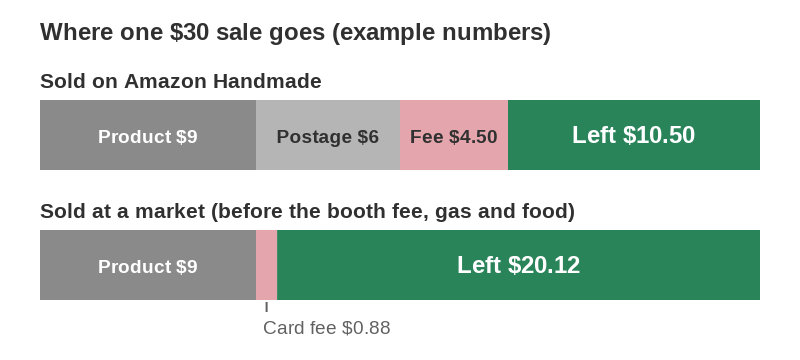
The market looks almost twice as good per sale, but it isn't the whole story. The market's $20.12 still has to pay for the booth fee, gas, food and a full day of your time. If a $120 booth, $30 in gas and $15 in food bring 40 sales, those costs take about $4.13 from each sale, leaving about $16 each. An online order needs no booth and no Saturday, but it does need photos, a listing, packing and a trip to the post office.
The fair comparison is profit per hour, not profit per sale:
| Example month | Amazon Handmade | One market |
|---|---|---|
| Orders or sales | 20 | 40 |
| Left after fees, postage, product (and booth, gas, food) | $210 | $640 |
| Hours (packing and shipping vs packing, driving, selling) | 10 | 11 |
| About per hour | $21 | $58 |
With these example numbers the market wins per hour, but the online orders come in during weeks with no market at all. Your own numbers decide it: track hours for both for a month, and put each market's sales and costs into the free craft fair profit calculator to compare.
Keep stock in sync with your markets
The biggest practical problem for makers who sell both online and in person is overselling: the last blue mug sells at the fair on Saturday morning, and the same mug sells on Amazon on Saturday afternoon. A few habits help:
- Keep separate counts. Decide how many of each item are "online stock" and how many go to the market. If you only make six of a design, list two online.
- Lower quantities before a market weekend. Change the quantity on your best sellers' listings to the number you know will stay home.
- Count after every market. Brought minus came home tells you what sold. Our free craft fair inventory sheet does that math and shows what to restock for online.
- Allow time to ship. If your listings let you set a handling time, make it long enough to cover market weekends, when you can't get to the post office.
If you run your own online store and a point of sale from the same system, inventory can update in one place. With a marketplace like Amazon, plan on keeping counts yourself or using a tool that connects them.
When Amazon Handmade fits, and when it doesn't
It tends to fit when:
- Your products are searchable by name. "Personalized dog collar" or "ceramic garlic keeper" are things people type into a search box.
- Your prices leave room for 15%. On a $30 item, $4.50 is manageable. On a $6 item with $3 in postage, it's hard.
- You can ship reliably. Orders arrive whenever they want, including the week of your biggest fair.
- You want orders between seasons. January and February are quiet for many markets.
It's a weaker fit when:
- Your product depends on touch, smell or a conversation. Some products sell much better in person.
- Your product type isn't eligible for Handmade in its category.
- You don't have time to photograph and list. A listing with poor photos rarely sells.
Whichever you choose, the market and the online shop can help each other. Business cards in every bag and an email signup at the booth send people to your online listings later; our guide on how to get repeat customers from craft fairs covers it. If you're still setting up the business itself, start with how to start a handmade craft business, and check our guide on how to price items for a craft fair to make sure your prices cover a 15% fee as well as a booth fee.
Before you apply: a short checklist
- Read the current Handmade page and eligibility rules in Seller Central.
- Check that your product type and category are eligible.
- Work out what a typical sale leaves after the 15% referral fee and postage.
- Budget for the first month's Professional plan fee.
- Take clear photos of your main products on a plain background.
- Decide how many of each item will be online stock.
- Plan how you'll ship during market weekends.
FAQ
How much does it cost to sell on Amazon Handmade?
Amazon's Handmade page lists a referral fee of 15% per unit or $0.30, whichever is greater, and a Professional selling plan whose monthly fee is waived for approved Handmade sellers after the first month. Postage, packaging and any fulfillment service are extra. Confirm current fees on Amazon before signing up.
Do I need to be approved to sell on Amazon Handmade?
Yes. Amazon Handmade is open to approved makers and collaborative groups such as cooperatives and nonprofits. You apply, Amazon reviews your work, and once approved you tag eligible listings with a Handmade Classification.
Can I sell on Amazon Handmade and at craft fairs at the same time?
Yes, many makers sell in both places. The main risk is overselling an item that sold at the market, so keep separate online and market stock counts and lower online quantities before market weekends.
Is Amazon Handmade better than selling at markets?
Neither is better for everyone. In our example, a $30 item left about $10.50 on Amazon Handmade and about $20 at a market before booth and travel costs. Compare profit per hour for your own products and markets before deciding where to spend your time.