Selling Children's Products at Craft Fairs: CPSC Basics
Selling children's products at craft fairs looks like any other booth from the outside: a table of soft toys, baby bibs, hair clips or kids' T-shirts. Behind the table, though, items made for children come with federal safety rules that most adult products don't have, and they apply to small makers too, not just big brands. This guide is a plain-language overview of what the US Consumer Product Safety Commission (CPSC) says about children's products, what it means for a maker who sells at markets, and how to build the cost into your prices so it doesn't surprise you.
This is not legal advice. Product safety rules are detailed, they change, and they depend on exactly what you make. Everything below links to the CPSC's own pages, checked in November 2026. Read them, use the CPSC's tools for your specific product, and talk to a professional before you sell items made for kids.
What counts as a children's product
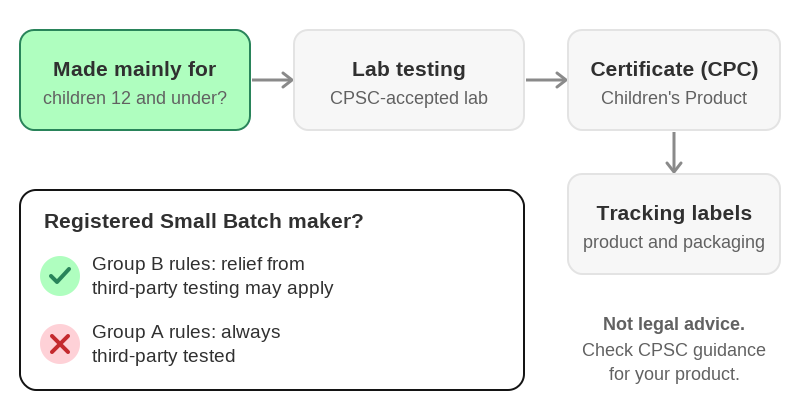
The CPSC describes a children's product as a consumer product designed or intended primarily for children 12 years of age or younger. It's not only about what you call it. According to the CPSC, four things are considered:
- What the maker says the product is for, including the label.
- Packaging, display and marketing. A toy shown with children or sold in a "for little ones" section points one way.
- How shoppers commonly see it. A plush unicorn will read as a children's item even if you don't say so.
- The CPSC's Age Determination Guidelines, which relate product features to children's ages.
So a stuffed animal, a baby blanket, a toddler hat or a kids' necklace are likely children's products. A mug with a cartoon on it, sold as kitchenware for adults, may not be. If you're not sure, the CPSC's Small Business Resources page points small businesses to its Regulatory Robot, a free tool that walks you through which requirements apply to a specific product.
Testing and the Children's Product Certificate
The CPSC says manufacturers and importers of children's products must issue a written Children's Product Certificate (CPC), based on test results from a third-party laboratory accepted by the CPSC. The certificate lists which safety rules the product meets and backs that up with the lab's results.
If you make the product yourself and sell it, you're the manufacturer in this sense. That's the part that surprises many makers: a one-person business that sews bibs in a spare room is treated as the maker of those bibs.
Which rules apply depends on the product. A toy, a pacifier clip, a child's garment and a crib accessory can each have different requirements. The Regulatory Robot and the CPSC's business guidance pages are the place to find the list for yours.
Lead: the limits and the materials CPSC has ruled out
Lead is the requirement most makers hear about first. The CPSC's total lead content FAQ says children's products must not have more than 100 parts per million (ppm) of total lead in any accessible part. Paint and surface coatings on children's products have a separate, lower limit of 90 ppm under the CPSC's paint rule (16 CFR part 1303), described on its lead in paint page.
There's useful news for many makers in the same FAQ. The CPSC has determined that some materials don't exceed the lead limits and don't need third-party testing for lead, including:
- Natural and manufactured fiber textiles, dyed or undyed. This doesn't cover after-treatments like screen prints, transfers or decals, which can contain lead.
- Untreated, unfinished natural wood. Coated wood and composite woods like plywood aren't covered by that determination.
That means a plain cotton bib may need no lead test for the fabric itself, but the snap on it, a printed design or a painted bead might. Read the FAQ for the exact wording before you rely on it.
Tracking labels
Children's products also need tracking labels: permanent marks on the product and its packaging that let someone trace it back to you. The CPSC lists missing tracking labels among the common safety violations it finds in online sales. Generally, the label identifies the maker, where and when the item was made, and batch information. A sewn-in label or a stamped tag can do this for handmade goods; the CPSC's guidance explains what has to be on it.
At a market, tracking labels have a practical upside too: if a customer has a question months later, you can tell exactly which batch their item came from.
Small Batch Manufacturer registration
Third-party testing can be expensive for a tiny business, and the law includes some relief for small makers. According to the CPSC's Small Batch Manufacturers page and FAQ:
- You have to register. Qualifying isn't enough; relief only applies to registered small batch manufacturers, and registration is renewed each year.
- There are limits. The SaferProducts.gov registry page lists a revenue cap of $1,480,296 in total gross revenue from all consumer products in the prior calendar year, and no more than 7,500 units of the covered product. The revenue figure is adjusted over time, so check the current number when you register.
- Relief is partial. Registered small batch makers may get relief from third-party testing for certain Group B rules. The CPSC says they never get relief from Group A rules, which still require third-party testing.
- You still issue a certificate. The CPSC's CPC FAQ says small batch makers still issue a Children's Product Certificate and include their registration number on it.
Which rules fall in Group A and which in Group B depends on the product. The CPSC's small batch pages explain the groups; this is a good point to get advice before you plan your testing.
Counting compliance in your prices
Testing, labels and the time it takes to keep records are real costs, and they belong in your product cost just like fabric and thread. Here's the math with made-up numbers. Ask labs for real quotes for your product; prices vary a lot.
| Example amount | |
|---|---|
| Lab testing for one product line, per year | $400 |
| Items you expect to sell in that line, per year | 200 |
| Testing cost per item | $2.00 |
| Tracking label per item | $0.15 |
| Materials and packaging per item | $4.50 |
| Cost per item with compliance | $6.65 |
If you'd priced a bib at $16 from materials alone, your margin drops from $11.50 to $9.35 once compliance is counted. That can still work, but only if you know it. Our guide on how to price items for a craft fair shows how to build a price from cost, and the free craft fair profit calculator shows what a market really leaves after product costs, card fees and the booth.
One way to keep this manageable: a small, focused children's line, with fewer designs made in larger batches, so each test's cost is spread over more items.
At the market
A few practical habits for a booth with children's items:
- Ask the organizer whether the event has any rules or paperwork for children's products. Our list of questions to ask before booking a craft fair has room for it.
- Keep your certificates handy, on your phone or in a folder in the cash box, in case an organizer or a shopper asks.
- Check every item for its tracking label when you pack. A product without one shouldn't go on the table.
- Label age ranges and warnings the way your product's rules require, and make sure your signs and display don't market an adult item to children by accident.
- Talk to your insurer. Product liability matters more when you sell to families. Our craft fair insurance guide covers what to ask.
- Keep records of materials, suppliers, batches and test results. They're the backbone of your certificate and your answer if anything goes wrong.
Where to read more
The CPSC pages linked in this guide are the starting point:
- Children's products business guidance
- Children's Product Certificate and its FAQ
- Total lead content FAQ
- Small Batch Manufacturers and the registry
- Small Business Resources, including the Regulatory Robot
If you're also deciding where to sell between markets, our guide on how to sell handmade crafts online covers the main options; the same product rules apply online.
FAQ
Do handmade children's products need to be tested?
Generally yes. The CPSC says manufacturers of children's products, which includes small makers, must certify them in a Children's Product Certificate based on testing at a CPSC-accepted lab. Some materials, like plain textiles and untreated natural wood, don't need lead testing, and registered Small Batch makers may get relief for some Group B rules but not Group A.
What age counts as a children's product?
The CPSC describes a children's product as one designed or intended primarily for children 12 and under. It looks at how you describe and market the product, how shoppers see it and its Age Determination Guidelines.
What is the CPSC Small Batch registration?
It's a yearly registration for small manufacturers that meet revenue and unit limits. Registered makers may get relief from third-party testing for certain Group B rules, but still must third-party test for Group A rules and still issue a Children's Product Certificate.
Do I need tracking labels on items I sell at a craft fair?
The CPSC requires tracking labels on children's products: permanent marks on the product and packaging that identify the maker, when and where it was made, and batch information. Check the CPSC's guidance for what yours must include.