Selling Soap at Craft Fairs: FDA Rules, Labels and Pricing
Selling soap at craft fairs looks simple from the shopper's side of the table: a stack of pretty bars, a scent to smell, a price. From the maker's side there are two questions most guides skip. First, which rules apply to what you make, since US regulators sort "soap" into true soap, cosmetics and drugs depending on what's in it and what you say about it. Second, whether a bar at your price actually covers the booth. This guide covers both, with links to the FDA pages so you can read the source yourself, and a full cost example for one bar.
This is not legal advice. It's a plain-language summary of FDA's own guidance pages as of November 2026. Rules change and depend on your exact products and claims. Read FDA's guidance for your products and talk to a professional if anything is unclear.
Soap, cosmetic or drug? How FDA sorts it
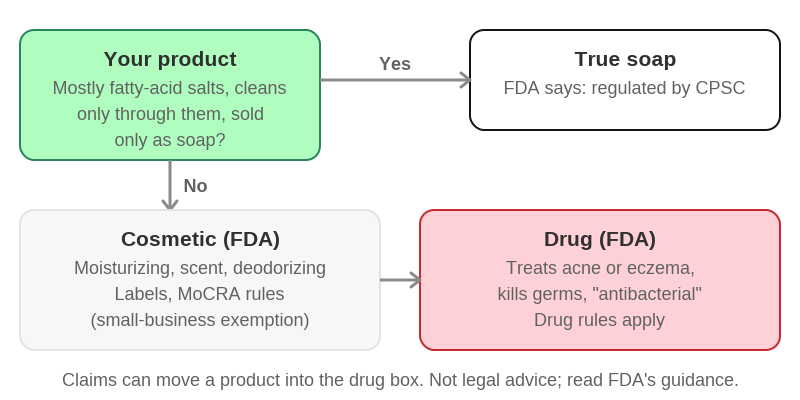
FDA's page Is It a Cosmetic, a Drug, or Both? (Or Is It Soap?) explains that "soap" has a narrow legal meaning. According to FDA, a product counts as soap only if all three of these are true:
- It's mostly made of alkali salts of fatty acids (what you get when fats or oils react with lye).
- Those salts are the only thing doing the cleaning.
- It's labeled and marketed only as soap.
FDA says products that meet this definition are regulated by the Consumer Product Safety Commission (CPSC), not by FDA, and it directs questions about them, including labeling, to CPSC. FDA also notes on its soap FAQ that most body cleansers today, liquid or solid, are synthetic detergent products rather than true soap.
Once a product falls outside that definition, FDA treats it as a cosmetic, a drug or both, and the deciding factor is the intended use:
| If the product is intended to... | FDA says it is... | Examples from FDA's page |
|---|---|---|
| Clean, and it meets all three soap conditions | Soap (CPSC) | A plain lye soap sold only as soap |
| Moisturize the skin, make the user smell nice, or deodorize | A cosmetic | A bar sold as "moisturizing" or with a fragrance claim |
| Treat or prevent disease, such as killing germs, or treat skin conditions like acne or eczema | A drug | "Antibacterial" cleansers, acne cleansers |
FDA also notes that a product can be both a cosmetic and a drug. For a market seller, the practical point is that the words on your label and your signs help decide which column you're in.
Label basics for cosmetic products
If your products are cosmetics (lotions, bath bombs, scrubs, or soaps sold with cosmetic claims), FDA's Cosmetics Labeling Guide and its summary of labeling requirements are the place to start. The core pieces FDA describes:
- Identity statement: what the product is, usually the product name (for example "Lavender Body Lotion").
- Net quantity: weight, measure or count, which FDA's rules place in the bottom 30% of the main display panel, with some exceptions for very small labels and tiny products.
- Ingredient declaration: for products sold at retail, ingredients listed in descending order of predominance, with some exceptions for ingredients at 1% or less and color additives.
- Name and place of business of the manufacturer, packer or distributor.
For true soap, FDA points labeling questions to CPSC, so check with CPSC rather than assuming the cosmetic rules apply. Either way, a clear label with what it is, how much is in it and who made it is also what shoppers want to see when they pick up a bar.
Claims to avoid at the booth
Most soap makers never plan to sell a drug. It usually happens through enthusiastic wording. Based on FDA's examples above, these kinds of claims can move a product into drug territory:
- "Antibacterial" or "kills germs"
- "Clears acne" or "treats eczema"
- "Heals" or "cures" anything
Cosmetic language stays on safer ground: how it smells, how it feels, that it moisturizes or leaves skin feeling soft. The same care applies to your booth signs, your product cards and what you say to shoppers. If a customer asks whether a bar helps their skin condition, a good answer is that you can't make medical claims and they should ask their doctor, then tell them what's in the bar. Our guide to what to say to customers at a craft fair has more on keeping booth conversations easy.
Registration, listing and the small-business exemption
The Modernization of Cosmetics Regulation Act of 2022 (MoCRA) added requirements for cosmetic businesses, including facility registration and product listing with FDA. FDA's registration and listing page and its fact sheet for small businesses and homemade cosmetics describe an exemption for small businesses:
- FDA defines a small business as one whose average gross annual US sales of cosmetic products over the previous 3 years is less than $1,000,000, adjusted for inflation.
- The exemption doesn't apply to businesses that make certain product types, such as products that regularly contact the eye's mucous membrane, products that are injected, products intended for internal use, or products intended to alter appearance for more than 24 hours.
- Exempt businesses can still register and list voluntarily.
The fact sheet also says that, under MoCRA, responsible persons must report serious adverse events to FDA and keep records supporting that their products' safety is adequately substantiated. FDA notes it doesn't require specific tests for that, and that ingredient suppliers' safety data or published studies can be part of it. Read the fact sheet for which of these duties apply to you, and contact FDA through the address listed there if you're unsure.
Testers and samples at the booth
Smell is the main reason people stop at a soap booth, so plan testers rather than letting people handle the stock:
- One tester bar per scent on a small dish, labeled "tester," replaced when it looks used.
- Sniff jars with shavings, for shoppers who don't want to touch anything.
- Lotion testers in a pump bottle, never an open jar, with hand wipes or sanitizer next to them.
- Wrapped or boxed bars for sale, so the bars people take home haven't been handled.
Count testers as a product cost. If you use four tester bars at $1.93 in materials each per market, that's $7.72 per market, which belongs in your numbers just like bags and labels.
Displaying soap so it sells
Soap is easy to display badly: a flat row of similar-looking bars. Stack bars by scent with a big scent label on each stack, raise the stacks on crates or risers so the table has height, and keep a short "how to use" or "what's in it" card for people who ask. Our guide to craft fair display ideas has layouts and a plan for a 6-foot table.
Pricing a bar: the full cost
Here's an example for a 4.5-ounce cold process bar, made in batches of 24 (made-up numbers to show the method):
| Cost per bar | Amount |
|---|---|
| Oils and butters | $0.95 |
| Lye | $0.08 |
| Fragrance or essential oil | $0.45 |
| Colorants and additives | $0.10 |
| Label and wrap | $0.30 |
| Mold wear | $0.05 |
| Materials and packaging | $1.93 |
| Labor (3 hours per batch of 24 at $20 an hour) | $2.50 |
| Overhead (website, insurance share, tools) | $0.40 |
| Cost per bar | $4.83 |
Our guide on how to price items for a craft fair explains the cost × 2 × 2 formula, which would put this bar near $19. That may be more than your market's shoppers expect for soap, so it helps to see what each price leaves you after a card fee of 2.6% plus 10 cents (an example rate):
| Price per bar | Left per bar | Bars to cover $180 in market costs |
|---|---|---|
| $10 | $4.81 | 38 |
| $12 | $6.76 | 27 |
| $14 | $8.71 | 21 |
The $180 is an example booth fee of $120 plus $60 for gas and food. At $10, you need to sell 38 bars before the market pays you anything; at $14, 21 bars. That difference often matters more than the price itself.
Cure time ties up money. If your recipe needs to cure for several weeks before it's ready, the materials for every bar on the curing rack are paid for long before you sell them. 200 bars curing at $1.93 each is $386 sitting on a shelf. Plan production for your busiest markets far enough ahead, and don't let that money hide in your head: it's real inventory.
Bundles: 3 bars, one price
Soap is a natural fit for bundles. At $12 a bar, three bars sold separately leave about $20.28. A "3 for $30" bundle leaves about $14.63 after the card fee. The bundle only pays off if it turns enough one-bar buyers into three-bar buyers; our guide to craft fair bundle pricing shows the break-even.
Insurance and product liability
Anything people put on their skin carries a risk of reactions and claims. Many markets ask vendors for liability insurance, and it's worth asking any insurer specifically how products you sell are covered. Our craft fair insurance guide covers the words to look for, and our guide on selling children's products at craft fairs is worth reading if you make anything for babies or kids.
After each market, put your sales, product costs, testers, booth fee and other costs into the free craft fair profit calculator to see what the day really earned.
FAQ
Do I need FDA approval to sell soap?
FDA says cosmetics are not FDA-approved but are FDA-regulated. True soap, as FDA defines it, is regulated by CPSC instead. Products with drug claims fall under drug rules. Read FDA's guidance for your exact products.
Do I have to register my soap business with FDA?
FDA describes an exemption from cosmetic facility registration and product listing for small businesses with less than $1,000,000 in average annual US cosmetic sales (adjusted for inflation), with exceptions for certain product types. True soap that meets FDA's definition isn't a cosmetic. Check FDA's registration page and small business fact sheet for your situation.
Can I say my soap helps with eczema or acne?
FDA says products intended to treat skin conditions like acne or eczema are drugs. Stick to cosmetic language such as scent, feel and moisturizing, and suggest that shoppers with skin conditions ask their doctor.
What should be on a handmade lotion label?
FDA's labeling guide lists an identity statement, net quantity, an ingredient declaration in descending order of predominance, and the name and place of business. Read the guide for placement and size rules before printing labels.