Craft Fair Season Review: Rank Your Markets, Plan Next Year
A craft fair season review is the hour that makes next season easier. The markets are over, the stock is counted, and application emails for next year will start arriving soon. Instead of rebooking from memory ("the fall festival felt busy"), you sit down once with every market's numbers, rank them the same way, and decide what to rebook, what to try once more and what to drop. This guide walks through the whole review with eight example markets, so you can see how the numbers, the non-money results and the rebook rules fit together.
Step 1: Gather each market's numbers
For every market this season, you need the same six numbers:
- Sales, all of them: card, cash and payment apps.
- Booth fee.
- Other event costs: application fee, gas or mileage, parking, food, hotel, helper, insurance share.
- Product costs and card fees.
- Profit: sales minus everything above.
- Hours: packing, driving, setup, selling and teardown.
If you kept one row per market in a craft fair profit spreadsheet, this step is already done. If not, rebuild it from your card reader's reports, your cash notes and your bank statement. Product counts from a craft fair inventory sheet will help in step 4.
Step 2: Rank markets two ways
Here's an example season with eight markets. These are made-up numbers to show the method; product costs and card fees are about a third of sales in each.
| Market | Sales | Booth fee | Other costs | Profit | Hours | Profit per hour | Booth multiple |
|---|---|---|---|---|---|---|---|
| Spring Makers Market | $1,240 | $95 | $35 | $700.80 | 10 | $70.08 | 13.1x |
| Fall Festival | $1,450 | $175 | $80 | $716.50 | 12 | $59.71 | 8.3x |
| Saturday farmers market | $620 | $45 | $20 | $350.40 | 7 | $50.06 | 13.8x |
| Brewery pop-up | $420 | $40 | $15 | $226.40 | 5 | $45.28 | 10.5x |
| Church holiday bazaar | $540 | $60 | $25 | $276.80 | 7 | $39.54 | 9.0x |
| Summer Art Walk | $960 | $150 | $60 | $433.20 | 11 | $39.38 | 6.4x |
| Holiday Makers Market (2 days) | $1,800 | $250 | $154.40 | $802.30 | 24 | $33.43 | 7.2x |
| County fair craft barn (3 days) | $2,600 | $350 | $420 | $972.00 | 34 | $28.59 | 7.4x |
| Season | $9,630 | $1,165 | $809.40 | $4,478.40 | 110 | $40.71 |
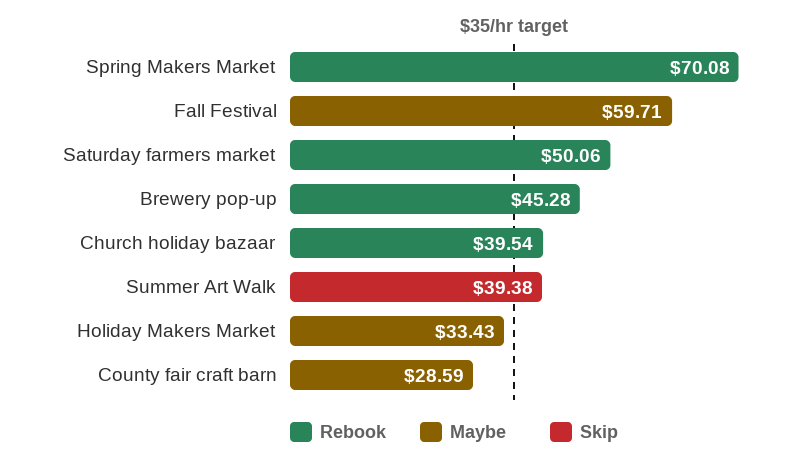
The table is sorted by profit per hour, which answers "what did my time earn here?" The last column, the booth fee multiple (sales divided by the booth fee), answers "was the booth worth its price?" Many vendors aim for at least 10x, so the booth is no more than 10% of sales.
The two rankings don't agree, and that's the useful part:
- The county fair made the most profit in dollars ($972) but the least per hour. Three long days with a paid helper add up.
- The Fall Festival is second per hour but only 8.3x on the booth fee. It's a good day with an expensive booth.
- The small farmers market and brewery pop-up look modest in dollars but pass both tests.
Step 3: Add the results that aren't sales
Some markets pay you later. Before deciding anything, add what each one brought besides money:
| Market | Contacts | Custom orders | Wholesale leads | Email signups |
|---|---|---|---|---|
| Spring Makers Market | 6 | 1 | 0 | 22 |
| Fall Festival | 5 | 1 | 1 | 25 |
| Saturday farmers market | 2 | 0 | 0 | 9 |
| Brewery pop-up | 3 | 0 | 1 | 11 |
| Church holiday bazaar | 2 | 3 | 0 | 6 |
| Summer Art Walk | 1 | 0 | 0 | 4 |
| Holiday Makers Market | 8 | 2 | 1 | 31 |
| County fair craft barn | 4 | 2 | 0 | 18 |
(Again, example numbers.) The church bazaar's three custom orders, worth $420 together in this example, change its story more than any line in the profit table. The Holiday Makers Market brought the most signups by far, which matters if your online sales come from your email list.
Step 4: Decide with the same rules for every market
Use simple rules and apply them the same way to every market, so the decision isn't about which day you remember best. In this example the targets are 10x the booth fee and $35 an hour:
| Decision | When |
|---|---|
| Rebook | Passes both targets |
| Maybe | Misses one or both, but it's the first edition or the bad result hasn't repeated |
| Skip | Misses a target for the second edition in a row, and the non-money results don't make up for it |
The last rule matters most. Weather, a bad booth spot or a clash with another event can sink one good market. Many vendors only drop a market after two disappointing editions, which is why last year's numbers belong in the review. Our guide to comparing craft fair sales year over year shows how to tell a bad day from a bad market, and is a craft fair worth it explains the booth fee rule and four others.
Applied to the example season:
| Market | Result | Why |
|---|---|---|
| Spring Makers Market | Rebook | 13.1x and $70 an hour |
| Saturday farmers market | Rebook | 13.8x and $50 an hour |
| Brewery pop-up | Rebook | 10.5x and $45 an hour, plus a wholesale lead |
| Fall Festival | Maybe | $60 an hour but 8.3x; ask whether a smaller or cheaper booth exists |
| Church holiday bazaar | Rebook (your call) | 9.0x misses by a little; three custom orders worth $420 make up for it |
| Holiday Makers Market | Maybe | 7.2x and $33 an hour, but it's the first year, with 31 signups |
| County fair craft barn | Maybe | First year; try it without the paid helper on the slowest day |
| Summer Art Walk | Skip | 6.4x this year and 5.9x last year, with few contacts both times |
Write the reason next to every decision. "Skip: under 7x two years running" is far more useful next spring than a bare "no".
Step 5: Turn product numbers into next season's stock
Your sales by product, market by market, tell you what to make over the winter. Look for:
- Stars: products with high sell-through and good profit per item. Make more.
- Season-only sellers: ornaments at holiday markets, garden or outdoor items in summer. Plan them by event type, not for the whole year.
- Space hogs: big pieces that sold once or twice. Bring fewer, or give them a reason to be there.
Our guide to what sells best at craft fairs shows how to rank products by sell-through, profit per item and profit per foot of table.
Step 6: Plan next season's calendar and budget
With the decisions made, build next season before the application windows open:
- List the markets you're rebooking and the "maybe" ones, with their application open and close dates. Popular holiday shows can open applications many months ahead.
- Leave a slot or two for new markets to replace the ones you skipped. Our guide on how to find vendor events covers where to look.
- Budget the costs that come before any sales.
An example budget for eight markets next season (seven keepers and one new market):
| Cost | Example amount |
|---|---|
| Booth fees (this year's keepers plus one new market) | $1,165 |
| Application and jury fees (4 × $25) | $100 |
| Insurance (annual policy, example quote) | $300 |
| Mileage (540 miles × $0.76) | $410.40 |
| Display and tent repairs | $120 |
| Total before the first sale | $2,095.40 |
The mileage line uses the IRS business rate that applied in the second half of 2026, 76 cents per mile, as a placeholder; swap in the new rate once the IRS publishes it. Our guide to the 2026 business mileage rate explains how to turn miles into a market cost, and the craft fair expenses checklist lists the other costs people forget.
A one-page season review template
Copy this table into a spreadsheet or onto paper, one row per market:
| Column | What to write |
|---|---|
| Market and date | Name, city, days |
| Sales | Card + cash + apps |
| Booth fee and other costs | Everything you spent for that market |
| Profit | Sales minus all costs |
| Hours | Packing, driving, setup, selling, teardown |
| Profit per hour | Profit ÷ hours |
| Booth multiple | Sales ÷ booth fee |
| Non-money results | Contacts, custom orders, wholesale leads, signups |
| Last year's result | The same numbers from the previous edition |
| Decision and why | Rebook, maybe or skip, with one line of reason |
| Change for next time | Booth spot, days, products, prices, helper |
If a market's numbers are missing, the free craft fair profit calculator rebuilds profit, the expense share, the booth fee multiple and profit per hour from sales and costs in a minute.
FAQ
When should I do a craft fair season review?
Soon after your last market, while receipts and notes are fresh, and before next season's applications open. Many vendors do it in the slower weeks after the holiday markets.
What is a good profit per hour at craft fairs?
It depends on what your time is worth to you. Set your own target before looking at the results, then compare every market against it. In the example above the target was $35 an hour and the season averaged $40.71.
Should I drop a craft fair after one bad year?
Usually not. One edition can be hurt by weather, a bad booth spot or a clash with another event. Many vendors only drop a market after two disappointing editions in a row, or when the non-money results don't make up for weak numbers.
What should I compare between craft fairs?
Compare profit per hour and the booth fee multiple, not just total sales. Then add contacts, custom orders, wholesale leads and email signups, since some markets pay off after the day itself.