Custom Orders at Craft Fairs: Pricing, Deposits and Deadlines
Custom orders at craft fairs can be the best part of a market or the reason you're still painting at midnight two weeks later. A shopper loves your work, asks "could you make one with my dog on it?", and saying yes feels like a sale. Whether it actually is one depends on what you charge, what you collect up front, and how many you've already promised. This guide covers when to say yes, a simple order form, how to price a custom piece so it pays you as well as your regular work, deposits, deadlines, and how to count custom orders when you judge a market.
When to say yes
Before you write anything down, run the request through five quick questions:
- Time: does it fit in your schedule before the date they need it?
- Materials: do you have them, and do you know what they cost?
- Margin: will the price cover the extra time, not just the materials?
- Skill and risk: can you do it well? Is the reference photo good enough to work from?
- Fit: does it look like your work? Would you be happy to show it at your booth?
A "no" on any of these is a reason to say "Not this one, but I can do something like this instead," and point to a version you already make. Saying no politely is part of taking custom work. Our guide on what to say to customers at a craft fair has a few lines for that moment.
A simple custom order form
Most custom order trouble starts with something that wasn't written down. A one-page form, filled in at the booth with the customer watching, solves most of it:
| Field | Why it matters |
|---|---|
| Order number | Matches the form to the payment in your POS |
| Name | So you know who's who at pickup |
| Phone or email, and OK to contact about this order | You'll need to send a sketch or a question |
| Email list: yes or no (a separate checkbox) | Contact about the order isn't the same as signing up for news |
| Item and options | Size, color, text, spelling of names, reference photo |
| Price and what's included | Gift box? Shipping? Name on the back? |
| Deposit paid, and how | Card, cash or app, with the amount |
| Balance due | So nobody is surprised at pickup |
| Due date and delivery | Pickup at your next market, local pickup or shipping (and the shipping cost) |
| Changes and cancellation (one or two lines) | See the section below |
Keep a stack of forms and a clipboard in your booth bin. Take a photo of each filled form before you hand over the customer's copy, so you have a backup if the paper gets lost.
Pricing a custom piece
Start from your regular price, which already covers your materials, your making time and overhead (our guide on how to price items for a craft fair explains that formula). Then add what the custom version adds: design and approval time, extra materials, messages back and forth, and the chance you'll need to remake it.
The easiest way to see whether a custom price is fair to you is to compare profit per hour with your regular work. Here's an example with a mug (made-up numbers to show the math; card fee estimated at 2.6% plus 10 cents):
| Regular mug | Custom pet-portrait mug | |
|---|---|---|
| Product cost | $11.00 | $13.00 (extra underglaze and firing) |
| Time | 30 minutes | 90 minutes (making, sketch and approval, painting) |
And what each price leaves you per hour:
| Price | Left after product cost and card fee | Per hour |
|---|---|---|
| $34 (regular mug) | $22.02 | about $44 |
| $55 (custom) | $40.47 | about $27 |
| $75 (custom) | $59.95 | about $40 |
| $82 (custom) | $66.77 | about $45 |
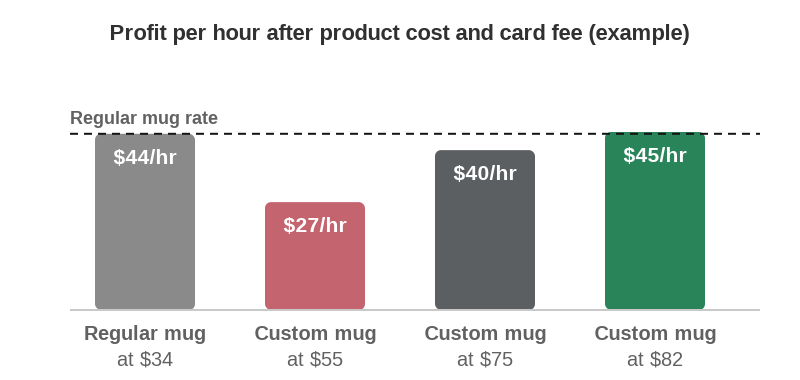
At $55 the custom mug brings in more dollars per piece but pays you far less per hour than the regular mug you could make in that time. To match your regular rate, the custom one needs to be around $82. You might still choose $65 or $75, because a happy custom buyer often comes back or tells friends, but make that choice on purpose, knowing what it costs you.
Two more lines worth adding to the price if they apply:
- A remake allowance. If, in your own experience, about one custom piece in five needs redoing, add about a fifth of the materials cost to each custom price.
- Rush fees. A shorter deadline means pushing other work aside. Charge for it, or don't offer it.
Deposits: how much and how to ring them up
A deposit does two jobs: it covers your materials and early work if the customer disappears, and it turns "I'd love one" into a real order. A common, easy-to-explain choice is half up front, but there's no rule. The useful test is that the deposit should cover at least your materials and the first stage of work.
Example: a $75 custom mug with a 50% deposit means $37.50 at the booth and $37.50 at pickup.
Ringing it up, at a plain level:
- Ring the deposit as its own line, for example a "Custom order deposit" item or a custom amount, and write the order number on the sale if your system allows a note.
- Write the same number on the form.
- Ring the balance as a second sale at pickup, with the same order number.
Some POS systems have built-in deposit, layaway or draft order features; check what yours offers before your next market. Whatever you use, the order number is what keeps the money and the form matched.
Deadlines and capacity
The most common custom order mistake is promising more than you can make. Work out your weekly capacity before the market:
| Example | |
|---|---|
| Hours a week you can give custom work | 6 |
| Time per custom piece | 1.5 hours |
| Custom pieces per week | 4 |
If you take 10 custom orders at a holiday market, that's two and a half weeks of custom work on top of everything else, plus any waiting time (drying, firing, curing, shipping). A safe promise in this example is about four weeks, not "next week."
For holiday markets, set a cutoff date: once your queue would run past the last date you can deliver before the holiday, stop taking orders for holiday delivery and offer a January date or a gift card instead. Write the cutoff on a small sign so you don't have to make the call under pressure at the booth.
Changes and cancellations, in plain words
Decide your terms before you take any money, and write them on the form in a line or two. This is a practical checklist, not legal advice; rules can differ by state, so ask a professional if you want formal terms.
- Approval: you'll send a sketch or photo for approval before you start, and changes after approval may cost extra.
- Cancellation by the customer: for example, the deposit is refundable until you start work, and not after.
- If you can't deliver: you refund the deposit in full.
- Pickup: how long you'll hold a finished piece, and what happens after that.
Clear terms protect both sides and make the conversation easier if something changes.
Delivering, and turning custom buyers into regulars
A custom buyer already likes your work enough to wait for it. Make the delivery part of the experience:
- Send a photo when it's finished, and ask whether you may share it.
- Include a thank-you card and a note about where you'll be next.
- Ask whether they'd like to hear about custom slots before the holidays.
If they said yes to your email list on the form, they'll hear about your next market. Our guide on how to get repeat customers from craft fairs covers what to do with that list.
Count custom orders when you judge a market
Custom orders don't show up in the day's sales the way a card sale does, so they're easy to forget when you decide whether a market was worth it. Write them down with the market's numbers:
| Market result | Example |
|---|---|
| Sales on the day | $1,080 |
| Custom orders taken | 6 |
| Value of custom orders | $450 |
| Deposits collected | $225 |
Work out the day's profit as usual in the free craft fair profit calculator, then add the custom orders as their own line. A market that looks average on sales but brings six custom orders may be worth rebooking. Our guide is a craft fair worth it explains how to weigh results that aren't sales, and the craft fair season review shows how to put them side by side with every other market at the end of the year.
FAQ
Should I take custom orders at craft fairs?
If you have the time and can price them so they pay you about as well as your regular work, yes. Check time, materials, margin, skill and fit before you agree, and say no politely when one of them doesn't work.
How much deposit should I take for a custom order?
Enough to cover at least your materials and the first stage of work. Half up front is a simple, common choice, but it's your decision. Write the deposit and the balance on the order form.
How much more should a custom piece cost?
Compare profit per hour with your regular work. In our example, a custom mug that takes three times as long needs to be about $82, not $55, to pay the same per hour as a $34 regular mug.
How do I keep track of custom orders from a market?
Give each order a number, write it on the form and on the deposit sale in your POS, and list the market's custom orders next to its sales when you review it.