Event Vendor Contract: What to Read Before You Sign
An event vendor contract usually arrives as the last step before you get a booth: a PDF or a checkbox that says "I agree to the vendor terms." Most vendors skim it, sign it and move on. That's fine until it rains, you get sick, the event moves your booth to the parking lot, or someone trips on your tent weight. Then those terms decide who pays. This guide walks through the clauses worth reading before you sign, what each one means in plain words, a checklist of questions, a few red flags, and an example of what a cancellation clause can cost in real dollars.
This is not legal advice. It's a practical reading guide from a seller's point of view. Contracts differ, and laws differ by state. If something in an agreement is unclear, ask the organizer in writing, and for anything with real money or risk attached, talk to a lawyer.
Why the vendor agreement matters more than it looks
The vendor agreement is where the event sets the rules it can enforce: what you pay and when, what happens if either side cancels, what you must bring and carry, and what you're responsible for if something goes wrong. The application tells the organizer about you. The contract tells you what you're actually buying with the booth fee.
Many of the questions you'd ask before booking are answered (or not) in the contract. Our list of questions to ask before booking a craft fair covers the crowd and the advertising; this guide covers the fine print.
The clauses to read before you sign
1. Fees and payment dates
Look for the booth fee, any application or jury fee, extra charges (corner booth, electricity, extra table, parking), and the dates each one is due. Some events take the full booth fee at acceptance, some split it into a deposit and a balance. Check whether a late payment means losing the booth.
2. Cancellation by you
This is the clause that costs vendors the most. Read exactly what you get back if you cancel, and by when. Common patterns are a sliding scale (a partial refund until a cutoff date, nothing after), refunds minus a processing fee, credit toward a future event instead of cash, or no refunds at all. Note the cutoff dates in your calendar the day you sign.
3. Cancellation by the organizer, and weather
Check what happens if the event is canceled, shortened or moved. Many agreements separate the organizer canceling for its own reasons from events outside anyone's control, like severe weather or an emergency order, often called "force majeure." Look for whether you'd get a refund, a credit to next year, or nothing, and whether "rain or shine" means the event runs in any weather.
4. Booth assignment
Does the contract promise a location, or can the organizer assign and change spots? Most events reserve the right to place vendors. If a corner or a spot near the entrance matters to you and you're paying extra for it, make sure that's written down.
5. Hours, load-in and teardown
Expect set load-in windows, a time the booth must be ready, and often a rule against packing up before closing. Early teardown rules exist because a half-empty event looks bad to shoppers, and some agreements back them with a fee or with not being invited back. Read these before you plan a three-hour drive home.
6. What you may sell
Many events accept you for specific products or a category. The agreement may say you can only sell what you applied with, that items must be handmade by you, or that resale isn't allowed. Some events give a category limited exclusivity; most don't promise you'll be the only one selling what you sell.
7. Insurance and additional insured
If the event requires insurance, the contract usually says how much coverage, who must be named as additional insured (the organizer, the venue, sometimes the city) and when the certificate is due. Our guides to craft fair insurance and event vendor insurance explain what those words mean and how one-day coverage works.
8. Indemnification and hold harmless
This is the clause most people skip because it reads like legal fog. In plain words, an indemnification or hold harmless clause is usually about who pays if someone makes a claim. A common version says you'll cover the organizer's losses and legal costs if a claim comes from your booth, your products or your helpers. That's often why insurance is required.
What to look at: whether the clause covers only claims connected to you, or reaches further, for example claims caused by the organizer or the venue. This is exactly the kind of clause to ask a lawyer about if the event is large or the wording worries you.
9. Sales tax and permits
Many agreements make vendors responsible for their own sales tax and permits, and some ask for your permit number before the event. The rules depend on the state where the event takes place. Our craft fair sales tax guide shows how several states handle one-day events.
10. What's included
Check what the booth fee includes: the space size, tables, chairs, electricity, Wi-Fi, a tent at indoor or covered events, parking, and listing in the event's marketing. "10 by 10 space" with nothing else is common for outdoor markets.
11. Photos and marketing
Some agreements let the event use photos of your booth and products, and your business name, in its promotion. Usually that helps you. If you have reasons to limit it, ask before signing.
12. Penalties and conduct rules
Look for fees or consequences for late arrival, no-shows, early teardown, leaving trash, blocking aisles or breaking sampling, music or signage rules. A no-show often means losing the booth fee and being left off next year's list.
A checklist of questions to answer before you sign
| Clause | Question to answer |
|---|---|
| Fees | What do I pay in total, and on which dates? |
| My cancellation | What do I get back if I cancel, and until when? |
| Organizer cancellation | Refund, credit or nothing if the event is canceled or shortened? |
| Weather | Does it run "rain or shine"? What if it's stopped partway? |
| Booth | Is a spot promised, or assigned? Can it change? |
| Hours | Load-in window, ready time, earliest teardown time? |
| Products | Can I bring new products, or only what I applied with? |
| Insurance | How much coverage, who is additional insured, when is the certificate due? |
| Hold harmless | Does it cover only claims from my booth and products? |
| Tax and permits | What does the event need from me, and by when? |
| Included | Tables, chairs, power, tent, parking? |
| Penalties | What happens if I'm late, absent or leave early? |
If any answer isn't in the contract, ask the organizer by email and keep the reply. A written answer is far more useful later than something said on the phone.
What a cancellation clause can cost: an example
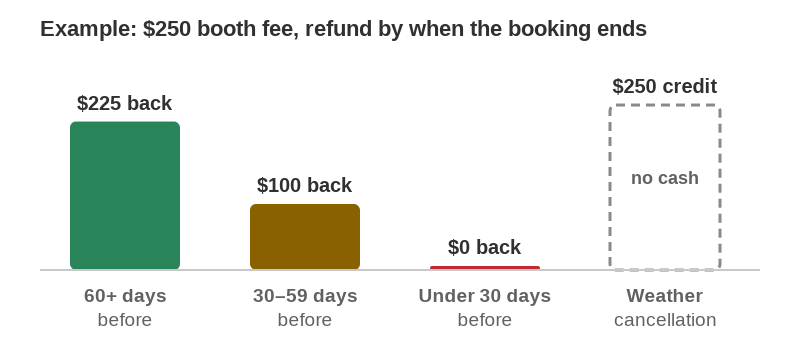
Here's a made-up but typical-looking cancellation clause, run through with numbers. The booth fee is $250, paid in full at acceptance:
- Cancel 60 or more days before the event: refund minus a $25 processing fee.
- Cancel 30 to 59 days before: 50% refund minus the $25 fee.
- Cancel less than 30 days before: no refund.
- Event canceled for weather: credit toward next year, no cash refund.
| When the booking ends | You get back | You lose |
|---|---|---|
| You cancel 75 days before | $225 | $25 |
| You cancel 45 days before | $100 (50% of $250, minus $25) | $150 |
| You cancel 20 days before | $0 | $250 |
| Event canceled for weather | $250 credit for next year | $250 if you don't go back |
Two things stand out. First, the cost of canceling jumps sharply at each cutoff date, so the dates belong in your calendar. Second, a "credit to next year" is only worth something if you'd book that event again. If you wouldn't, treat it as a loss when you decide whether the event is worth the risk.
You can fold this into your planning. If an event's expected profit is $400 and there's a real chance you'll have to cancel late, the $250 booth fee at risk is a large share of that. The free craft fair profit calculator shows an event's expected profit, which makes these trade-offs easier to see.
Red flags worth a second look
None of these automatically means "don't sign," but each one deserves a question:
- No written agreement at all, just a payment link. You may have no clear terms on refunds or weather.
- "No refunds under any circumstances," including if the organizer cancels for its own reasons.
- A hold harmless clause that covers the organizer's own mistakes, not just claims from your booth.
- Insurance requirements that change after you've paid, for example a new additional insured or a higher limit.
- Penalties that aren't stated as amounts, like "fees at the organizer's discretion."
- Promises in the marketing that aren't in the contract, like attendance numbers or a featured spot.
When something looks off, ask. Organizers of well-run events usually answer clear, polite questions quickly, and how they answer tells you something too.
Keep the paperwork with the event
Save the signed agreement, any emails that clarify it, your payment receipts and your insurance certificate in one folder per event. If you need them later (a refund, a dispute, next year's application), you won't be searching your inbox. And when you look back at the season, include fees you lost to cancellations in that event's costs; they're as real as gas and the booth fee. Our craft fair expenses checklist lists every cost worth tracking.
FAQ
What should be in an event vendor contract?
At least the fees and due dates, what happens if you or the organizer cancel, weather rules, booth size and assignment, load-in and teardown times, what you may sell, insurance requirements, who is responsible for claims, sales tax and permit duties, and any penalties.
Can I get a refund if I cancel as a vendor?
It depends entirely on the contract. Many events refund part of the fee until a cutoff date and nothing after it, some give credit instead of cash, and some never refund. Read the cancellation clause and put the cutoff dates in your calendar.
What does hold harmless mean in a vendor agreement?
Generally, it's a promise about who covers losses if someone makes a claim. In many vendor agreements, you agree to cover claims connected to your booth or products. Wording varies a lot, so ask a lawyer if it's unclear or seems to cover more than your own booth.
Do I have to sign a vendor contract to sell at an event?
Most organized events require you to accept their vendor terms, whether as a signed document or a checkbox on the application. If an event has no written terms, ask for the key ones (fees, refunds, weather, hours) by email before paying.