Handmade Jewelry Business: Pricing, Costs and Market Profit
A handmade jewelry business has a few things going for it at markets: small pieces, easy to carry, easy to gift, and a booth that can hold hundreds of items on one table. It also has its own traps: tiny parts that make costs easy to underestimate, metal words that have real meanings, and small, valuable pieces sitting within arm's reach of a busy aisle. This guide covers the parts that are specific to jewelry: building a product line and price ladder, working out the cost of one piece (with a full example), describing metals honestly, keeping stock safe at the booth, and checking whether each market actually pays.
If you're still at the stage of registering the business, sales tax and insurance, start with how to start a handmade craft business. This post picks up from there.
Build a line you can make again and again
A booth with forty one-of-a-kind pieces is lovely and exhausting. Every sale means a new design, new photos and a new price. A line works better: a few designs, each in several colors or metals, that you can remake in batches.
A simple structure many jewelry makers use:
- Two or three earring designs in a few colors each. Earrings are usually the easiest yes at a booth: no sizing, easy to try against an ear in the mirror.
- One or two necklace designs that match the earrings, so a shopper can buy a set.
- Rings or bracelets only if you can size them easily. Adjustable bands or a size range you keep in stock avoid the "do you have it in a 7?" problem.
- A few statement pieces that show what you can do and make everything else look affordable.
Write down for each design how long one piece takes and what goes into it. That list is the start of your costs.
A price ladder for a jewelry table
Shoppers at the same market have very different budgets. A ladder of prices gives each of them something to say yes to.
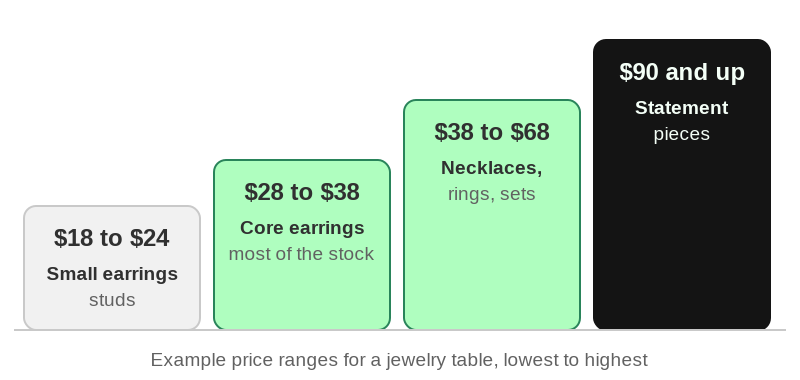
| Step | Example range | Role at the booth |
|---|---|---|
| Small earrings, studs | $18 to $24 | An easy gift; good for cash |
| Core earrings | $28 to $38 | Most of your sales and stock |
| Necklaces, rings, bracelets | $38 to $68 | Sets with the earrings; a bigger average sale |
| Statement pieces | $90 and up | Few pieces; they anchor the table |
These ranges are examples, not market averages. Walk a few markets in your area and note what jewelry booths charge before you set your own. Each step still has to cover its costs, which is where the next section comes in. Our guide on how to price items for a craft fair has the general formula; here is how it works for jewelry.
Cost per piece: a worked example
Jewelry costs hide in small parts. A pair of earrings might use wire, ear wires, jump rings, beads, a backing card, a bag and a sticker, each costing cents. Add them up per piece, not per order from your supplier.
Example: sterling silver hoop earrings with a stone bead (made-up numbers to show the method):
| Part | Cost per pair |
|---|---|
| Sterling wire for two hoops | $2.10 |
| Ear wires and jump rings | $0.90 |
| Two beads | $1.40 |
| Card, bag and sticker | $0.55 |
| Labor: 15 minutes at $20 an hour | $5.00 |
| Overhead (tools, polishing, website, share of photos) | $0.75 |
| Cost per pair | $10.70 |
The cost-plus formula (cost × 2 for wholesale, × 2 again for retail) gives $42.80. If the markets you do sell earrings mostly in the $28 to $38 range, you might price these at $34 and check what's left:
- $34 − $10.70 cost = $23.30
- Card fee at about 2.6% plus 10 cents: $0.98
- About $22.32 per pair, before booth fee and travel
Two habits keep this honest. First, recheck material costs every few months: metal and stone prices move, and a supplier's price change you never noticed can quietly cut your margin. Second, time a real batch instead of guessing. "About ten minutes" per pair often turns out to be fifteen once you count cutting, shaping, finishing and carding.
Describe your metals honestly
Metal words on jewelry have specific meanings in the US, and shoppers rely on them. The FTC's consumer guide to buying platinum, gold and silver jewelry explains the common terms. In plain words:
- Sterling silver (often stamped 925) means the metal is at least 92.5% silver.
- Gold-filled, gold overlay or rolled gold plate means a layer of karat gold (at least 10 karat) is bonded to a base metal, and the marking should say so, for example "14K gold overlay."
- Gold-plated pieces have a much thinner layer of gold over another metal, and shouldn't be described as solid gold or gold-filled.
These terms come from the FTC's Guides for the Jewelry, Precious Metals, and Pewter Industries. If you're not sure how to describe a piece, describe it plainly ("brass with gold plating," "stainless steel ear wires") rather than reaching for a word that sounds better. It also helps shoppers with metal sensitivities: many will ask what the ear wires are made of, so put it on the card or the sign. This is general information, not legal advice.
Display: small things need structure
A jewelry table can look like a beautiful collection or a tangle. Height, grouping and clear price signs make the difference: earring cards on racks, necklaces on busts or bars, rings in trays, a mirror at the front. Our guide to craft fair jewelry display ideas has a full 6-foot table plan and how to test it. For the signs themselves, see vendor booth signs.
Keeping small, valuable pieces safe at the booth
Small pieces are easy to pick up, and at a busy market you can't watch every corner. A few practical habits help without making the booth feel like a vault:
- Put the most expensive pieces closest to you, in the zone you can see while you take payments, and the low-priced earrings toward the aisle ends.
- Don't put everything out. Show one or two of each design and restock from a box under the table. A display with five of each looks fuller but gives you more to lose and more to count.
- Count trays at opening and at closing. Write the numbers on your inventory sheet. Brought minus sold minus came home tells you whether anything is missing, and when.
- Keep the statement pieces on a stand or in a case that needs you to hand them over.
- Have a helper on busy days. One person handles payments while the other talks with shoppers.
If you track stock with a sheet, our craft fair inventory sheet has a column for a tally during the day, which makes a missing pair easy to spot.
Selling jewelry online too
Markets and online sales help each other: a shopper who loved your earrings at the fair often looks you up later for the matching necklace. Online, jewelry depends heavily on photos:
- Show scale: one photo on a model, a bust or next to something familiar, so people can see the size.
- Show the details: close-ups of clasps, ear wires and finish.
- Keep backgrounds consistent across the shop, the same way you would for a jury application.
- List the metals plainly, using the same words as on your market cards.
Jewelry is small and light, so it usually costs less to ship than heavy crafts, which makes online sales of lower-priced pieces more workable. Our guide on how to sell handmade crafts online compares marketplaces and your own store by fees, with a worked example.
Check whether each market pays
Jewelry booths can look busy and still earn less than they seem, because the average sale is small. Work out each market's real profit. An example one-day market (made-up numbers):
| Amount | |
|---|---|
| Sales | $1,240 |
| Product costs (about 30% of sales) | $372.00 |
| Card fees (35 card sales, $1,000 on cards) | $29.50 |
| Booth fee | $120.00 |
| Gas and food | $45.00 |
| Profit | $673.50 |
| Hours (prep, drive, setup, selling, teardown) | 9, about $75 per hour |
Here, sales were 10.3 times the booth fee and the market's own expenses (booth, gas, food) were 13.3% of sales: a market worth rebooking by the usual rules of thumb. The free craft fair profit calculator does this math in a minute, and our guide on how to calculate craft fair profit explains each line. Do it after every market, and compare markets of the same type: a jewelry line that thrives at a holiday market may be slow at a summer farmers market, and only the numbers will tell you which is which.
FAQ
Is a handmade jewelry business profitable?
It can be, but it depends on your cost per piece, your prices and which markets you do. Work out the cost of each design (materials, findings, packaging, labor and overhead), then check each market's profit after the booth fee, travel and card fees. Those numbers tell you more than any average.
How do I price handmade jewelry?
Add up the cost of one piece, including small parts, packaging and your time, then use a formula like cost × 2 × 2 as a starting point. Adjust to what your markets pay, and check that the price still leaves a healthy profit after card fees and the booth fee.
How should I describe the metal in my jewelry?
Use the plain, accurate term: sterling silver only for metal that is at least 92.5% silver, and terms like gold-filled or gold-plated only when they match how the piece is made, as the FTC's jewelry guidance explains. When in doubt, describe the actual materials.
What jewelry sells best at craft fairs?
It depends on the crowd and your prices. Earrings are often the easiest purchase because there's no sizing, while necklaces and sets raise the average sale. Track sell-through and profit per design at each market to see what works at your booth.