How to Start a Handmade Craft Business: A 90-Day Plan
If you're figuring out how to start a handmade craft business, you've probably already done the hard part: you make something people ask to buy. Turning that into a small business is mostly a series of plain, unglamorous steps: pick a few products and price them properly, set a starter budget, handle the paperwork your state and city require, decide where to sell, and keep simple records so you know what's actually making money. This guide walks through each step with example numbers and ends with a 90-day plan you can copy.
This is general information, not legal or tax advice. Registration, permits and taxes depend on your state, county and city. Check with them, and with an accountant if you're unsure.
Step 1: Start with a few products, priced for profit
Resist the urge to launch with everything you can make. Three to five products you can make well and repeat are easier to price, photograph, stock and sell. Pick ones that:
- Use materials you can buy reliably at a known cost.
- Take a predictable amount of time to make.
- Work at more than one price point (a small version and a larger one, or single and set).
Then price each one from its real cost: materials, your time and a share of overhead. A common cost-plus formula is cost × 2 for wholesale and wholesale × 2 for retail, and then you check the price against what a market will cost you. Our guide on how to price items for a craft fair works through it with a full example. Leaving your time out of the price is the most common reason a busy craft business still doesn't make money.
Step 2: Set a starter budget
You don't need much to start, but it helps to write it down so you know when the business has paid you back. An example for a maker who plans to sell at local markets and online (made-up numbers to show the categories):
| Item | Example cost |
|---|---|
| Materials for first stock (about 120 items) | $420 |
| Packaging, tags and labels | $60 |
| Table cover, risers and display pieces | $110 |
| Signs and price cards | $40 |
| Card reader | $49 |
| Business name filing and local license (varies a lot by place) | $50 |
| First market booth fee | $75 |
| Total to get started | $804 |
If the first 120 items sell for an average of $22 and cost about $4 each in materials and packaging, they bring in about $2,640, enough to cover the starter budget with room to restock. That's only true if they sell, which is why the first markets are about learning as much as earning.
Things to leave out until you need them: a tent (only for outdoor events), an LLC, a website you pay for monthly, and big batches of stock in untested designs.
Step 3: Register and get the basics in place
This is the part that worries people most, and it's usually simpler than it sounds for a one-person craft business.
Your business structure. The SBA explains that you're automatically considered a sole proprietorship if you do business activities but don't register as any other kind of business. It also notes the trade-off: a sole proprietorship has no separate legal identity, so you can be held personally responsible for its debts. Many makers start this way and revisit the question (an LLC, for example) with an accountant or attorney once the business grows.
Your business name. If you sell under a name that isn't your own legal name, you may need to register it as a "doing business as" (DBA) name. The SBA says a DBA may need to be registered with your state, county or city, depending on where you are.
Licenses and permits. The SBA's licenses and permits guide explains that requirements come from the state and from city and county governments, and points to your state's website and your local government's site to find what applies. Home-based businesses and food makers often have extra local rules.
An EIN, if you need one. An employer identification number is free from the IRS, which warns people to beware of websites that charge for an EIN. According to the IRS, a sole proprietor without employees and without excise or pension plan tax returns doesn't need an EIN, but can get one. Some makers get one anyway so they don't hand out their Social Security number on vendor forms.
A separate bank account. Not always required for a sole proprietor, but keeping business money apart from personal money makes every later step easier, especially taxes.
Step 4: Sales tax and insurance
Sales tax. In states with a sales tax, handmade goods are usually taxable, and selling at events often needs a seller's permit, a temporary permit or a special event license. How states handle one-day events varies a lot. Our craft fair sales tax guide shows how several states do it, with links to their official pages.
Insurance. Many markets and venues ask vendors for liability insurance and a certificate naming the event. Even when they don't, it's worth thinking about if you sell anything people eat, burn, wear or put on their skin. Our craft fair insurance guide explains the terms and how to compare an annual policy with per-event coverage.
Step 5: Decide where to sell first
A handmade craft business usually sells in two places: in person and online. They do different jobs. Our guide on how to sell handmade crafts online compares the fees.
| Channel | Good for | Watch out for |
|---|---|---|
| Local markets and craft fairs | Fast feedback, cash flow, meeting customers | Booth fees, travel, your time at the booth |
| Pop-ups and small events | Low booth fees, testing new products | Small crowds |
| Your own online shop | Repeat customers, selling between events | Getting traffic takes time |
| Online marketplaces | Built-in shoppers | Fees and competition |
For a first season, many makers start with small local events, because a Saturday at a market teaches you more about prices and products than a month of waiting for online orders. Our guide on how to be a vendor at events compares the event types, and how to find vendor events covers where to look. When you're ready to go deeper on markets, how to sell at craft fairs walks through the whole loop.
If you sell in person and online, try to use one system for both, so inventory and sales live in one place and you're not counting the same mug twice. Our comparison of the best card reader for craft fairs looks at the common options.
Step 6: Keep simple records by channel and by event
You don't need accounting software on day one, but you do need to answer two questions every month: how much did I sell, and what did each place I sold actually make me?
Keep one line per sales channel per month, and one line per market:
| Month: May (example) | Sales | Costs | Profit |
|---|---|---|---|
| Online shop | $380 | $152 (materials, shipping supplies, fees) | $228 |
| Saturday market (4 weeks) | $1,640 | $864 (materials, card fees, booth fees, gas) | $776 |
| One pop-up | $310 | $166 | $144 |
| Total | $2,330 | $1,182 | $1,148 |
Now you can see that the pop-up made $144 for a long afternoon, and decide whether to do it again. For each market, the free craft fair profit calculator turns sales and costs into profit, profit per hour and the booth fee multiple. If you'd rather keep a spreadsheet, our craft fair profit spreadsheet has a free template with one row per market.
Save receipts for materials, booth fees, mileage and supplies as you go. Your accountant (or your future self in April) will thank you.
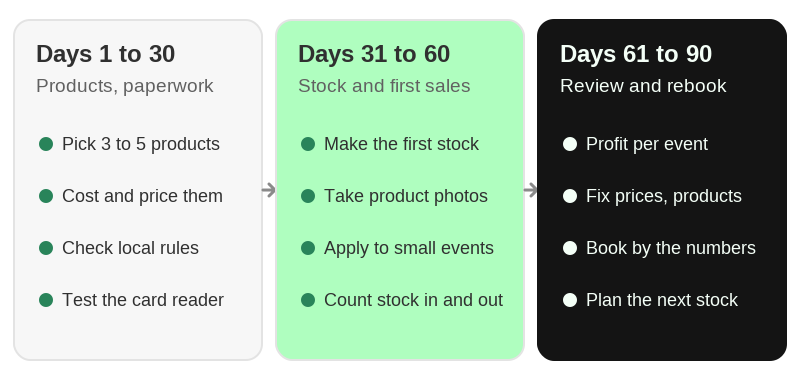
A 90-day plan
| Days | Goals |
|---|---|
| 1 to 30 | Choose 3 to 5 products. Cost and price each one. Check your state and local rules (name, license, sales tax). Open a separate bank account. Set up a card reader and do a test sale. |
| 31 to 60 | Make the first stock. Take product photos. Apply to two or three small local events. Do your first market or pop-up. Count what you bring and what comes home. |
| 61 to 90 | Work out the profit of each event and each channel. Adjust prices or products that didn't work. Book the next events based on the numbers, not on how busy a day felt. |
At day 90 you'll have real numbers: which products sell, which prices work, and which events are worth your Saturdays. That's the foundation of a handmade craft business, more than any logo or website.
FAQ
Do I need a license to sell handmade crafts?
Often you need something, but it depends on where you live and sell. Your city or county may require a business license, your state may require a seller's permit for taxable sales, and you may need to register a business name. The SBA's licenses and permits guide points you to the right state and local offices.
Do I need an LLC to start a craft business?
No. If you start selling without registering as another kind of business, the SBA says you're automatically a sole proprietorship. An LLC can separate business and personal liability, so many makers revisit the question with an accountant or attorney as the business grows.
How much money do I need to start a handmade business?
It can be a few hundred dollars. In our example, materials for a first batch, packaging, display pieces, signs, a card reader, a local filing and one booth fee came to about $804. Start small and let the first sales pay for the next batch.
How do I know if my craft business is making money?
Track sales and costs for each channel and each event, including materials, card fees, booth fees and travel. If an event or channel doesn't cover its costs and your time after a few tries, change something or drop it.