How to Do a Pop-Up Shop at a Local Business (Deals and Math)
A pop-up shop at a local business is one of the easiest ways to sell in person between craft fairs: one table at a brewery on a Saturday afternoon, a corner of a coffee shop during the holiday rush, a shelf and a table at a boutique's open house. There's usually no application, no jury and no 10 by 10 tent. But there's also no organizer doing the promotion and no one to tell you what a fair deal looks like. This guide covers how to pitch a host, the three common deal types with the math side by side, what to ask before you say yes, a smaller setup that fits a corner, and how to judge the afternoon by profit per hour.
Why local businesses say yes
A host isn't doing you a favor; a good pop-up helps them too. Keep their side in mind, because it's what your pitch should be about:
- New faces. Your followers and email list come through their door, some for the first time.
- A reason for regulars to stay. People linger, order another coffee or a second round.
- Something to post. "Meet the maker this Saturday" is easy content for their social accounts.
- No cost or risk. You bring the table, the stock and the card reader.
If you can show a host that your customers look like their customers, most of the work is done.
Find the right host
Not every busy business is a good fit. Look for a match between their crowd and your products:
- Breweries and taprooms: adults with time to browse, often in groups. Good for prints, stickers, apparel, home goods and gifts.
- Coffee shops: short visits, steady traffic in the morning. Small, giftable items at impulse prices work best.
- Boutiques and gift shops: shoppers already in buying mode. Watch for overlap with what the shop sells.
- Studios, salons and gyms: a loyal crowd that comes back weekly, good for a recurring pop-up.
Visit as a customer first, at the time you'd sell. Count people coming in for ten minutes, look at where a table could go without blocking anything, and notice what people buy and spend.
A short pitch you can adapt
Keep it short, specific and about them. Send it by email or bring it in person at a quiet time, with two or three product photos.
Hi [name], I'm [your name], and I make [product] here in [town]. I'd love to set up a small pop-up table at [business] on a [day] afternoon, about [hours] hours. I bring my own table, display and card reader, and I'll promote it to my [number] email subscribers and on [social account], so it should bring some new faces in. Would you be open to it? I'm happy to work with whatever setup suits you: free, a flat fee, or a small share of sales.
Mention a date range rather than one date, and offer to tag them in every post.
Deal types: free, flat fee or a share of sales
Pop-up deals usually fall into one of these:
- Free: the host gets traffic and content; you get the space. Common for a first try or a small table.
- Flat fee: a fixed amount for the day, sometimes paid in advance.
- Percentage of sales: the host takes a share of what you sell, sometimes with a minimum.
Which is best for you depends on how much you'll sell. Here's a comparison with example numbers: a $40 flat fee, 15% of sales, or 10% of sales with a $30 minimum.
| Sales that day | Flat $40 | 15% of sales | 10% with $30 minimum |
|---|---|---|---|
| $200 | $40 | $30 | $30 |
| $480 | $40 | $72 | $48 |
| $800 | $40 | $120 | $80 |
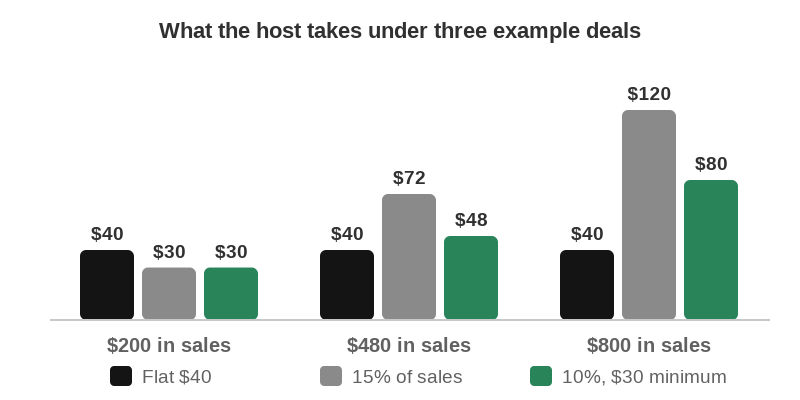
What the numbers say:
- A percentage deal is cheaper on a slow day and more expensive on a good one. At 15%, it passes a $40 flat fee once you sell more than about $267 ($40 ÷ 0.15).
- A flat fee is a bet on yourself. If you expect a strong afternoon, it's usually the better deal.
- If the host wants a percentage, ask how they'll check sales. Many accept a screenshot of your POS report for the hours you were there; agree on that before the day.
What to ask before you say yes
Get the answers in writing, even a short email, so there are no surprises.
| Question | Why it matters |
|---|---|
| Date, hours and setup time? | Your profit per hour includes setup and teardown |
| How busy is it at that time? | A quiet Tuesday won't pay for the drive |
| Where exactly is the table, and who provides it? | Size, light, and whether you block the door or the bar |
| Is there power and Wi-Fi? | For lights and your card reader; plan for offline payments anyway |
| Who promotes it, and when? | Shared posts a week ahead make the biggest difference |
| Do they sell anything similar? | Avoid competing with the host's own shelves |
| Do they need proof of insurance? | Some do; see our guide to event vendor insurance |
| What happens if it's canceled? | Weather, staffing or a private booking can bump you |
Sales tax still applies to what you sell, and the rules follow the place where the pop-up happens. If it's in another city or state, check what that location requires; our craft fair sales tax guide covers the basics and how a few states handle temporary sellers.
A smaller setup than a craft fair
A pop-up corner is closer to one 6-foot table than a full booth. That makes packing easier, but every inch counts:
- One table with a floor-length cover, and a riser or two for height.
- Your best sellers only. Bring the products with the highest profit per foot of table, not the whole line. Our guide to what sells best at craft fairs shows how to rank them.
- Three signs: your name and what you make, group prices, and the payment methods you take. Our guide to vendor booth signs covers sizes and wording.
- A small light if the room is dim, which many taprooms and cafes are in the evening.
- Bags and a spot to wrap, so checkout doesn't spill onto the host's counter.
Our printable craft fair checklist works for a pop-up too; just cross out the tent.
Being a good guest at breweries and cafes
The host's business comes first. A few habits get you invited back:
- Don't block the bar, the counter or the line. Ask where the flow is before you set up.
- Don't serve or handle drinks. At breweries and bars, follow the host's rules on anything related to alcohol; you're there to sell your products, not theirs.
- Keep it tidy and quiet. No music unless the host suggests it.
- Buy something. A coffee or a pint is a small thank-you that staff notice.
- Tag them in every post before, during and after.
Promote it together
At a craft fair, the organizer brings the crowd. At a pop-up, much of the crowd is yours. Make promotion easy for the host:
- Send them a ready-made image and two lines of text a week ahead, so they can post it in a minute.
- Post on your own accounts three times: a week before, the day before and when you open.
- Email your list. A pop-up is a good reason to invite local subscribers in person.
- Ask the host for a small sign at their counter during the week before.
- Collect emails at the table for next time; our guide on how to get repeat customers from craft fairs has ideas that work here too.
Judge it by profit per hour
A pop-up can feel busy and still pay poorly, or feel quiet and pay well. Work it out the same way you would for a fair. An example Saturday at a brewery, 15% deal (made-up numbers):
| Amount | |
|---|---|
| Sales | $480 |
| Product costs (30% of sales) | $144 |
| Card fees (about 2.6% + 10¢ on $420 of card sales) | $13 |
| Host's share (15%) | $72 |
| Gas | $8 |
| Profit | $243 |
| Hours (promotion, packing, drive, setup, selling, teardown) | 6 |
| Profit per hour | about $40 |
Compare that with your craft fairs. If a fair with a bigger booth fee earns you $55 an hour and this pop-up earns $40, the pop-up may still be worth it as a midweek or between-season addition, or as a way to meet new local customers. If it comes in at $15 an hour twice, it's probably not the right host or the right time slot.
Put your own numbers in the free craft fair profit calculator: use the host's flat fee or share as the "booth fee." Our guide on how to calculate craft fair profit explains each line.
Turn one pop-up into a series
If the first one works, ask for a regular slot: the first Saturday of every month, or every Friday in December. Regular dates build a habit for the host's customers and yours, make promotion easier, and give you a fair comparison from one month to the next. Keep notes on each date (weather, what else was going on, what sold) so you can tell a slow month from a slow spot.
FAQ
How do I ask a business to host a pop-up shop?
Visit first as a customer, then send a short pitch focused on what the host gets: new faces, something to post, and no cost to them. Include two or three product photos, a date range and how you'll promote it.
How much should I pay to do a pop-up shop at a local business?
It varies. Some hosts ask for nothing, some for a flat fee, some for a percentage of sales. Compare the options against your expected sales: a percentage is cheaper on a slow day, and a flat fee is cheaper on a strong one.
Do I need insurance for a pop-up at a brewery or cafe?
Some hosts ask for a certificate of liability insurance, especially if they host vendors often. Ask before the day; one-day event policies exist if you don't carry an annual one.
What sells best at a brewery or coffee shop pop-up?
Products that suit the crowd and are easy to carry: prints, stickers, apparel, small gifts and items at impulse prices. Bring your best sellers by profit per foot of table rather than your whole line, and track what sells for next time.