Wholesale vs Craft Fairs: Which Earns More for Makers?
Wholesale vs craft fairs is a question most makers hit the first time a shop owner picks up a piece at the booth and asks, "Do you sell wholesale?" Saying yes sounds like growth: bigger orders, no booth fee, no Saturday on your feet. But wholesale pays you about half of what you'd get at the booth for the same item, and the shop pays later. This guide works through both channels for the same 100 items with full example numbers, shows when each one wins, and explains how to do both without the two getting in each other's way.
The margin math behind wholesale
A common convention in handmade pricing is that the wholesale price is about half the retail price. It's a convention, not a rule: shops and makers negotiate, and some categories work differently. Our guide on how to price items for a craft fair uses the same idea from the other direction: cost × 2 for wholesale, then wholesale × 2 for retail.
Using that guide's earrings as the example:
| Amount | |
|---|---|
| Cost per pair (materials, 15 minutes of labor at $20 an hour, overhead) | $9.00 |
| Wholesale price (cost × 2) | $18.00 |
| Retail price (wholesale × 2) | $36.00 |
The $9 cost already pays you for making the earrings. Everything below is about the other part of the job: selling them.
The same 100 pairs, two ways
Here's a full comparison with example numbers. Change them to your own; the method is what matters.
Route 1: sell them at craft fairs
Say the 100 pairs sell over four one-day fairs, and earrings are about half of your sales at each one, so they carry half of each fair's costs and hours.
| Fair route (example) | Amount |
|---|---|
| Sales: 100 pairs × $36 | $3,600.00 |
| Product cost: 100 × $9 | −$900.00 |
| Card fees (about 3%) | −$108.00 |
| Half of 4 fairs' booth, gas and food (4 × $210 ÷ 2) | −$420.00 |
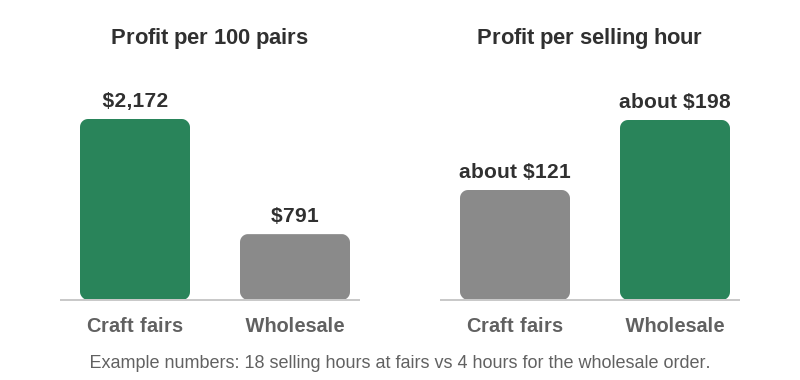
| Profit | $2,172.00 |
| Selling hours: half of 4 × 9 hours (packing, driving, setup, selling, teardown) | 18 |
| Profit per selling hour | about $121 |
Route 2: sell them wholesale to a shop
Now say one shop orders the same 100 pairs.
| Wholesale route (example) | Amount |
|---|---|
| Sales: 100 pairs × $18 | $1,800.00 |
| Product cost: 100 × $9 | −$900.00 |
| Shipping the order (you pay in this example) | −$25.00 |
| Card fee on the invoice (about 3%; $0 if paid by check or transfer) | −$54.00 |
| Samples and printed line sheets | −$30.00 |
| Profit | $791.00 |
| Selling hours: emails, invoicing, packing the order | 4 |
| Profit per selling hour | about $198 |
Which number should decide?
Both routes "win," depending on what's scarce in your business:
- If making time is your limit (you sell out at fairs and can't make more), each pair is precious. At fairs a pair leaves you $21.72; wholesale it leaves $7.91. Every pair you send to a shop is a pair you didn't sell at the booth, so fairs win clearly.
- If selling time is your limit (you could make more, but you can't do more weekends), wholesale wins. The order took 4 hours instead of 18, and those 14 hours can go into making the next batch or into family time.
That's why profit per hour is the best judge for the selling side, the same way it is for comparing markets. The free craft fair profit calculator does the fair side of the math, and our guide on how to calculate craft fair profit explains each line.
Cash flow: when the money arrives
At a fair, you're paid the same day: cash in the box, card payouts within a few days. Wholesale works differently:
- Prepaid orders. Many makers ask new accounts to pay before the order ships. It's the simplest way to start.
- Payment terms. Shops often ask for terms like "net 30," which means the full invoice is due 30 days after the invoice date. That's 30 days (or more, if the shop pays late) where you've paid for materials and the money isn't in your account yet.
- Deposits. For large or custom orders, a deposit up front (for example half) covers materials.
If you take on wholesale, plan for the gap. A $1,800 order on net 30 can mean $900 of materials bought in October and paid back in December. Fairs never create that gap.
Minimums and line sheets
Shops expect a few things from a wholesale maker. You decide the details, but write them down before the first shop asks:
| Item | Example |
|---|---|
| Opening order minimum | $150 |
| Reorder minimum | $100 |
| Lead time | 2 to 3 weeks from order |
| Payment | Prepaid for first orders; net 30 after that |
| Shipping | Paid by the shop, or included over a set order size |
A line sheet is the one- or two-page document that puts it all together: a photo of each product, an item number, the wholesale price, the suggested retail price, minimums, lead time, payment terms and how to order. Keep it simple and current; an outdated price on a line sheet becomes an awkward email later.
Keep your retail price the same everywhere
This is the rule that keeps wholesale relationships healthy: don't undercut your shops at your booth. If a shop sells your earrings at $36, sell them at $36 at the fair too, and online. If shoppers can get the same item for $28 from you on Saturday, the shop is left holding stock nobody wants to buy at full price, and you probably won't get a reorder.
A few practical habits:
- Use the suggested retail price on your line sheet as your own booth price.
- If a shop is near one of your regular fairs, tell them. Some shops are fine with it; others would rather carry pieces you don't bring to that fair.
- Keep end-of-season discounts for discontinued items, not for products shops still carry.
How craft fairs bring wholesale leads
Shop owners and buyers sometimes walk craft fairs looking for new makers. A booth is a live product demo, which makes a fair a natural place to meet wholesale accounts without cold emails.
To catch those leads:
- Say it on your card. A line like "Wholesale inquiries welcome" on your business card or a small sign. Our guide to business cards for handmade crafts covers what else to print.
- Ask and write it down. When someone mentions a shop, ask for the shop name and an email, and note what they looked at.
- Follow up within a week with your line sheet and a short note about what they liked.
- Count leads per fair. Next to sales and profit, write "wholesale leads: 2." A fair with average sales and three good leads may deserve a rebook. Our guide on how to get repeat customers from craft fairs shows a simple table for tracking contacts like these.
Doing both: a decision table
Most makers who wholesale keep doing some fairs. The question is the mix. Use this as a starting point:
| Your situation | Lean toward |
|---|---|
| You sell out at fairs and can't make more | Fairs: more profit per item |
| You have spare making time but no more free weekends | Wholesale: more profit per selling hour |
| You need cash this month | Fairs: paid the same day |
| You want orders between fair seasons | Wholesale: shops reorder on their own schedule |
| Booth fees take a big share of your fair sales | Wholesale, or cheaper fairs (see is a craft fair worth it) |
| Your product needs explaining or trying on | Fairs: you're there to show it |
| You're new and still testing prices | Fairs first, wholesale once prices are settled |
A hybrid plan that often works: keep your best few fairs (the ones with the highest profit per hour and the best leads), and add a small number of shops that aren't right next to those fairs. Then compare the season's numbers by channel, the same way you'd compare markets.
FAQ
Is wholesale or craft fairs more profitable for makers?
Per item, craft fairs usually leave more, because you keep the full retail price. Per selling hour, wholesale can leave more, because one order replaces several weekends at the booth. Which matters more depends on whether your making time or your selling time is the limit.
How much is wholesale compared to retail for handmade items?
A common convention is that wholesale is about half of retail, which is where the cost × 2 × 2 pricing formula comes from. It's not a rule; some shops and categories use different ratios, so agree on it with each shop.
What does net 30 mean for a wholesale order?
It means the full invoice is due 30 days after the invoice date. Many makers ask new accounts to prepay and offer net 30 only after a few orders.
Can I sell at craft fairs and wholesale at the same time?
Yes, many makers do. Keep your retail price the same at your booth as in the shops that carry you, and be open with shops about the fairs you do near them.