Flea Market Vendor Guide: Space Rent, Rules and Real Profit
Becoming a flea market vendor is one of the cheapest ways to start selling in person. Space often costs less than a craft fair booth, many markets run every week, and you can usually show up with a table and a cash box. But flea markets work differently from craft fairs: shoppers expect bargains, many vendors resell rather than make, and rent comes in daily, weekly and monthly flavors that change the math. This guide walks through how to become a flea market vendor as a maker or small seller, with real published rent examples, the permit question, pricing for hagglers, and a weekly profit example.
Indoor, outdoor and swap meets
"Flea market" covers a lot of formats:
- Outdoor flea markets: rows of spaces in a field, parking lot or fairground, often one or two days a week, rain or shine. You bring the table, chairs and often a canopy.
- Indoor flea markets: permanent stalls in a building, open on weekends or several days a week. Usually higher rent, but no weather and sometimes storage.
- Swap meets: the term is common in the West; in practice they're similar to outdoor flea markets, often in a drive-in or stadium lot.
- Antique and vintage markets: monthly or seasonal events, closer to a curated show, with higher prices.
Visit the one you're considering on a market day before renting. Walk every row, note what sells near your category, and count how many shoppers pass a busy corner in ten minutes. It's rough, but it beats guessing.
What flea market space costs: real examples
Rent varies a lot by market, location, day and space size. Here's what three markets publish on their own vendor pages (checked in November 2026; prices change, so confirm before you pay):
| Market | Daily | Weekly | Monthly |
|---|---|---|---|
| Shipshewana Trading Place, Indiana (outdoor) | $45 per space | $65 per space | $207 to $242, by location |
| Mile High Flea Market, Colorado (outdoor) | About $20 to $47, by day and booking | $444 (non-corner) | |
| Jax Flea Market, Florida | $42 (10 by 10 with a table) | $450 plus tax (10 by 20) |
Read what's included. Shipshewana's vendor page, for example, says spaces include one standard outlet, while tables, chairs and canopies are your responsibility, and extra holiday and weekend market days cost more.
Daily, weekly or monthly?
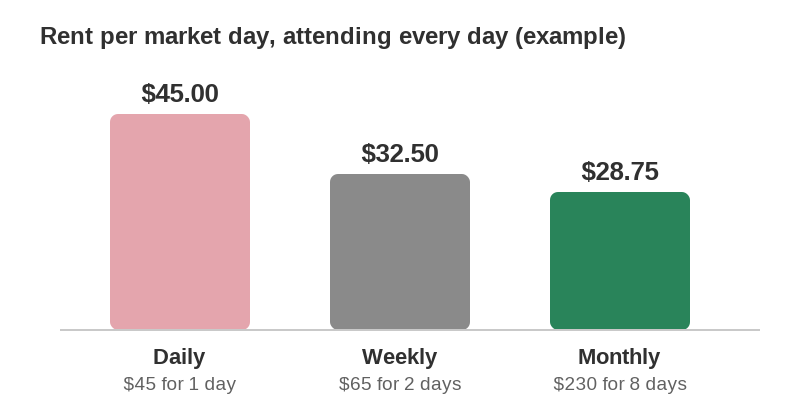
The longer the commitment, the less you usually pay per market day. Using Shipshewana's published outdoor rates as the example (its flea market runs two days a week):
| Rental type | Price | Market days covered | Per market day |
|---|---|---|---|
| Daily | $45 | 1 | $45.00 |
| Weekly | $65 | 2 | $32.50 |
| Monthly (example: $230, mid-range) | $230 | 8 | $28.75 |
The catch: the cheaper rates only pay off if you actually show up every market day. If you'll only do Tuesdays, the weekly rate is $65 for one day, more than the daily rate. Start daily, then switch once you know which days work. The same logic applies to farmers market fees; our guide on how to become a vendor at a farmers market compares daily, season and percentage fees.
Handmade, resale and what's allowed
Most flea markets allow resale, vintage, collectibles and new merchandise alongside handmade goods. That's the big difference from juried craft fairs, and it shapes your pricing: the booth next to you may be selling imported jewelry for $5.
Check the market's rules for:
- Prohibited items: many markets list items they don't allow (often weapons, certain food, counterfeit goods).
- Food: selling food usually needs health department approval and sometimes a separate food vendor space.
- Electricity, tents and setup times: when you can arrive, how you park, and when you must be packed up.
If you make what you sell, say so on a sign. "Handmade by me in [your town]" separates you from resale at a glance, and gives shoppers a reason to pay a little more.
Sales tax and seller's permits
Selling at a flea market is still selling, and most states with a sales tax expect you to have the right permit and collect tax on taxable items. Rules differ by state, and flea markets often have their own process because operators may have to check vendors.
California is a useful example. Its tax agency's guide for swap meet, flea market and special event sellers explains that sellers give the event operator their information on a CDTFA form, and that a seller who doesn't need a permit has to state why (for example, being an occasional seller or selling only exempt items). It also says that if you take part in three or more swap meets, flea markets or special events in a 12-month period, you need an ongoing seller's permit. A weekly flea market vendor passes that threshold within a month.
Other states handle it differently. Our craft fair sales tax guide shows how a few states treat event vendors and how to keep records by market. This is general information, not tax advice: confirm with your state's revenue department before you sell.
Pricing for a crowd that haggles
Flea market shoppers often expect to negotiate. A few ways to handle it without losing your margin:
- Know your floor before the day. For each product, write down the lowest price you'll accept. Base it on cost plus a minimum profit, not on the mood of the moment. Our guide on how to price items for a craft fair explains the cost side.
- Leave a little room. If your floor is $20, a sign price of $24 lets you accept $22 and still smile.
- Offer bundles instead of discounts. "2 for $40" moves more product than knocking $4 off one item, and keeps your average sale up.
- Use round prices. Whole dollars make cash faster and haggling simpler.
- Mark "firm" where you mean it. Handmade pieces with a clear sign ("Handmade, price firm") get fewer offers.
Haggling costs more than it looks. On a $24 item that costs you $8, accepting $20 instead of $24 cuts your profit on that sale from $16 to $12, a quarter of it gone.
Cash, cards and payment apps
Flea markets are more cash-heavy than craft fairs, but many shoppers now carry no cash at all. Bring:
- A cash float of small bills (ones and fives), counted and written down.
- A card reader and a charged phone, plus a power bank. Outdoor markets often have weak signal, so test offline mode before the day. Our comparison of the best card reader for craft fairs lists fees and offline rules for common options.
- A sign with payment apps you accept, and a way to record those sales so they count in your totals.
Card fees are a percentage plus a few cents per sale, so they hurt most on $3 and $5 items. Some flea market vendors set a small card minimum or round small items into bundles.
A weekly profit example
Here's one Saturday at an outdoor flea market for a maker selling candles and soap. These are example numbers to show the math:
| Amount | |
|---|---|
| Sales (cash $180, card $300) | $480 |
| Product costs (30% of sales) | $144 |
| Card fees (about 2.6% plus a few cents per sale, on $300) | $9 |
| Space rent | $45 |
| Gas | $12 |
| Food | $10 |
| Profit | $260 |
| Hours (packing, driving, setup, selling, teardown) | 9, about $29 per hour |
Sales were about 10.7 times the space rent, which passes the common rule of keeping the booth fee at or under 10% of sales. Do this math every week and patterns show up fast: which day is better, whether a corner space pays for itself, whether the weekly rate is worth it. The free craft fair profit calculator works for flea markets too.
When a flea market beats a craft fair, and when it doesn't
| Flea market | Craft fair | |
|---|---|---|
| Space cost | Often lower, and you can come every week | Higher booth fees, fewer dates |
| Shoppers | Bargain hunters, browsers, regulars | Gift shoppers expecting handmade prices |
| Competition | Resale and imports next to you | Mostly handmade, often juried |
| Prices that work | Lower, impulse-friendly | Mid to higher |
| Repeat customers | Weekly regulars can come back | Once or twice a year |
A flea market tends to suit you if your products are lower-priced, practical or consumable (candles, soap, plants, stickers), if you want a steady weekly income, or if you're testing prices before bigger shows. A craft fair tends to suit you if your work is higher-priced, giftable or clearly artisan, where a shopper who expects handmade prices is worth a higher booth fee. Many makers do both: a flea market most weekends and a handful of craft fairs in the fall. Our guide on how to be a vendor at events compares more event types, and is a craft fair worth it has rules for judging any market.
For the gear, our printable craft fair checklist works for a flea market table too, and the craft fair tent guide covers canopies and weights for outdoor rows.
FAQ
How do I become a flea market vendor?
Pick a market, visit it on a market day, read its vendor rules, and reserve a space (daily, weekly or monthly). Check whether your state requires a seller's permit for flea market sales, bring a table, a cash float and a card reader, and work out your profit after each market day.
How much does a flea market booth cost?
It varies by market. Published examples include $45 per day or $65 per week at Shipshewana Trading Place in Indiana and $42 per day for a 10 by 10 at Jax Flea Market in Florida. Monthly spaces cost more upfront but less per market day if you attend every day.
Do I need a license to sell at a flea market?
Often you need a seller's permit for taxable items, and some states have specific rules for flea market and swap meet sellers. California, for example, requires an ongoing seller's permit if you take part in three or more such events in 12 months. Check with your state.
Can I sell handmade items at a flea market?
Yes, at most flea markets, alongside resale and vintage. Mark your products as handmade so shoppers can tell them apart from imported goods, and price for a crowd that often expects to negotiate.