How to Be a Vendor at Events: A Beginner's Guide
If you're figuring out how to be a vendor at events, the first surprise is how many kinds of events there are: farmers markets, craft fairs, holiday markets, pop-up shops, festivals, conventions, school and church bazaars. They don't draw the same shoppers, cost the same or need the same gear. This guide helps you pick the event types that fit what you sell, shows a starter budget with example numbers, lists what organizers will expect from you, and works out a sales target for your first event so you know what "a good day" means before you load the car.
The main kinds of vendor events
Every event is different, so treat this as a starting map, not a rulebook. The best way to know an event is to visit it as a shopper first.
| Event type | Usually | Often good for |
|---|---|---|
| Farmers market | Weekly or seasonal, outdoors, food and growers first | Food, plants, flowers, everyday handmade goods |
| Craft fair | One or two days, indoors or out, handmade focus | Most handmade products, gifts |
| Holiday market | November and December, gift shoppers | Ornaments, gifts, stocking stuffers, decor |
| Pop-up shop | A few hours inside a store, brewery, cafe or studio | Small, giftable items; testing a new product |
| Festival | Big outdoor crowds, long days, food and music | Low-priced, impulse items; things that don't mind weather |
| Convention or expo | Indoor, multi-day, one topic or audience | Products made for that audience (fandom, pets, home, books) |
| Community bazaar | School, church or club fundraiser, small and local | First events, testing prices, low booth fees |
Farmers markets have their own rules about who can sell (many are built around growers and food producers). If they're on your list, read how to become a vendor at a farmers market first.
Pick events that fit your products
Before you look at dates, answer five questions about your products. They rule out more events than any list.
- What do most of your items cost? Where shoppers mostly buy on impulse, as at many big festivals, lower prices are an easier yes. A juried fine craft show may suit higher prices. Visit as a shopper and note what booths in your category charge.
- Is it food? Food vendors usually need health or cottage food paperwork, and some events limit food categories. Check the rules where the event takes place.
- Can it handle weather? Paper goods, candles in summer sun and anything that blows away are hard at outdoor events. Indoor events remove that risk but often cost more.
- How many days can you do? A three-day convention means three days of stock, food and time off work. A two-hour pop-up is a gentler start.
- Who buys it? If your products speak to a specific group (gamers, dog owners, gardeners), an event built for that group can beat a bigger general one.
A starter setup: what it costs
Here's a realistic starter budget for someone doing their first outdoor event. These are example numbers to show the categories; your prices will differ by brand, size and where you shop.
| Item | Example cost | Notes |
|---|---|---|
| 10 x 10 canopy tent | $150 | Outdoor events only |
| Tent weights (4 legs) | $80 | Outdoor events; check the event's rule |
| 6-foot folding table | $60 | Check whether the event provides tables |
| Floor-length table cover | $25 | Hides stock boxes under the table |
| Risers, crates, display pieces | $60 | Height makes the booth visible |
| Signs (name, prices, payments) | $40 | |
| Bags and packaging | $30 | |
| Card reader | $49 | For example, Shopify lists its Tap & Chip reader at $49 |
| Gear (one time) | $494 | |
| First booth fee | $75 | |
| Insurance for one event | $45 | Only if required; see below |
| First outdoor event total | $614 |
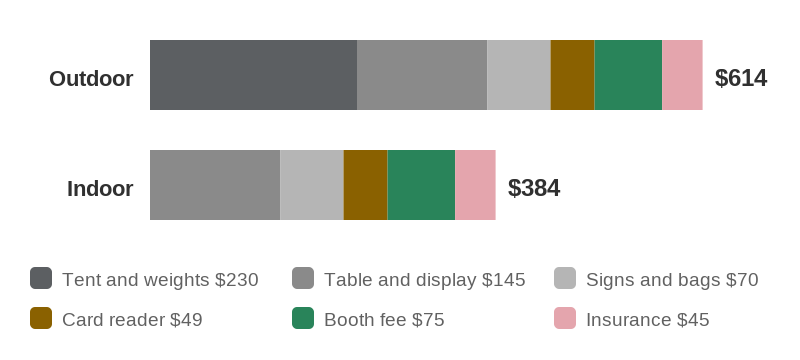
For an indoor event, drop the tent and weights and the total in this example falls to $384. That's one reason many vendors start indoors or at small community bazaars.
Two things aren't in the table because they vary too much to guess:
- Permits. Many states want vendors at events to hold a seller's permit, a temporary permit or a special event license. California, for example, treats anyone selling at a location for less than 90 days as a temporary seller who needs a temporary seller's permit. Our craft fair sales tax guide shows how a few states handle events.
- A cash float. Small bills for change, often $100 or so, aren't a cost because you take them home again. Just don't count them as sales.
What organizers will expect from you
Organizers juggle dozens or hundreds of vendors. The ones who get invited back make that job easy. Expect to be asked for some or all of this:
- An application with photos of your products and often your booth. Our craft fair vendor application guide covers photos and descriptions.
- Paperwork: a certificate of insurance naming the event (see our craft fair insurance guide), your seller's permit number, and food permits if you sell food.
- The booth fee on time, and an understanding of the refund and weather policy.
- Arriving within load-in times and setting up only in your assigned space.
- Selling what you applied with. Many events limit categories, so swapping in new product lines without asking can cause problems.
- Following the event's rules on tent weights, signs, music, sampling and teardown times.
If an event asks for insurance and you don't carry an annual policy, our guide to event vendor insurance explains one-day coverage. Read the vendor rules once when you apply and again the week before. They answer most of the questions people email the organizer about the night before.
Set a sales target for your first event
A target turns a vague hope into a number you can plan stock around. Here's the math for a one-day event with a $75 booth fee, using example numbers:
| Amount | |
|---|---|
| Booth fee | $75 |
| Target: 10 times the booth fee | $750 |
| Gas and parking | $20 |
| Food | $15 |
| Product costs (35% of sales) | $262.50 |
| Card fees (about 3% of sales) | $22.50 |
| Profit if you hit the target | $355.00 |
| Hours (packing, driving, setup, selling, teardown) | 8 |
| Profit per hour | about $44 |
Ten times the booth fee is a rule of thumb many vendors use; our guide is a craft fair worth it explains it and four others. And if sales come in lower? Your costs that don't change with sales are $110 (booth, gas, food). Each dollar of sales leaves about 62 cents after product costs and card fees, so you break even at about $177 in sales ($110 ÷ 0.62).
There's one more number worth knowing: your $494 in gear. At $355 profit per event, it pays for itself in about two events like this one. After that, the same setup works for every event you do.
To get the target in units, divide by your average sale. At about $25 per sale, $750 means 30 sales over a 6-hour selling day, or 5 an hour. Bring roughly double the items you expect to sell so the table still looks full in the afternoon.
Your first event: what to bring and do
The night before, pack from a list, count your stock, charge the card reader and do a test sale. Our printable craft fair checklist covers the full list for any kind of event. On the day:
- Arrive early, set up, then walk the event for five minutes to see what's around you.
- Stand up and say hello when people slow down.
- Take every kind of payment you can. If you're choosing a card reader, our comparison of Square vs Shopify POS for craft fairs covers fees and offline payments.
- Write down what people ask for and what they pick up and put back.
After the event: decide with numbers
Before you book the next one, work out what the event really made: sales minus product costs, card fees, the booth fee and everything else you spent, divided by your hours. The free craft fair profit calculator does it in a minute and works for any event, not just craft fairs. Our guide on how to calculate craft fair profit explains each line.
Then try a second event of a different type and compare; our guide on how to find vendor events shows where to look and how to vet them. After four or five events you'll know which kinds of events suit your products, and you can spend your booth fees where they earn the most. When you're ready to go deeper into the craft fair side, how to sell at craft fairs walks through the full loop from choosing markets to deciding what to rebook.
FAQ
Do I need a license to be a vendor at events?
Often yes. Depending on the state and what you sell, that can be a seller's permit, a temporary permit or special event license, a local business license, and food permits for food. Check with the state where the event takes place and read the event's vendor rules.
How much does it cost to become a vendor at events?
In our example, a basic outdoor setup came to about $494 in gear plus $120 for a first booth fee and one-event insurance. An indoor event without a tent was about $384. Your costs depend on what you already own and what each event requires.
How do I get accepted as a vendor at events?
Apply with clear product photos, a booth photo and a short, specific description, and meet every paperwork deadline. Smaller community events and pop-ups are easier to get into and give you booth photos for bigger applications.
What sells best at vendor events?
It depends on the crowd and your prices. Small, giftable items often sell in volume, while a few larger pieces make the booth look like a shop. Track what you bring and what comes home at each event to learn what sells for you.