Selling Handmade Items on Consignment: Splits, Math and Terms
Selling handmade items on consignment sounds like the easy option: a local shop puts your work on its shelves, and you get paid when something sells. No booth fee, no early alarm, no tent in the wind. But the shop keeps a share of every sale, your stock sits somewhere you can't see it, and the money arrives on the shop's schedule, not yours. This guide explains how consignment works for makers, runs the per-item math against a craft fair and wholesale with example numbers, and gives you a plain checklist for the agreement before you drop off a single box.
How consignment works
In a consignment deal, you keep ownership of your products while they sit in someone else's shop. The shop displays them and sells them at a retail price you agree on. When an item sells, the shop keeps its share and pays you the rest, usually on a set schedule. Items that don't sell stay yours: you can take them back, swap them for new work or leave them longer.
The split is the shop's share and your share of the retail price. Splits vary from shop to shop, so treat every number here as an example, not a standard. In this guide we use two example splits:
- 70/30: you get 70% of the retail price, the shop keeps 30%.
- 60/40: you get 60%, the shop keeps 40%.
Read the split in the agreement carefully: some shops write it as their share first, others as yours first.
The per-item math: consignment vs craft fair vs wholesale
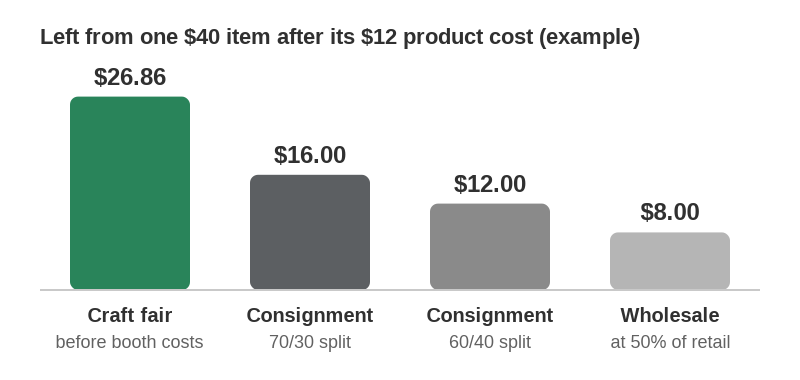
Take one product as an example: a mug with a $40 retail price that costs you $12 to make (clay, glaze, firing, packaging). Here's what each sale leaves you.
| Per item sold (example) | Craft fair | Consignment 70/30 | Consignment 60/40 | Wholesale at 50% |
|---|---|---|---|---|
| You receive | $38.86 | $28.00 | $24.00 | $20.00 |
| Minus product cost | $12.00 | $12.00 | $12.00 | $12.00 |
| Left per item | $26.86 | $16.00 | $12.00 | $8.00 |
| When you're paid | At the sale | After it sells, on the shop's schedule | After it sells, on the shop's schedule | Up front or on invoice terms |
| If it doesn't sell | It comes home | It comes back to you | It comes back to you | The shop owns it |
The craft fair column subtracts a card fee of 2.6% plus 10 cents (about $1.14), but not the booth fee, gas, food or your hours at the booth. Those costs are real: if a $150 booth and $60 in gas and food are spread over 40 items sold, that's about $5.25 more per item. Our guide on how to calculate craft fair profit walks through every line, and the free craft fair profit calculator does it in a minute.
A 20-item example over a season
Now say you place 20 mugs in a shop for three months, and 12 sell (example numbers).
| 20 mugs, one quarter (example) | Consignment 70/30 | Consignment 60/40 | Wholesale at 50% |
|---|---|---|---|
| Items sold or bought | 12 sold | 12 sold | 20 bought |
| You receive | $336 | $288 | $400 |
| Product cost of those items | $144 | $144 | $240 |
| Left | $192 | $144 | $160 |
| Items still yours | 8 | 8 | 0 |
At 70/30, consignment beats wholesale here, and you still have 8 mugs to sell elsewhere. At 60/40 it's behind wholesale on the items sold, though the 8 unsold mugs are still yours. The difference comes down to two numbers you only learn over time: the split you negotiate and how fast your work sells in that shop. If you sell wholesale too, check your wholesale price against the same per-item math; our guide on how to price items for a craft fair explains the common cost × 2 × 2 formula behind a 50% wholesale price. For a closer look at those two channels, see wholesale vs craft fairs.
When consignment makes sense
Consignment tends to fit when:
- You want a presence between markets. A shop near home keeps selling while you make stock.
- You're testing a new product or area. The shop takes little risk, so it may say yes to new work.
- The shop's customers match yours. A gift shop near your best market can be a natural fit.
- You have stock to spare. Consignment works with inventory you'd otherwise keep in bins.
It's a weaker fit when cash flow is tight (you wait for sales and payouts), when your margins are thin (a 40% shop share can wipe out profit on low-priced items), or when you can't check on your stock regularly.
The consignment agreement: a plain checklist
Get the deal in writing, even with a friendly local shop. This list covers what the agreement should answer. It's a practical reading guide, not legal advice; if something is unclear, ask the shop in writing, and for larger deals talk to a lawyer.
| Topic | What to check |
|---|---|
| Split | Your share and the shop's, in plain numbers. Is it on the retail price or on the price after discounts? |
| Pricing | Who sets the retail price? Can the shop change it without asking? |
| Discounts | Can the shop put your work on sale, and who absorbs the discount? |
| Payout schedule | How often you're paid (for example monthly), by what method, and how soon after the sale |
| Sales reports | Will you get a list of what sold, at what price and when? |
| Inventory list | A signed list of every item you drop off, with retail prices |
| Damage, loss and theft | Who pays if an item is broken, lost or stolen in the shop? |
| How long items stay | A set period before unsold items must be picked up or renewed |
| Taking items back | How much notice you must give, and when you can collect |
| Fees | Any display, setup or monthly fees on top of the split |
| Ending the deal | How either side ends it, and what happens to unsold stock and money owed |
Two clauses deserve extra attention. Damage, loss and theft: if the agreement is silent, a missing mug can turn into an argument. Discounts: a 20% off sale on a 60/40 split can cut your share hard if it comes out of your side.
Track consigned stock like its own location
Once items leave your studio, they're easy to lose track of. Treat each shop as its own location in your records:
- Drop-off list: product, quantity and retail price, signed by both of you. Keep a copy.
- Each payout: match the shop's sales report to your list: sold, still on the shelf, missing.
- Every few months: visit, count what's on the shelf and compare with your records.
A simple way to do this is the same sheet you'd use for a market: one row per product, with brought, sold and came home columns. Our free craft fair inventory sheet works for a consignment shop too; use one copy per shop and treat "came home" as "still in the shop." If you use a POS or online store that tracks inventory by location, give each shop its own location so its stock isn't counted as available for your booth or website.
Also note your craft fair expenses and consignment costs separately (driving to drop off and pick up, packaging for the shop), so you can compare channels fairly.
Keep your retail prices consistent
If your mug is $40 in the shop, it should be $40 at your booth and on your website. Selling it for $32 at a market undercuts the shop that's displaying your work, and it can sour the relationship. Set one retail price per product and stick to it everywhere, with the shop's share built into that price from the start. If a 60/40 split leaves too little at your current price, the fix is usually a higher retail price everywhere or a different split, not a cheaper price at your booth.
Sales tax on consignment sales
Who collects and reports sales tax on a consignment sale is a question for the state and the shop, and the answer can differ by state. Don't assume either way: ask the shop how it handles sales tax on consigned items, and check with your state's revenue department or an accountant. Our craft fair sales tax guide covers the basics for the sales you make yourself.
Is consignment worth it for you?
Run your own numbers before you commit, using your real product cost, the split the shop offers and a realistic guess of how many items will sell in the first three months. Then compare that with what the same items would leave you at your next market, after the booth fee and your time. You might keep consignment as a steady background channel and save markets for the bigger sales days, or try it once and decide the split is too high for your margins. Both are fine choices if the math backs them up.
FAQ
How does consignment work for handmade items?
You keep ownership of your work while a shop displays and sells it. When an item sells, the shop keeps its share of the retail price and pays you the rest on a set schedule. Unsold items stay yours and can be picked up or swapped.
What is a fair consignment split for handmade goods?
Splits vary by shop and are negotiated, so there's no single fair number. Work out what each split leaves you per item after your product cost, compare it with what the item leaves at a market or at wholesale, and decide from your own margins.
Is consignment better than wholesale for makers?
It depends on how fast your work sells. Consignment usually pays more per item sold but only when it sells, and you carry the risk of unsold or damaged stock. Wholesale pays less per item but the shop buys the items outright.
Who pays sales tax on consignment sales?
It depends on the state and the arrangement. Ask the shop how it handles sales tax on consigned items and confirm with your state's revenue department or an accountant. This isn't tax advice.