Sharing a Booth at a Craft Fair: Rules, Costs and Sales
Sharing a booth at a craft fair can turn an expensive show into a reasonable one: two makers, one booth fee, one hotel room, one car. It can also turn into an awkward weekend if nobody agreed on who pays for what, whose table gets the front, or whose sales are whose. This guide covers when sharing makes sense, what event rules usually say about it, three fair ways to split the costs (with a worked example), how to keep each seller's sales separate, and a short checklist to write down before you go.
When sharing a booth makes sense
Sharing works best when it solves a real problem, not just because a friend asked. Good reasons:
- The show is expensive. A $300 booth plus a hotel is a big bet for one person. Split in two, the same show might pass your numbers.
- It's your first big show. Splitting the cost lowers the risk of trying a market you don't know yet.
- Your products fit together. Ceramics and candles, prints and cards, soap and towels. Shoppers who stop for one often look at the other.
- You don't have enough stock to fill 10 by 10 feet. Half a booth that looks full beats a whole booth that looks empty.
- Someone to cover breaks. Two people means one can eat, use the restroom or walk the show without closing the booth.
Sharing works less well when your products compete directly (two jewelry makers at the same price), when your styles clash so the booth looks like two booths, or when one person sells far more and resents paying half.
What the event rules usually say
Before you agree on anything, read the vendor rules. Shows treat shared booths very differently. A few examples from official event pages:
- The Moscow Renaissance Fair in Idaho allows two artists to share a booth, but each one applies separately and is juried separately.
- The City of Lawrence, Kansas says in its Artisan Fair rules that each booth space must be occupied by only one vendor.
- Historic Folsom's spring arts and crafts fair doesn't allow sharing unless the vendor coordinator approves it.
So the possibilities range from "yes, if you both apply" to "no." Look for words like share, co-op, one vendor per booth or subletting in the rules, and if it isn't mentioned, ask the organizer in writing. Juried shows in particular usually want to approve every maker whose work is in the booth. Our list of questions to ask before booking a craft fair has a ready-made email you can adapt.
Three fair ways to split the costs
Decide the split before the show, not while counting cash on Sunday night. These are the costs most pairs share:
- Booth fee (and any application or jury fees, if you apply together)
- Hotel room
- Gas or mileage, if you drive together
- Shared display pieces, tent or table rental
- Parking
And these usually stay with each person: your own product costs, card fees, food, and your own insurance and permits (more on those below).
Here's an example with made-up numbers: two makers share a 10 by 10 booth at a two-day holiday show. The shared costs are a $300 booth, a $160 hotel night and $70 in gas for one car, so $530 in total. Maker A sells ceramics and takes about 60% of the table space. Maker B sells candles and takes about 40%. Maker A sells $1,500 over the weekend; Maker B sells $900.
| Method | Maker A pays | Maker B pays | Feels fair when |
|---|---|---|---|
| Equal split | $265.00 | $265.00 | You use similar space and expect similar sales |
| By space (60 / 40) | $318.00 | $212.00 | One of you needs much more table or wall |
| By sales (62.5% / 37.5%) | $331.25 | $198.75 | Sales are very uneven, or you're testing a show together |
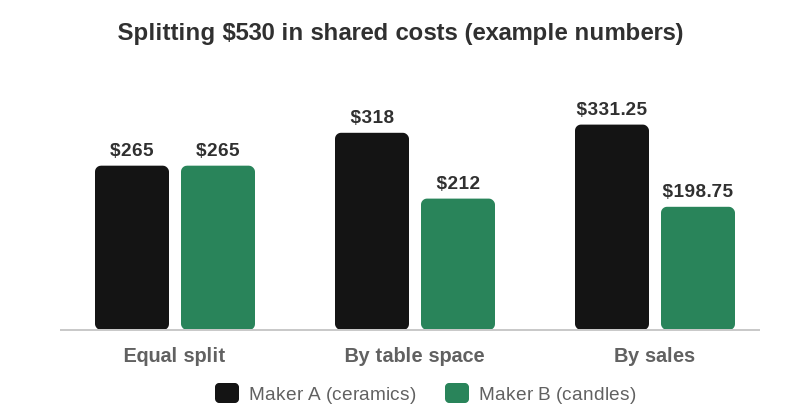
None of these is the "right" one. An equal split is simplest. Splitting by space is fair when one display is clearly bigger. Splitting by sales protects the person who has a slow weekend, but it means you can't settle up until the show is over, and it rewards the bigger seller less. Whatever you choose, write it down.
What it looks like per person
Sharing only helps if each person's own numbers work. Here's the same weekend with the equal split, plus each maker's own costs (example numbers):
| Maker A | Maker B | |
|---|---|---|
| Sales | $1,500 | $900 |
| Product costs | $525 (35%) | $270 (30%) |
| Card fees (about 3%) | $45 | $27 |
| Share of booth, hotel, gas | $265 | $265 |
| Own food | $30 | $30 |
| Own insurance (share of an annual policy) | $25 | $25 |
| Profit | $610 | $283 |
| Sales ÷ booth share ($150) | 10x | 6x |
Now imagine Maker B had done this show alone, paying the whole $530: profit would have dropped to $18 for a full weekend. Sharing is what made the show worth it for B. For A, it's a good show either way; sharing just made it better.
Run each person's numbers separately in the free craft fair profit calculator, using only your share of the shared costs. Our guide on how to calculate craft fair profit explains each line, and is a craft fair worth it has the rules many vendors use to decide whether to go back.
Keep your sales separate
The fastest way to fall out with a booth partner is a mixed-up cash box. Keep the money apart from the start:
- Separate card readers. Each person rings up their own sales on their own reader and account. If you both use Shopify POS, our guide to tracking craft fair sales in Shopify POS shows how to keep one market's sales apart by date and location.
- Separate cash boxes, or one box with two clearly labeled envelopes and a written float for each.
- Separate payment app handles on your signs, so Venmo or Zelle payments go to the right person.
- A rule for bundles across both tables ("a mug and a candle for $40"): decide in advance who rings it up and how the money is split, or skip cross-bundles.
- Clear signs so shoppers know whose products are whose, and who to pay.
Insurance and sales tax are per seller
Sharing a booth doesn't usually mean sharing paperwork. If the show requires a certificate of insurance, expect each seller to need their own, naming the event as required. Our craft fair insurance guide explains what's usually asked. The same goes for sales tax: each seller typically collects and reports tax on their own sales under their own permit. How a state handles event vendors varies, so check the state's rules and ask the organizer; our craft fair sales tax guide shows how a few states do it. This is general information, not legal or tax advice.
Split the space, not just the bill
A shared booth should still look like one good booth. Agree on:
- Who gets the front edge. Alternate by day, or split the front table in half.
- One shared look: the same color of table covers and a common sign at the top, with each maker's name on their section.
- Height on both sides, so neither half disappears behind the other.
- Where the checkout spot is for each person.
Our guide to craft fair display ideas has four layouts for a 10 by 10 booth; the U-shape and L-shape split naturally between two sellers.
Write it down: a short sharing checklist
A text message thread is fine, as long as it covers these points. This isn't a legal contract, just a record so nobody has to remember who agreed to what.
- Who applies, and whether the show requires both of you to apply.
- The cost split method, and when you settle up (before the show is easiest).
- Who pays what up front: booth, hotel, gas.
- Space: who gets which side and the front edge.
- Setup and teardown: who brings the tent, tables and weights, and who arrives first.
- Breaks: how long, and who watches whose stock.
- Money: separate readers, cash, payment apps; how cross-bundles work.
- What happens if one of you has to cancel (who keeps the spot, who covers the fee).
- Insurance and permits: each person's own, sent to the organizer by the deadline.
- A quick talk after the show: would you share again?
FAQ
Can two vendors share a booth at a craft fair?
Often, but not always. Some shows allow it if both makers apply and are approved, some require approval from the organizer, and some allow only one vendor per booth. Read the vendor rules and ask the organizer in writing before you plan.
How do you split the booth fee when sharing?
Common options are an equal split, a split by table space, or a split by each person's sales. Equal is simplest; by space fits when one display is bigger; by sales protects the person with a slow weekend. Agree before the show and write it down.
Do both vendors need insurance when sharing a booth?
Usually each seller needs their own coverage if the event requires insurance, with the event named as required. Check the event's paperwork and ask the organizer if it isn't clear.
How do we keep sales separate in a shared booth?
Use separate card readers or accounts, separate cash boxes or labeled envelopes with a written float, and separate payment app handles on your signs. Decide in advance how any combined bundles are rung up and split.